



| « Vivian Maier, Street Photographer | Support Art Students, Shop Marwen's Art Fair » |
Theatre Wed Oct 14 2009
Ma Rainey's Black Bottom at Court Theatre
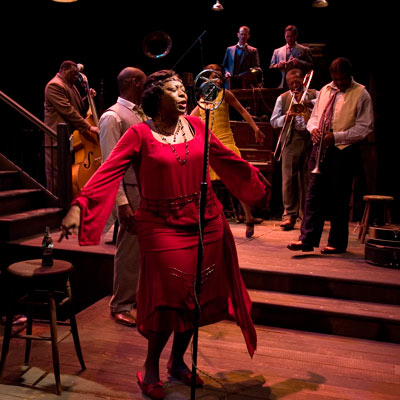 Every good play should have sex, drugs, and timeless moral lessons. Ma Rainey's Black Bottom has all three, plus good jokes and even better music.
August Wilson's 1984 play, part of his Pittsburgh cycle, describes the plight of the black musician in depression-era Chicago. The story is masterfully directed by Ron OJ Parson and equally well executed by a small team of talented actors. Wilson's story is a quintessential drama, simultaneously timeless and modern, drawing from traditions of storytelling that go back to biblical times, and building up to an explosive ending.
The entire play is set in a fictional recording studio. All of the action takes place on one set, but it is an ambitious set, split-level, with three tiers -- an extremely economic use of space, which can also be read as metaphor for class. The musicians -- Cutler, Slow Drag, Toledo and Levee -- are relegated to the grungy basement, where they joke and argue while they wait for Ma Rainey to arrive for the recording. Because there is no need for set changes, there are very few scene breaks. Instead, the action is fluid and filmic. Finally Ma (Greta Oglesby) arrives, fashionably late, followed by an entourage and a policeman who threatens to charge her with assault and battery after a run-in with a cab driver who won't give her a ride because of the color of her skin.
After the policeman is sent away with a bribe by her manager, the recording is delayed further by Ma's diva-like procrastination, seemingly pointless until she reveals to Cutler, the trombonist, (Cedric Young) that she knows she will be cast aside "like a whore" after they get her voice down. And we know she is right, her suspicions are warranted. Although her behavior is obnoxious, we are empathetic because she is the underdog in this business relationship. She is being taken advantage of, but she is a willing participant, so instead of pointing fingers, we are just left feeling uneasy about the whole thing.
Despite the title of the play, Ma Rainey is not the star of the show. Instead, it is Levee, (James T. Alfred) the fiery young horn player. His character is the most complex of all, arguably the only multi-faceted one. The rest can be described by terms, by stereotypes: the sexy young girl; the sleazy manager; the wise old man; even the robust, middle-aged, domineering black woman. Levee, on the other hand, is simultaneously naive, weathered, ambitious, cynical and playful. He is a know-it-all, but he is irrational. He is misunderstood, but we are not sure if we really want to get to know him. He's not the sort of guy most people would want to hang around with; he's a bit of a drag. But, given his plight, we can relate.
The debates that ensue between band mates are perhaps the most interesting and entertaining part of the play, although pacing is a little off, some of the banter seems to go on forever, but who wants to split hairs? The acting is impeccable. A.C. Smith is hilarious as Slow Drag, with his curt, smartass comments -- a refreshing antidote to Toledo's philosophical, Afrocentric rants on life and Levee's sophomoric whining. The conversation ebbs and flows, moving from that of the perks of having nice shoes to the political responsibilities of underrepresented Americans.
Each of the main characters in the play has their own way of dealing with marginalization. Ma seems to have a take-what-you-can-get attitude, walking all over her manager because she can, and she knows she won't always be able to. Levee, on the other hand, has a sort of subservient approach, which obviously eats him up inside, but he does it because he has big dreams and he knows the white man can give him what he wants.
The tension that builds throughout the story, and within Levee, culminates in a tragic, pessimistic ending, which seems fitting for a generally lighthearted play that flirts with heavy subjects. We are, at first, disappointed by the shame of it all, but ultimately pleased that we were not satiated with a sugary ending. Instead, we are left with our thoughts, our questions, and our lack of answers.
Performances at Court Theatre through Oct. 18. Call the box office at 773-753-4472 for tickets.


