Americans are statistically more likely to be killed by a storm or by their neighbor's dog than fall victim to an ISIS marauder or jihad-inspired rando. Nonetheless, the Conventional Wisdom seized on the Paris and San Bernardino massacres to declare that national security was now the top issue in the presidential campaign. Thus seemingly the entire first half of the most recent presidential debates consisted of "moderators" pressing the candidates not only to affirm being on board the national mass hysteria train, but to state how much coal they were ready to shovel into the firebox. As a result, you can search the entire 20,000-word transcript for the third Democratic debate without stumbling across the word "peace" passing any candidate's lips.
Continue reading this entry »
— Jeff Smith
Chicago Wed Dec 30 2015
If somehow you haven't seen the news anywhere else: Gapers Block is going on hiatus effective January 1. You can read the open letter from our esteemed editor-in-chief here.
There have been many nice things said about Andrew and Gapers Block across Chicago media circles, including this from Mike Fourcher and this from Whet Moser. They provide a lot of context to why this is a big deal, and not just for the people immediately involved.
Now, I'm a Johnny-come-lately. I've been writing about politics here -- and, along the way, also about coffee shops, professional wrestling, and bowling balls -- for about two years. But I'm also here at the moment-before-hiatus, which means I get the chance to write about Gapers Block for Gapers Block. Sure, it's an exercise in the meta. But see: Gapers Block is all about Chicago, and Chicago is especially all about Chicago. It's all one huge ball of meta.
Continue reading this entry »
— Phil Huckelberry
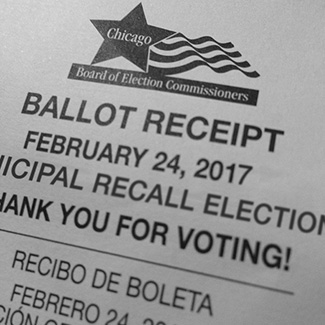 A lot of Chicagoans want to see Rahm Emanuel's second term as mayor end prematurely. Weeks after the release of the Laquan McDonald dashcam video, calls for Emanuel's resignation have not slackened, and one published poll shows an outright majority of Chicagoans favoring such a resignation. Emanuel has been adamant that he will not resign. In turn, some have looked for some other process by which he might no longer mayor.
The leading contender for such a process is House Bill 4356, introduced by State Rep. La Shawn Ford (D-8). HB4356 provides for a mechanism of recalling the mayor by public election. HB4356 now has five co-sponsors -- perhaps fewer than might be expected, but perhaps more given that the legislature is out of session. While the Tribune took a look at HB4356 this week, publishing what was essentially a hatchet piece, even that article suggests the idea is at least going to stick around for a while.
My take is different from the Tribune. I think recall legislation, whether in the form of HB4356 or some other bill, has a decent shot of passage. It has already lined up some interesting co-sponsors, and prominent politicians such as Lisa Madigan and Pat Quinn have come out in favor of recall at least conceptually. I think it's extremely unlikely that Rahm Emanuel will ever be recalled, but that will not stop legislation from proceeding. The credible threat of recall is important enough that enough political operators will allow it to stay on the table.
HB4356 is of course subject to amendment, and competing bills could also be introduced that would offer different processes. Still, even though it is a largely speculative exercise to consider all of the permutations of how recall legislation might proceed, it is worth stepping back and regarding some of those possibilities. Key distinctions regarding different processes may lead to significantly different results in terms of who might replace Emanuel -- even if no recall ever takes place. The details of pending and prospective state legislation could therefore be of critical importance for the fate of not only Emanuel but the entire city.
Continue reading this entry »
— Phil Huckelberry /
Race Tue Dec 15 2015
By Dave Stieber
If you haven't heard of Cedric Chatman, then you should know his name. Cedric is another tragic example of a black youth being killed by police and the city trying to cover up the murder. Cedric was killed nearly three years ago, almost two years before Laquan McDonald. To no surprise to anyone in Chicago, Rahm is currently trying to prevent the video from being released.
Black Americans being killed by police is not just a Chicago problem. This is an American problem.
Continue reading this entry »
— Mechanics /
Doings in Evanston this Sunday gave strong indication that State's Attorney Anita Alvarez, in her bid for re-election, is heading for some rocks along the north lakefront of Cook County as perilous as those that occasioned the erection of the historic Grosse Point Lighthouse in the 1800s. Bearing in mind, as an old Danish proverb goes, that it is always dangerous to prophesy, especially about the future, and that that danger is multiplied by trying to use orchestrated political events as tea leaves, the Democratic primary bid of Kimberly Foxx stands to gain a massive boost from both the Chicago wards and suburban townships of the shoreward persuasion.
Continue reading this entry »
— Jeff Smith
Chicago Wed Dec 09 2015
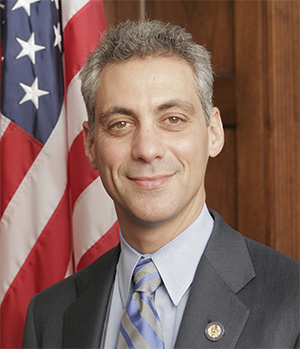 State Rep. La Shawn Ford (D-8) has filed legislation in Springfield which would provide for a mechanism for recalling the Mayor of Chicago. The bill is House Bill 4356.
Ford's bill is of course not submitted arbitrarily. With a recent poll suggesting an outright majority of Chicagoans want Rahm Emanuel to resign, Emanuel being steadfast that he will not do so, and no existing legal mechanism in place by which Emanuel might otherwise be removed from office, HB4356 could very well become a very hot topic in Springfield.
Continue reading this entry »
— Phil Huckelberry /
A downstate lawsuit filed shortly before Thanksgiving sums up what's wrong with Illinois government right now. Hitting local radar via a press release suggesting an action by SEIU Healthcare, the request for a temporary restraining order against the State was brought by more than a dozen public employee unions, including lead plaintiff AFSCME Council 31, nurses, and police officers, over the State of Illinois's failure to pay for health insurance for state employees.
The suit may have been overlooked here due to more sensational events, or because lawsuits against the State over its fiscal mess are no longer news; half a dozen have been filed, and court orders are part of how Illinois keeps spending money despite no budget in place. However, unusual in this case is the judge's language used in granting a TRO. In his order, Judge LeChien wrote on Nov. 25 that the inability of "the Governor and the General Assembly to perform duties makes essential services and assistance headed for a chaotic bust." The court charged both the executive and legislative branches of Illinois government with adopting a "fiddling while Rome burns posture" that forces the courts to act.
Continue reading this entry »
— Jeff Smith /
Op-Ed Mon Dec 07 2015
By Susan Bandes
Mayor Rahm Emanuel says he didn't watch the video of a Chicago police officer shooting a citizen in cold blood because he then couldn't be asked about it. Which is the perfect Chicago move. In fact, it crystallizes the city's longstanding attitude toward police abuses: if nobody has access to information, nobody can be expected to act.
The body that's supposed to be keeping police accountable, the Independent Police Review Authority, does almost nothing to track patterns of police misconduct and brutality. When reviewing a complaint, it does not make inquiries into any previous complaints against the same officer. Although the agency says it now has an early warning system for repeat offenders, that system identified only six percent of the officers with 11 or more complaints.
Continue reading this entry »
— Mechanics /
In the hours after the mass shooting in San Bernardino on Wednesday, dozens of elected officials took to Twitter to offer "thoughts and prayers" to the victims of the attack and their families. Many people responded by challenging congressmen and senators to actually do something, not just think and pray. Igor Volsky, contributing editor at Think Progress, took it a step further, calling out several legislators who offered condolences but had taken campaign contributions from the National Rifle Association.
The only Illinois congressman called out by Volsky was Rep. Peter Roskam (R, 6th), who received $2,000 from the NRA in 2014, $3,000 in 2012, $2,000 in 2010 and more going further back.
But according to OpenSecrets.org, several other congressmen and women from Illinois have benefited from NRA contributions -- six of whom are still serving in Washington. Here's a look at how they reacted to the San Bernardino shooting.
Continue reading this entry »
— Andrew Huff
Chicago Thu Dec 03 2015
In the aftermath of the release of the video of the killing of Laquan McDonald, the calls for Mayor Rahm Emanuel's resignation keep coming in. Well, go ahead and add my name to the list. And you all can say it along with me:
Mr. Mayor, the public can have no faith in you at this point, and you need to resign.
That felt great, didn't it?
Now, back to reality.
Continue reading this entry »
— Phil Huckelberry /
Chicago Tue Nov 24 2015
Laquan McDonald was shot and killed on Oct. 20, 2014 by Chicago police officer Jason Van Dyke. Exactly 400 days later, Van Dyke was formally charged with murder in McDonald's death. The charges were filed one day before the court-ordered public release of the dashcam footage showing the killing.
If the footage was so blatant that no less than Rahm Emanuel called it "hideous" (albeit without actually seeing it), then how on earth did it take 400 days for charges to be filed?
I asked that question online. Within an hour, I saw three other variations on that question asked by other people.
Unbelievably, Cook County State's Attorney Anita Alvarez gave the answer that she "moved up" filing the charges, saying her original intention was to wait until the concurrent federal investigation had concluded. You can read that article for more of Alvarez's explanation. I'm not going to rehash it here, because there are limits to how much bullshit I can quote.
Continue reading this entry »
— Phil Huckelberry /
 Nate Silver is one of America's sharpest political analysts, so when he writes a piece like "Maybe Republicans Really Are In Disarray", it should raise some eyebrows. Silver doesn't come to a definite conclusion, but he does lay out a logical explanation of why "disarray" might be the right term to describe the current standing of the Republicans nationally. I would add that it could easily be extended to the situation in Illinois, where Governor Bruce Rauner seems to be alienating his own party, and where at a glance it would seem increasingly likely that Senator Mark Kirk will lose next November.
Silver, though, also argues against the disarray argument, by making a fairly simple point: excluding the presidency, Republicans are winning a lot more than they're losing. Even here in Illinois, with Democratic supermajorities in both houses of the General Assembly, the reality is that the Republicans hold the governorship, one U.S. Senate seat, and eight of 18 U.S. House seats. The voting profile of the state would suggest that the Republicans should be doing far worse here.
So are the Republicans in disarray? I think the answer has to be yes. But does it matter very much? Maybe not. As bad as things may seem for the Republicans, they're nevertheless the majority party in the country, based on control of both houses of Congress, a large majority of governorships, and most state legislatures.
The party with the worst problems right now is the Democratic Party, and we can even see this playing out in Illinois.
Continue reading this entry »
— Phil Huckelberry
It's now been 11 days since the carbon monoxide leak which sent over 80 Prussing Elementary School students and staff to the hospital. While officials from Chicago Public Schools have partially answered some questions, and CPS CEO Forrest Claypool has informed that he will be visiting the school to field more questions on Nov. 16, many parents remain irate at the CPS response to date. The main point of contention remains the fate of the school boiler system, but it is far from the only issue at hand.
Last week, I focused on the inadequacy of safety protocols for incidents like this. That theme was picked up on by the Reader's Ben Joravsky, who still can't get over how the main school building had no detectors. Had there just been one properly functioning detector, installed in a manner such that it would have alerted school administrators, the worst of the incident never would have occurred.
With that said, the leak did occur. It is critical that all parents citywide should focus on safety protocols at their own schools, but some of the questions about what happened at Prussing, and what is happening in the aftermath, still need to be answered. Not only does the incident itself need to better understood, but so too does the waffling CPS response, and how parents are responding to what they're seeing.
Continue reading this entry »
— Phil Huckelberry /
 The story made national news: over 80 students and staff from Prussing Elementary School on the Northwest Side went to hospitals on October 30 because of carbon monoxide exposure. The official word is that the school boiler was the culprit, specifically a faulty gas regulator.
There are a lot of questions which still need to be answered about the boiler. For two and a half years, administrators at Prussing have reported problems with the boiler. While none of those issues suggested the potential for a carbon monoxide leak, the trail of complaints is lengthy, and Chicago Public Schools officials have been put on notice that the school community expects a decision to come down this week that the boiler will not be "fixed" yet again, but outright replaced, and soon.
The other immediate issue raised regards the school carbon monoxide detectors, or the lack thereof. How did CO levels get so high without any alarm going off? The boiler room at Prussing was equipped with a detector. At this time, it is not clear why it did not go off. But the situation begs the question of why a school with 700 children had only one detector in the first place.
As it turns out, there are some answers to be found in state law and Chicago building code, and they're not that great. For a city which prides itself on the most stringent fire codes in the country, the city code regarding carbon monoxide detectors is inadequate, and it is clear that CPS protocols regarding detectors don't even yet exist.
Continue reading this entry »
— Phil Huckelberry
 By Mayra Almaraz-De Santiago
When I was 6 years old, I believed you could not be Mexican and American. In my world, they did not go together. It was like wearing polka dots and plaid: each was interesting on their own, but they could never be together. To me, there was a time to a time to be Mexican and a time to be American. Being Mexican was a private affair, reserved for people who did not need an explanation for my differences.
I grew up on the Northwest Side of Chicago in a mostly Polish, Irish, and Italian neighborhood. I clearly recall being in kindergarten and telling my teacher that I was the youngest of 10 siblings. Shocked, my teacher asked me to tell her the names of my siblings. Afterwards, she walked me over to one of her colleague's classrooms and asked me to recite the names for her. What followed was thunderous laughter. Then I was escorted off to a new classroom to recite my siblings' names again. To this day, I'm not sure why the teachers were so amused. Was it my siblings' names? Was it that I had 10 siblings? All I know is that I was being singled out for being different. In later years, whenever my teachers asked for the number of siblings in my family, I told them I had two sisters and one brother. Every time I told that lie, I felt my heart sink. I hated knowing that I had allowed others to make me reject a part of me.
Continue reading this entry »
— Mechanics