Gapers Block published from April 22, 2003 to Jan. 1, 2016. The site will remain up in archive form. Please visit Third Coast Review, a new site by several GB alumni. ✶ Thank you for your readership and contributions. ✶
In the hours after the mass shooting in San Bernardino on Wednesday, dozens of elected officials took to Twitter to offer "thoughts and prayers" to the victims of the attack and their families. Many people responded by challenging congressmen and senators to actually do something, not just think and pray. Igor Volsky, contributing editor at Think Progress, took it a step further, calling out several legislators who offered condolences but had taken campaign contributions from the National Rifle Association.
The only Illinois congressman called out by Volsky was Rep. Peter Roskam (R, 6th), who received $2,000 from the NRA in 2014, $3,000 in 2012, $2,000 in 2010 and more going further back.
Please keep #SanBernardino in your thoughts and prayers this evening. Our hearts are heavy for the victims and their families.
But according to OpenSecrets.org, several other congressmen and women from Illinois have benefited from NRA contributions -- six of whom are still serving in Washington. Here's a look at how they reacted to the San Bernardino shooting.
Nate Silver is one of America's sharpest political analysts, so when he writes a piece like "Maybe Republicans Really Are In Disarray", it should raise some eyebrows. Silver doesn't come to a definite conclusion, but he does lay out a logical explanation of why "disarray" might be the right term to describe the current standing of the Republicans nationally. I would add that it could easily be extended to the situation in Illinois, where Governor Bruce Rauner seems to be alienating his own party, and where at a glance it would seem increasingly likely that Senator Mark Kirk will lose next November.
Silver, though, also argues against the disarray argument, by making a fairly simple point: excluding the presidency, Republicans are winning a lot more than they're losing. Even here in Illinois, with Democratic supermajorities in both houses of the General Assembly, the reality is that the Republicans hold the governorship, one U.S. Senate seat, and eight of 18 U.S. House seats. The voting profile of the state would suggest that the Republicans should be doing far worse here.
So are the Republicans in disarray? I think the answer has to be yes. But does it matter very much? Maybe not. As bad as things may seem for the Republicans, they're nevertheless the majority party in the country, based on control of both houses of Congress, a large majority of governorships, and most state legislatures.
The party with the worst problems right now is the Democratic Party, and we can even see this playing out in Illinois.
The temporary heavy equipment bridge through the west lagoon.
Jackson Park's Wooded Island is currently closed to the public while it is being reworked by a consortium of groups led by the Army Corps of Engineers, but last Saturday the Chicago Park District offered a special tour of the island's rehabilitation and Yoko Ono's in-process sculpture,"Sky Landing."
Construction equipment on the bed of the future Thornton Reservoir. Trucks on the Tri-State Tollway can be seen above the quarry.
On Saturday, I joined the Southeast Environmental Task Force (SETF) on one of its tours of Chicago's goliath infrastructure. The tour featured the future site of the Thornton Composite Reservoir, the largest such reservoir in the world, and a Deep Tunnel pumping station 350' below ground at the Calumet Water Reclamation Plant. Both are part of the Metropolitan Water Reclamation District (MWRD)'s gargantuan Tunnel and Reservoir Plan, the multi-decade, multi-billion dollar project designed to protect the Chicago region from the flooding and pollution caused by overflowing sewer and stormwater infrastructure.
While you were out celebrating New Year's Eve, the State of Illinois ushered the new year in with a tradition of its own: new laws. January 1 is the state's default effective date for any new law unless otherwise specified. As such, more than 200 new laws took effect January 1 in Illinois.
To say Illinois is in a broken state and needs fixing is to state the obvious. The state has a $47.2 billion debt and is often the butt of jokes when it comes to corruption. In James D. Nowlan and J. Thomas Johnson's new book Fixing Illinois: Politics and Policy in the Prairie State, there are 98 suggestions given as to how to solve and lessen the problems in Illinois, but many of them don't feel feasible in the current political climate for the state.
The book covers a variety of topics in Illinois policy including education, budgeting, economic development, transportation, health care and human services. Outside of the section on transportation, many of these ideas ring as absurd for implementation in Illinois. Some of these may be more feasible in states other than Illinois, but could never work in this particular state.
Water resource management, with impacts sweeping across public health, food production, security, energy, industry, and environmental sustainability, is one of the most consequential economic and societal drivers today.
Legislation currently on Governor Quinn's desk could dramatically alter the way Illinois manages its own water resources. House Bill 1379 would allow Illinois American Water and Aqua Illinois, two of the state's largest private water companies, to expedite acquisitions of municipal water systems and increase customer rates to fund their expansion.
A coalition of groups throughout the state has announced the creation of the campaign Yes for Independent Maps. Yes for Independent Maps seeks to reform the legislative redistricting process in Illinois through a ballot initiative.
Yes for Independent Maps will begin today with the collection of more than 298,000 signatures on a petition to have the initiative appear on the ballot for the 2014 general election. They will collect signatures up until May 4, 2014.
"We are excited to launch this campaign to fix Illinois' broken, behind-closed-doors redistricting process and put the voters back in charge," said Ryan Blitstein, Yes for Independent Maps' senior advisor in a press release. "Our coalition members have been working for more than two years to reach this point. With their help, and with support from a diverse group of volunteers and activists across the state, we will gather the necessary signatures to place this measure on the November 2014 ballot."
What would happen if a tornado hit a million-gallon tank full of fracking wastewater in southern Illinois? I don't know for sure, but I suspect the result would be to spray the countryside with poisonous waste. If legislators don't know, they need to pass a fracking moratorium, as five Illinois counties have already called for, alongside any bill that would open up Illinois to fracking.
House Bill 1 may not be the top priority for the General Assembly when it comes to passing legislation before the summer recess, but it's on its way to Gov. Pat Quinn's desk and, with it, medicinal marijuana appears to be on its way to legalization in Illinois.
Here's a quick overview of the bill and some context in medicinal marijuana laws across the United States.
• It's gonna happen.
Illinois has been working toward legalization of medicinal marijuana for the better part of the last decade, and it's going to pass this year, barring a big surprise from Gov. Quinn.
The big move came last Friday, when the State Senate passed the legislation by a 35-21 margin. The bill becomes law when Gov. Quinn signs it, although he is expected to sit on it for a bit before giving it the green light. Still, a conversation he had with the Chicago Tribune this week indicated he'll almost certainly give it the go-ahead in the coming weeks.
Illinois will become the 20th state to approve medicinal marijuana, and there's little question that this is the right thing to do, both from a democratic standpoint and in observation of studies on the issue. Various polls show that more than 60 percent of Illinois voters approve, and the bill has support from a wide variety of groups in the medical community. Additionally, studies show that the concerns of critics (such as increased usage among youths) have not materialized in other states with similar laws.
The tarnished legacy of indicted community officials no longer lies in Chicago ranks but has indeed spread to the south suburban areas of Cook County. Three villages are now victim of the all too familiar spirit of greed and exploitation that infests those in leadership. After the embarrassing episode of Jesse Jackson, Jr. that shattered the 2nd congressional district, three south suburban towns face again the deception and humiliation from community officials.
Most recently, former Crestwood Police Chief Theresa Neubauer was found guilty of 11 counts of purposely reciting false claims to environmental regulators. As Crestwood water head, she repeatedly lied to state regulators about the quality of the village's water that was chemically altered. She claims two other individuals including former longtime Mayor Chester Stanczek are guilty of the tainted water scheme that possibly harmed the 11,000 residents. Neubauer also implies both were well-aware of vinyl chloride remnants in water that was used for 22 years until 2007. Neubauer possibly faces that maximum of five years in prison and $250,000 fine for each count. Even after nearly seven hours of deliberation, the mother of four still proclaims her innocence. "I suppose today I have to say I am the unfortunate person that the village of Crestwood hired when I was an 18-year-old girl," said Neubauer. She resigned from her post May 2.
But while House Republican Leader Tom Cross (also a co-author of the bill, along with Rep. Elaine Nekritz) called it "the meat and potatoes of pension reform," it doesn't seem so clear that today's step is actually one in the right direction.
The Illinois pension problem has heated up in a major way over the past several weeks, with Standard & Poor downgrading the state's credit rating back in January and the SEC announcing charges against the state for misleading bond investors regarding the implications of unfunded pension obligations. Some lawmakers have even called for--gasp--skipping the upcoming break from session in order to settle the pension mess.
But while today's bill has the right idea (i.e. something has to happen), it doesn't seem likely that the bill will make it past (1) the Senate or (2) the Supreme Court. Yesterday, the Senate shot down a bill that was similarly far-reaching regarding pension reform. And even if the bill does pass the Senate, as CapitolFax guru Rich Miller put it on Monday, the Nekritz-Cross pension bill "makes almost no pretensions of being constitutional."
The argument over gun control is not, as some want to frame it, primarily partisan, let alone a battle between those opposed to violence and those OK with it. It's as much a geographic and cultural divide as anything else. Understanding the different perspectives stemming from the very different homicide rates in very different areas is key to overcoming simplistic sloganeering or unfounded assumptions, and is critical to basing policy on evidence. Consider Chicago and Iowa, for starters.
If you're registered to vote in Chicago, you won't just be selecting candidates. In addition to national, state and local office holders, you will also directly vote on at least four ballot measures: one that could alter the state constitution, one that could lower your monthly electric bill, and two non-binding, advisory votes of debatable significance. Depending on where you are registered in Chicago, you may even get to vote on additional neighborhood-specific questions.
So here's an explanation of each referendum that could appear on your ballot.
It's a big week for Midwestern conservatives. Days after WI Gov. Scott Walker's victory on Tuesday in the recall election against him will be a weekend double-whammy of the Friday-Saturday Illinois GOP convention in Tinley Park and Friday's regional installment of the Conservative Political Action Conference in Rosemont.
The Illinois General Assembly is considering legislation, known as SB3261, to require hospitals that receive property tax exemptions to provide more than stabilization care (already required by the federal Emergency Medical Treatment and Active Labor Act, or EMTALA) to people who earn 125% or less of the federal poverty level in rural areas, and 200% or less in urban areas. The amount of free and subsidized care provided by hospitals has been a hot button issue in Illinois, and across the country, at least since 2007, when the U.S. Senate began a series of hearings on charity care, and in Illinois since a high-profile case involving Provena health care put hospitals' tax exemptions in limbo. The legislation is an interesting approach to solving the problem of health care provisioning for low-income residents, given the immense shortfalls in Medicaid funding states have been facing since the freefall in tax revenue brought on by the Great Recession.
"Loving Chicago is like loving a woman with a broken nose."
—Nelson Algren
"Do you want a beer?" Rebecca Reynolds, campaign manger for Will Guzzardi, shouted at me from across the back room of Cole's bar on Milwaukee Avenue. "I usually buy so many beers for people during a campaign, but I haven't this time. I need to catch up!" Last week, 20 days before Election Day, the Guzzardi campaign, an agile, grass roots operation that is fighting for its life against the Berrios family and the Chicago machine, held one of its final fundraisers. Between the craft brews and the Guzzardi supporter wearing magenta velvet, a campaign button and stilts, the mood could best be described as jubilant.
Six months ago, Will Guzzardi announced his candidacy for state representative in the 39th District in that very same room. That night, the bar was filled with his friends, a large group of 20-somethings, and Will Guzzardi, with a new haircut, a red tie and a pressed suit, became a candidate.
Guzzardi, looking eminently more comfortable but infinitely more tired up on stage Thursday night, drew a narrative of how far he and his staff had come since he called the incumbent Representative Toni Berrios and told her he'd be challenging her in March.
"I sat down with a lot of people when I was getting started," Guzzardi said, "And I remember one of those conversations like I was yesterday. Someone said to me, 'You'll get 20-30 percent, and you'll be out of Chicago in three months.'"
Everyone booed. One of the most noticeable differences between this crowd and the one that gathered back in September are the call-and-response style shout-outs. The noticeably older, new supporters come from political organizing backgrounds, from groups like the Illinois chapter of Democracy for America and the local Democratic organization, 1st Ward First. That group, a project of Alderman Proco Joe Moreno, assembled at Cole's as a tacit endorsement of Guzzardi. With the alderman's blessing, they will continue to work with the campaign through Election Day, shoring up Guzzardi's efforts to Get Out the Vote.
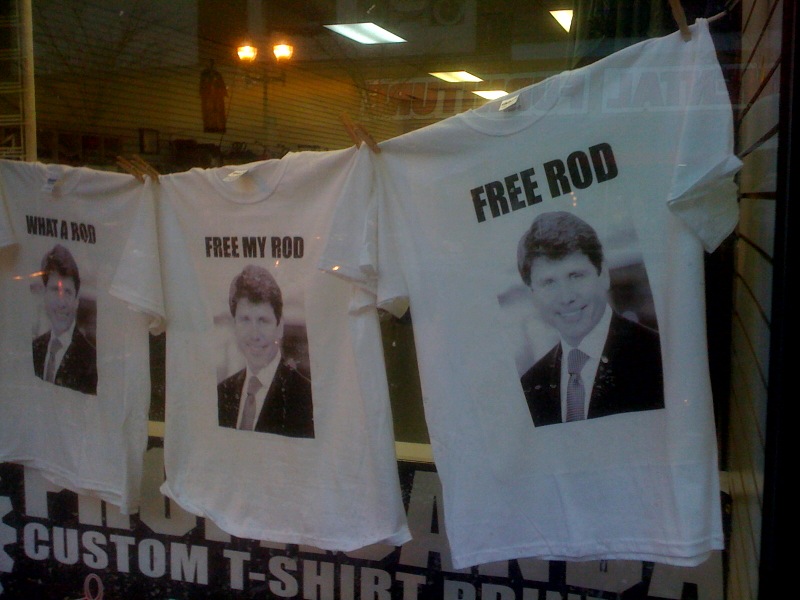
Today former Gov. Rod Blagojevich was sentenced to 14 years in prison for corruption that was first discovered three years ago when Blagojevich conspired to sell the senate seat of President Obama. The sentencing was livetweeted and here's some of the coverage and observations made during the process.
At 7p.m. tonight, Occupy Chicago will hold its first overnight occupation on the South Side following a general assembly on property owned by New Beginnings Church. The church is hosting the event in conjunction with its own occupation of the derelict Super Motel at 6625 S. Martin Luther King Blvd, which is across the street from its main sanctuary. Its pastor, Corey B. Brooks, has been camping on the roof of the motel for a dozen days and fasting on water alone. He plans on camping on the site until the church raises $450,000 to raze the former motel and build a community center with mixed-use, mixed-income development on site.
Pastor Brooks said that he was "excited" when contacted by Occupy Chicago. "I think that anybody who -- especially when they're not from this area -- wants to come lend support, we've got to be open to that." Ultimately, the pastor hopes that he can play a role mediating between the group and Mayor Emanuel. "I want to have good relations with everybody. We are the church. We're not supposed to be at war with anybody ... We bring about peace."
According to the Tribune, the State Senate has approved a plan that would give tax breaks to two specific companies, although the House of Representatives overwhelmingly rejected the Senate plan. The proposed plan would give incentives to Sears Holdings Corp. and the CME Group Inc., which is the parent company of the Chicago Mercantile Exchange and the Board of Trade, to stay in Illinois.
The companies had threatenedleaving the state over the rising income tax and there have been other stories involving other companies wanting to leave Illinois, including sandwich company Jimmy John's.
According to Peter Heimlich at the blog The Sidebar, Secretary of Education Arne Duncan and Senator Dick Durbin are tied to money given to the now defunct Save-A-Life Foundation by the Centers for Disease Control and Prevention (CDC).
According to the post, about $3.33 million was awarded from the CDC to Save-A-Life and a portion of that money was supposed to be used by the Chicago Public Schools to provide first aid training to students in the CPS. However, the CPS apparently never did the training, which begs the question of where the money went.
At the time the money was awarded, Duncan was the CEO of the CPS and even appeared as an animated pitchman for Save-A-Life.
According to Heimlich, during the years of 2004-09 Douglas Browne served as the treasurer for Save-A-Life. During that same time Browne was apparently also a deputy director for the CDC. Heimlich also says that Durbin allegedly tried to appropriate money for Save-A-Life.
For more on the situation, read the whole thing over at The Sidebar.
In addition to this, former mayoral candidate Gery Chico recently appeared before the State Senate to testify about his connection to the Save-A-Life Foundation.
On Monday, Massachusetts physician Jill Stein announced she will be running for president as a Green Party candidate for 2012. Previously, Stein was a gubernatorial candidate for Massachusetts in 2010. Stein was born in Chicago and raised in Highland Park and attended Harvard for both her undergraduate degree and medical school.
According to a press release, Stein plans to create a "Green New Deal" by initiating direct action by the Federal government in order to create jobs, "ending the Bush/Obama recession," according to the press release.
Stein also would try to create a universal Medicare system, forgive existing student loan debt, ending home foreclosures.
According to the press release, the Occupy Wall Street movement inspired Stein and some of her stances on the campaign issues are similar to the demands of some of the Occupy protesters.
Meanwhile, the Illinois Green Party filed a lawsuit against the State Board of Elections regarding the interpretation of the statute that defines who can be considered an "established party." Laurel Lambert Schmidt, who is running for the Third District state congressional seat, also filed the lawsuit.
If the Green Party would win their lawsuit, it would potentially make it easier for candidates like Schmidt to run for office. According to the current law, established party candidates need 600 registered voters in a district to sign a petition while non-established party candidates need 5,000 signatures and a petitioned filed earlier than established party candidates.
Any decision made by a court could potentially affect those in other parties and make it easier to run for an office in Illinois.
Last week, Illinois officially declared Sept. 14 to be Lilly Ledbetter Day, a day to recognize the equal pay activist and remember the fight for gender equality. Although this newest of official days pales in comparison to other auspicious days, such International Talk Like a Pirate Day (which you just missed), Lilly Ledbetter Day gives voice to an issue many of us assume is passé but is unfortunately very much current.
Way back in the archaic, Neanderthal days of 1998, Lilly Ledbetter sued Goodyear Tire and Rubber Company for wage discrimination. When Ledbetter neared retirement, she inquired about the salaries of her colleagues and discovered she was making on average $1,000 less per month than her male (and often junior) colleagues. She called BS, sued, won, then lost on appeal, and ended up in the Supreme Court. The Supreme Court ruled narrowly against her on the basis that gender discrimination could not be proven within the 180-day time statute of limitation required by the Equal Pay Act. Ruth Badger Ginsberg gave a famous dissent noting that wage discrimination is neither as time-sensitive nor as obvious as firing a woman outright for not having a Y chromosome.
Fast forward more than a decade after the initial suit to 2009, when President Obama signed the Lilly Ledbetter Day Fair Pay Act as his first act of office. The Act said discrimination starts again with each new paycheck issued. It was a big deal.
Women still earn 77 cents to every dollar men earn. For women of color, this gap is even wider. For many young women working the espresso machine or slave-wage entry-level positions next to their similarly impoverished male co-workers, this argument doesn't seem applicable. Yet on average, a woman will lose one million dollars over the course of her lifetime from not getting raises on par with her male colleagues. Lesson of life: You may be equal to your paycheck-to-paycheck boyfriend now, but in four decades, you will be a million dollars or about 200,000 Starbucks pumpkin-lattes behind him.
Lilly Ledbetter Day and Act are a start to getting women their fair share of deliciously sugary Starbucks drinks, but not enough. For example, did you know that the famous Equal Rights Amendment (ERA), has never actually been ratified? What!? You don't remember that from 8th grade U.S. history? Did you go to public school? Don't worry, many don't realize this iconic amendment was never actually ratified.
To learn more about the ERA and why it should or should not ratified, consider attending "Searching for Equality in the US Constitution - Debating the ERA," an event hosted by the Northwestern Law School. The event is on Friday October 28th at noon at the downtown campus. Sign up on Facebook or just show up with a sugary caffeinated beverage of your choice. If you are female, may I suggest bringing a budget cola such as Super Chill; never to early to start accepting your wage disparity and embracing it.
The state has released its annual report on "gaming" (gambling) in Illinois, and there are some surprising statistics in there. The most shocking to me is that Chicagoland is the third largest gambling market in the country, behind Las Vegas and Atlantic City, and really not all that far behind Atlantic City, considering it is the (filthy) East Coast Vegas between Philly and New York.
Most troubling to me personally is the lottery. Granted at least the cash all goes into education (supposedly) but it is still troubling to me that the state will generate $1.2bn just on the instant lottery games.
Sheriff Arpaio of Maricopa County, Arizona, has been invited to the Kendall County Republican Party's annual picnic this Saturday in Yorkville as the event's keynote speaker. Arpaio has made a name for himself around the country and the world for his consistent willingness to degrade the prisoners under his watch--especially immigrants.
Rather than respect the image of God present in all people regardless of their country of origin, the sheriff has singled out immigrants as a population that is less than human, thus undeserving of basic human dignity.
By inviting Arpaio to their picnic, the Kendall County Republican Party is endorsing the dehumanization and degradation with which Sheriff Joe's name has become synonymous.
Is it worse to get elected as a candidate who says he is going to jerk over public employee unions or get elected with union support and then jerk over public employee unions?
Pat Quinn, who spent a decent amount of time giving Governor Walker flackoverwhat Wisconsin did to public employees under the guise of budget issues. Governor Quinn has not even paid off his bet with Governor Walker over the Bears/Packers NFC Championship Game.
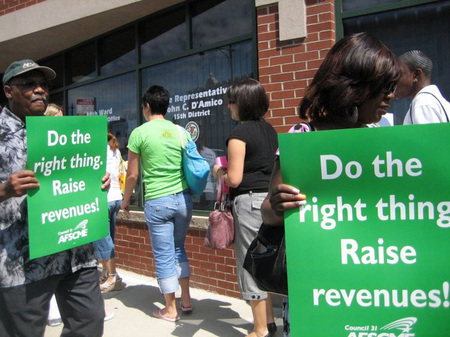
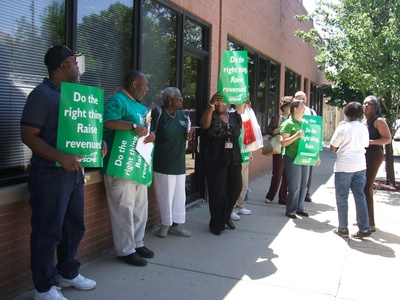
Governor Quinn, who cut a concession deal with AFSCME shortly before getting their endorsement, has since the election turned around and decided that due to budgetary reasons, the union's members should not get the raises specified in their contract.
It seems to me that in many ways, going back on a union contract with a union that endorsed you and worked hard to get you elected in a close election would be worse than having a governor who you knew was going after you from the start.
Suffice to say, AFSCME does not seem real happy about all this and I got to talk to AFSCME Council 31 Executive Director Henry Bayer about Governor Quinn's move and next steps.
For political junkies like myself there is little better than watching politicians subvert the electorate every ten years through the process of redistricting.
It happens every ten years after the constitutionally mandated census and requires states to reapportion Congressional districts. Watching how this ritual plays out suggests that maybe allowing elected officials to draw their own districts is not the best idea. They carve out neighborhoods and towns like turkey, looking for the juiciest bits of meat.
With Democrats controlling both chambers of the legislature as well as the Governor's mansion, the state party has redrawn the proposed map to benefit themselves. That is, after the 2012 elections.
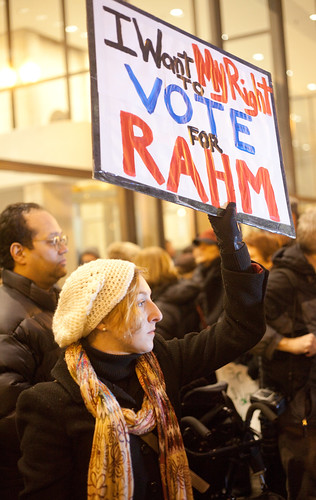
Rahm Emanuel's campaign organized a demonstration at the Chicago Board of Election Commissioners office tonight following an Illinois appellate court's 2-1 ruling that he does not meet residency requirements to run to be Chicago's mayor. For their efforts, several dozen demonstrators showed up, some with handmade flyers, most with official "Rahm for Mayor" signs. While the demonstration only lasted a few minutes before leaving the office, the issue will be around until the Illinois Supreme Court rules on the case.
The death penalty is almost history in Illinois. From Progress Illinois:
The State Senate followed the lead of the House and approved the bill (SB 3539) by a 32-25 margin this afternoon. The legislation, if signed, would end the practice and redirect money the state pays in death row prosecution and defense fees ($100 million in the past seven years alone) to support law enforcement training and programs for the families of murder victims. It now heads to Gov. Pat Quinn, where it faces an uncertain future.
Since 1977, 13 Illinois men since have been exonerated for murders they did no commit; several investigations found that dubious evidence, racial discrimination, and prosecutorial misconduct tainted many of those cases. The use of the death penalty is declining nationwide. Fifteen other states do not sentence criminals to death.
There has been a de facto ban on the death penalty for the past for a decade after it was found that a number of innocent prisoners had been executed. According to the Trib's Clout Street blog, "[s]ponsoring Sen. Kwame Raoul, D-Chicago, urged his colleagues to 'join the civilized world' and end the death penalty in Illinois" during the debate.
The Better Government Association recently made some significant changes to its board of directors -- and its overall governance structure -- in an effort to broaden and strengthen its connection to Chicago's minority communities and to expand its reach in Illinois beyond the collar counties.
"We passed a package pertaining to the roles of board members, and added job descriptions for board members and for officers, and the board voted to elect new officers for the beginning of 2011," said Andy Shaw, president and CEO of the BGA. "We spent the fall coming up with a new list of board officers, new committee chairmen and a new list of board prospects that we could recruit and ask to join us, and several weeks ago we approved seven new board members, the most so far. We can add five to 10 more, I believe. The seven we approved are very formidable, it's a very impressive group."
At its last meeting, the BGA board of directors voted to add seven new board members, including David Hoffman, former Chicago inspector general and senate candidate; Graham C. Grady, partner at the law firm of Bell, Boyd & Lloyd; Robin Steans, executive director of Advance Illinois; Tamara Edmonds Askew, director of the American Bar Association's Section on State and Local Government; M. Hill Hammock, former chief administrative officer of Chicago Public Schools and former vice chairman and COO of LaSalle Bank; Mary Lee Leahy, influential Springfield attorney; and Jack Modzelewski, president of client relations at Fleishman-Hillard. An eighth new member, DePaul University general counsel Jose Padilla, is expected to be confirmed at the next board meeting January 21, when the others will be seated for the first time.
Additionally, Rod Heard, partner at law firm Barnes & Thornburg, was named chairman of the board, Phil Clement, global chief marketing and communications officer of Aon, was named vice chair. And Shaw's title was changed from executive director to president and CEO.
The BGA also created a new tier to its oversight structure: "life trustees," which is made up of former board members who have each served for several decades. Moving these senior board members to the life trustee board made room for new blood, Shaw said, "people who understand government, are committed to improving it, and have the contacts and resources to carry on our mission."
Earlier today the U.S. House of Representatives voted on whether to bring the Bush tax cuts up for debate. The ending tally was 213 in favor, 203 against. Thirty Democrats voted against and of those 30 three are from Illinois (Melissa Bean, Jerry Costello, and Dan Lipinski). Congressman Lipinski's name stuck out to me considering his fairly progressive record on tax reform.
A spokesman from Lipinski's office explained that the Congressman voted against the measure because a yea vote would have meant there would be no opportunity to amend the bill.
"He did not like the way the rules were used to deny any type of amendment," Lipinski spokesman Nathaniel Zimmer said. "It would be his preference that there would be a temporary extension of the cuts for all earners and he would like to be able to vote for an amendment to that effect. It's his expectation that in the end there will be a temporary extension for all earners. He believes that this is a very fragile recovery and that raising taxes on anyone right now poses an unacceptable risk to that recovery."
Zimmer also told me that Lipinski planned on voting for extending the middle class tax cuts (that vote passed but when I talked to Zimmer it was a few minutes away) and expected an the Bush cats to be extended for all earners.
Although Lipinski wants to extend tax cuts for all earners most House Democrats are in favor of extending the tax cuts for everyone except the very wealthy. Republicans have mostly been in favor of extending the cuts for everyone.
The Chicago Housing Authority recently surprised residents of the last Cabrini-Green high-rise by moving their eviction forward by several weeks. The new date? Tuesday.
While some residents indicated they would resist leaving 1230 N. Burling, moving trucks slowly filled and drove to new residences. By evening only a couple of families remained -- and it was unclear if they would stay the night.
(Crain's) -- U.S. Rep. Peter Roskam was named chief deputy majority whip of the incoming GOP-controlled House on Monday.
The Wheaton Republican will rank fourth among House Republican leaders, giving Illinois a voice at the upper levels of the party's hierarchy.
Mr. Roskam is positioned to be a go-between with the White House for the House GOP leadership. He and President Barack Obama served together in the Illinois Senate and collaborated in Springfield on issues such as death penalty reform.
It's the bottom rung of House leadership, but a stepping stone where former House Speaker J. Dennis Hastert, R-Plano, started in 1995 after Republicans gained majority control of the House. Others who started as chief deputy whip include incoming House Majority Leader Eric Cantor, R-Va., and the incoming majority whip, Rep. Kevin McCarthy, R-Ca., who appointed Mr. Roskam to the post.
The majority whip and his chief deputy are primarily concerned with counting votes, communicating the party's agenda and lining up undecided members to vote for the leadership's position on bills before the House.
The position has seen its share of big names before they were big names including Dennis Hastert of Illinois who later served as Speaker of the House and soon-to-be Majority Leader Eric Cantor so the job is likely a sign that Roskam is line for more important positions. Greg Hinz notes that Roskam is building quite a resume. In addition to his new gig, Roskam is also a member of the powerful Ways and Means committee. Politico recalls that Roskam also helped direct America Speaking Out, an online grassroots initiative that helped craft the GOP's Pledge to America.
The Politico article also hypothesizes that Roskam's selection may be because he has worked with President Obama before when he was in the state legislature. Roskam could act as a go-between between the GOP and the president, an astute assumption given that Roskam and Obama have worked together and are from the same state.
There are some longtime rituals on Election Day that politically active American citizens repeat every election cycle. Voters gather in homes or public places on the first Tuesday of November and watch televised up-to-the-second exit poll figures and vote tallies. They arrive at these parties with some basic expectations: their party will win some, and their party will lose some. Hopefully the former will outweigh the latter. If not, they can try again in two years.
A strange atmosphere hangs in the air of such a get-together put on by a party that considers five percent of the vote a victory. No one goes to a Green Party election-watching expecting their candidates to win the majority of the electorate--no one. It's like rooting for the Cubs, except the Greens never even make it to the playoffs.
But Election Day 2010 was different. The party that accepts losing as a way of life thought that maybe they would get to win.
As you may have heard, some people (but probably not very many) are going to be voting on some stuff tomorrow. It's been a wild campaign season locally and nationally, and both will probably see some shakeups. But unlike the fights for governor or senator, there's one tight race that isn't between a Republican and a Democrat and most Chicagoans (particularly those outside of the Northwest Side) know little about: the fight for state representative in the 39th district.
State rep races usually fly well below the media's radar, overshadowed by races for higher offices. This year has been no exception: much attention has been paid to Quinn vs. Brady and Kirk vs. Giannoulias. But the fight in the 39th district between eight-year incumbent Democrat Toni Berrios and insurgent Green Party candidate Jeremy Karpen should be worth watching tomorrow. While the winner will not be the most powerful politician in Illinois, an incumbent loss would result in the only Green Party politician in any state house in the country.
Democrats rallied on the Midway Plaisance in Hyde Park on Saturday evening for the "Moving America Forward Rally with President Barack Obama." The estimated 35,000 attendees heard performances by Chicago rockers Dot Dot Dot and hip-hop artist Common, as well as speeches by a variety of officials and citizens, including Mayor Richard M. Daley, Senator Richard Durbin, State Treasurer and US Senate Candidate Alexi Giannoulias, Governor Pat Quinn, Alderman and Cook County President Candidate Toni Preckwinkle and -- of course -- President Barack Obama.
A photo essay of the event by David Schalliol is below.
Despite the title of this post, no offense is meant towards the lovely state of Tennessee. Its Smokies are indeed majestic, who could argue with a town like Memphis, Dollywood calls it home, and Nashville is home to the legendary Skull's Rainbow Room, first established by honky-tonk legend "Skull" Schulman. You won't find any qualms with the state here. But when GOP gubernatorial candidate Bill Brady exclaimed the following at a debate last week, it's cause for consternation:
"If the viewers are happy with the way Illinois is going, elect Pat Quinn. But if you want an Illinois that looks more like an Indiana or a Tennessee --- a state that can turn the page -- we need new leadership in Springfield"
The Chicago Tribune's Eric Zorn immediately picked up on the quote and did some quick head-to-head statistical comparisons that highlight Brady never would have made the allusions if he had done any amount of research at all. The sentiment behind Brady's statement though is something to keep heavily in mind when heading out to the polls next Tuesday. What Brady's comment conveys is a cultural argument meant to rile up Downstaters to challenge Chicago and urban hegemony against their interests. Politically, it makes a bit of a sense. Logically, it's an absurdity.
It is a further illustration of the tension between the political unit of measurement that is the State -- that is, Illinois -- and the economic force that enables its being -- Chicago. In a recent article by Bruce Katz, the Director of the Metropolitan Policy Program at the Brookings Institution, he notes that ""Greater Chicago contains 67 percent of the residents of Illinois and generates 78 percent of the state's economic output. But Illinois has pursued transportation and infrastructure policies that divert tax revenue from Chicago to subsidize inefficient investments in the rest of the state." Unless leadership can start being aboveboard about the realities of the economic structure of our co-dependence, Illinois will remain a mess, and Chicago will stagnate. All the while, Chicago will be forced to continue searching for private dollars for public works, as it becomes an ever-larger welfare donor to the rest of the atrophying state.
At some point, there has got to be a critical mass when the untenability of the illusion of the versus culture that pits states like Tennessee against Illinois and towns like Bloomington against Chicago becomes politically apparent. All places are equally vital and important in their own regard, but the truth dictates that some carry larger weight than others. As the process of right-fixing spaces across the nation begins, realizing that the one-size-fits-all prescriptions of growth that had been counted on for so long have become unsustainable, hopefully an embracing of the actual place one occupies will accompany this development.
Any potential candidate for statewide office is foolish not to be actively selling further investment in Chicago. Whatever faults it may carry, the reality of it is that Chicago is a top-tier alpha city in a region devoid of any others. It is an exceptionally powerful place of prestige could be utilized as a tremendous asset. Aside from the states of California and New York, no other state has a city as influential as Illinois. Not only should Tennessee be so lucky to have such a problem, but Brady's thoughtless thought process indicates Chicago is somehow apart from the rest of the state. With 78% of the economic output coming from the city, a responsible candidate would encourage more growth in the city to solidify the strength and virtues of the small, rural hometown. Poison the source of the river and soon, the banks of all of its tributaries will be bare.
There are two solutions here: honesty in management, or go it alone and have Chicago take measures to decouple itself from the state. The latter isn't a political reality, so the former better become in vogue fairly soon. Unfortunately, it doesn't seem to be so happening this election season.
The Grateful Dead's "Tennessee Jed"
I won't wade into the political operative-fabricated "who should apologize for what" media bullshit back-and-forth, nor will I link to it, but I do want to take a moment to address Rickey Hendon. Feel free to go make some soup.Unless you are State Senator Rickey Hendon. You stick around.
Rickey. Mr. Hendon, rather. Senator Hendon. State Senator Hendon. Whatever. I find you oft-hilarious. You're clearly a very clever man who can turn a phrase. However, don't say shit like this:
"Let me tell you a couple things. I've served with Bill Brady. I've never served with such an idiotic, racist, sexist, homophobic person in my life," Hendon told the crowd. "If you think that the minimum wage needs to be $3 an hour, vote for Bill Brady. If you think that women have no rights whatsoever except to have his children, vote for Bill Brady. If you think gay and lesbian people need to be locked up and shot in the head, vote for Bill Brady."
I believe, like I think you do, that Senator Brady is opposed to the concept of a minimum wage. Certainly, Brady has shown little interest in actively addressing racial disparities in income or prison sentencing. I also believe, like you apparently do, that Brady's position on gay marriage amounts to homophobic policy even if he isn't personally homophobic. Brady's positions on reproductive rights are far from enlightened. However, I don't know if he wants the women of Illinois to bear his children. Nor do I think that even in his fevered fantasies, he thinks we should imprison gay people and execute them NKVD style. Nor do I think you actually believe those things.
Given these facts, do you think that maybe your point would have been better served sans the accusations of murderous impulses and harem-lust? Maybe taken more seriously?
I guess what I'm trying to say, Rickey--Senator Hendon--what I'm trying to say is, you know, take it easy.
Be Well,
Ramsin Canon
P.S. I believe the proper Chicago elocution is "couple of two, three things." Let's keep it professional.
Hey everybody, you can come back now. You're welcome for the soup.
I have one question that I believe should be used to disqualify people from running for executive office. It is, "Do you accept the theory of evolution?" Anybody who says no should be disqualified. No, it's not a religious test that would violate the Article VI prohibition. It's a moron test. We could also ask, "Are you a moron?" but then we'd be less likely to get an honest response. This way we could actually root out the morons.
This has nothing to do with conservative/liberal, Democrat/Republican. Evolution is a fact--in fact, it's more than a fact. It is a theory built upon literally millions of facts. Believe whatever other thing you want, but denying that evolution took place--maybe not exactly how science now conceives, but that it took place in some way--is absolutely no different than denying gravity. Newtonian physics got the mechanics of gravity wrong, but that didn't make gravity itself wrong. If you think "the jury is out" on evolution, you're not particularly bright, willfully ignorant, or poorly educated (which may not be your fault, but still--probably shouldn't be elected to executive office).
Bill Brady thinks it's okay to teach Creationism in schools. By doing so, he betrays his claim that he accepts "both" creationism and evolution. Accepting both as equivalent to be taught is like saying you accept "both" the theory of electromagnetism and fish are delicious. I don't care about any of the rest of his politics. How can you vote for a person like that? Creationism in schools? Really? We want the US to create well-educated kids prepared to tackle the most significant problems of the future--not to mention stay on the cutting edge of science--and we're going to allow school districts to teach Creationism? How stupid is this guy?
Hat-tip to Capitol Fax. This debate took place at the Union League Club of Chicago today.
Just to remind you that in about a month we have an immediate election before we even consider the mayoral contest in February. We have seen that there has been a lot of focus on who's going to replace Daley or whether or not the Presidential Chief of Staff will run for Mayor of Chicago and leave the Obama administration.
Next month we will elect a Governor and a US Senator.
Rep. Jesse Jackson Jr. directed a major political fund-raiser to offer former Gov. Rod Blagojevich millions of dollars in campaign cash in return for an appointment to the U.S. Senate, sources said the fund-raiser has told federal authorities.
The allegation by Oak Brook businessman Raghuveer Nayak counters public statements made as recently as last week by Jackson that he never authorized any deal to attempt to buy the Senate seat.
Rep. Jesse Jackson Jr. (left) and Raghuveer Nayak pose in front of the White House on Oct. 8, 2008, the day Nayak says a critical meeting occurred.
Nayak also told authorities he paid for two airline trips for a "social acquaintance" of the Democratic congressman at Jackson's request, raising more potential ethical and political problems for Jackson.
The FBI interviewed that acquaintance -- a Washington, D.C., restaurant hostess named Giovana Huidobro -- about a year ago as part of its corruption probe of Blagojevich. Authorities were trying to determine whether Jackson had asked Nayak to offer Blagojevich campaign cash in exchange for the then-governor appointing Jackson to the seat once held by President Obama, according to sources with knowledge of the probe.
Huidobro, Jackson and Nayak all dined together on Oct. 8, 2008 -- the same day that Nayak has told authorities he had a key conversation with Jackson about the Senate appointment, sources said. The three then ended up at Ozio, the restaurant and club where Huidobro works and where Jackson has held fund-raisers.
Huidobro told authorities she knew nothing of Jackson's political dealings regarding the Senate seat, according to sources. She also said she flew to Chicago on several occasions at Jackson's request and that Jackson sometimes reimbursed her for her travels.
Nayak told the FBI that he paid for two airline trips for Huidobro from Washington to Chicago in 2008.
A spokesman for Jackson declined to comment on Monday.
Reached Tuesday on his cell phone, Jackson said: "I have nothing to say. Call my office. Have a good day."
I hate to bring it up because the above is really a story in itself but this really does do even more damage to Jackson's already less than perfect mayoral prospects. It also leaves a gaping hole in the selection of black candidates for mayor. Contrary to popular belief, I don't think Carol Moseley Braun has much of a chance and State Senator James Meeks isn't exactly a friend of gay Chicagoans. That may mean that blacks and those who would vote for a black candidate will have to choose between Sheriff Dart and Rahm.
Chicago's political media sphere is abuzz with where Illinois pols ranked in this "unscientific" Washingtonian survey. According to the Tribune, those surveyed were "administrative aides, press secretaries, legislative directors and high-level committee staffers willing to participate." Here are the results:
Best dressed and a gym rat and most likely to star in a scandal? What are they trying to say about Schock? And since Emmanuel ranks near the top in both Best and Worst Obama administration figure does that mean he's doing something right or wrong?
Once upon a time there were three school districts, two of the districts were right next to each other and one was a few miles away and they were all informed that they could get new federal funding to help them retain teachers.
But once the school districts got to see the numbers they got three very different stories. The three districts were the Aurora East, Oswego and Yorkville school districts, all were consolidated districts so they taught K-12. The federal funding numbers come from the Beacon News.
But lets look at some of the numbers. First the amount that the new funding will provide to each district.
So you would think it's a slam-dunk -- this is going to scare suburban women and they will end up not voting for Bill Brady.
Social issues may not be the key to the suburban mom vote this time around. The question is going to be what will tick off suburban women more?
Will it be Bill Brady's stance on social issues or the millions of dollars the state is behind in paying local school districts? Which is going to have the bigger impact on the moms vote come election day?
When kids return to no music programs and larger classes, will that trump social issue concerns?
I think the school funding issue puts the suburban mom vote into play. It will be interesting to see if the campaigns attempt to capitalize on that.
Probably the most difficult type of organizing is what's known as "coalition politics", pulling together existing organizations to move a grassroots program. The conflicting ideologies and tactics of different groups, differentials in resources, and often hard to manage personalities make coalition politics immensely frustrating. This makes the continued existence--and, in fact, progress--of the Responsible Budget Coalition particularly surprising.
It is also eye-opening. There is often a lazy false equivalence between left and right "special interest groups" when it comes to public spending; anti-tax zealots like to stoke resentment of "public employee unions" as a means to pressure legislators to slash public spending. Take a look at the RBC's roster of organizations and consider if these "special interests" are equivalent to large profit seeking firms that fund the "cut to the bone" think tanks and political funds:
Apparent gubernatorial candidate and poor black child Dan Proft faced off with Hank Scheff of the American Federation of State, County, and Municipal Employees (AFSCME) Council 31 to talk about Quinn's reform. While I agree with Scheff generally, both he and Proft are very smart guys and come from a sincere (non-partisan) place. That makes this very worth a watch:
Republicans often criticize Illinois Democrats for running a patronage army of loyal state employees. However this website is encouraging loyal republicans to be given state jobs as well.
Of course new administrations are able to appoint people to implement their vision for the state, to implement the policies that they campaigned on and were elected to enact. What is odd about this website is its tone, a confidence that the GOP will win Springfield back, and a gleeful lust for 6 figure jobs. In particular the site exhibits a tendency towards the corrupt and a disdain for "the awshucks-we're-sorry-for-having-principles-types."
When you click on the Jobs List, it lists different state departments that the Governor is able to appoint heads of. What is disturbing is the partisan descriptions for the jobs. Is the head of the Historic Preservation Society a partisan position?
The site implies that Republicans would only be interested in jobs enforcing Human Rights because, "Check out the pay scale here!"
It describes Homeland Security as "the new patronage place to be." A scary thought that our security and safety be entrusted to partisan hacks instead of trained and specialized experts.
It describes positions on the Illinois Gaming Board as though it were a casino, "Great spot to meet people and make money, come to work every once and a while, too!"
In what should be a scary comment to organized labor, the site claims that the GOP will, "rebuild [the Department of Labor] and remake it so that it is more efficient. Get on board and help."
The site is run by a woman named Jenifer Sims. It is unclear if she has any connections to the Brady campaign, the state GOP, or if she is just a crank writer. Attempts to gain quotes from the Brady for Governor campaign and the Tea Party Patriots were made. Neither gave any quotes.
When you borrow money it is reasonable that the folks who loaned you the money expect to be paid back, with interest. That is another issue that is now facing the state budget and it's another issue that did not appear overnight. The Civic Federation on Chicago has a report (PDF) that covers some of this in depth.
But like I pointed out in my last post about the budget, none of this is really a surprise.
Long Term Debt
In FY 2001 the state was spending about a billion dollars a year on long term debt service; in FY 2008 it had doubled to $2 billion; in FY 2011 it is projected to be $2.7 billion. So in the past seven years it has just about doubled.
In terms of the debt, in FY 2001 the state had about $8.4 billion in debt; FY 2008 it had $21.1 billion in debt and in FY 2011 it is estimated at $25.4 billion. These are state bonds that need to be paid, not the general underfunding of the state pension system.
Short Term Debt
Short-term debt is state debt that has to be paid back in a year. In FY 2007 it was $900 million, FY 2008 it was $2.4 billion, in FY 2009 $1.4 billion.
Paying increased costs for employee pensions, health care for the poor and debt service will eat up virtually all new money the state can expect to bring in over the next three years, Comptroller Dan Hynes said Monday.
The state faces "a serious crisis" by 2010 unless lawmakers take a long-term view of state finances, Hynes told a business group in Chicago.
But this is a problem that has been brewing for years and years. The current economic situation may have hastened it, but this day has been coming for a long time and a large number of different issues have contributed to it.
UIC Students, Faculty and Staff Rally Against Budget Cuts.
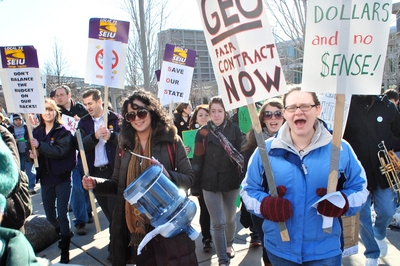
Several hundred students, faculty and staff rallied at the University of Illinois Chicago campus on March 4th, to demand an end to budget cuts that target the poor. They rallied in the Quad, before marching around campus and marching to University Hall where the administrative offices for the school are. It was part of a national day of action to defend public education.
SEIU Local 73 chief Steward Joe Iosbaker led the crowd in chants, "They Say Furlough Day, We Say No Way! They Say Cut Back, We Say Fight Back!" and the sarcastic, "They Say Fee Hike, We Say, Yea, Right!"
At University Hall SEIU members served Soup to passer-by's "to prepare us for what we'll be eating if the budget cuts go through." They then sang a parody of Gnarls Barkley's Crazy, "Is UIC crazy? They must be crazy,to think that they can defeat, local 73."
The Chicago News Cooperative looks at the Service Employees International Union's state council and their growing importance in state and local politics.
SEIU was a major backer of Rod Blagojevich and the Democratic caucus in Springfield, and was the cash and manpower engine behind the 2007 challenges to incumbent alderman after the big box living wage ordinance fight. With CFL president Dennis Gannon easing out the door, SEIU State Council President Tom Balanoff is left standing as arguably the most high profile labor leaders in local politics.
The piece is worth a read for background on an organization that will undoubtedly have a large impact on the 2011 elections; though I would think they would have mentioned that the state council was a founding sponsor of Progress Illinois, which has done yeoman's work in reporting on complex state and regional policy issues.
An early supporter of Barack Obama's White House aspirations, the service employees union also backed the winners in the three highest-profile state primary races this year. Besides Mr. Quinn, it sided with Alexi Giannoulias, the Democratic nominee for Mr. Obama's former United States Senate seat, and Toni Preckwinkle, who toppled Todd Stroger, the Cook County Board president.
"It was a good day for us," Tom Balanoff, president of the union's state council, said in an interview last week.
The union's successes culminated a long push for prominence that has seen it become the biggest financial contributor to Illinois political campaigns. Its campaign committees, which were only bit players in local politics a decade ago, have spent more than $10 million across Illinois in the past six years, a Chicago News Cooperative analysis of state campaign finance records found.
In case you haven't noticed yet, you can now submit your resume to be considered by the Illinois State Democratic Central Committee to be slated and become the nominee for Lt. Governor. You can find detailed instructions at http://www.ildems.com/ltgovnominees.htm
Perhaps more entertaining than applying yourself, is sorting through the resumes and applications of those who think that they can achieve what Scott Lee Cohen could not. Over 40 applications have been submitted so far and are posted on the Illinois state Democrats website. What seems to jump out to me is that many of these candidates, with little experience with elected office, seem to think they can play in the big leagues without going to training camp.
The Responsible Budget Coalition is taking to the capitol on Wednesday to advocate on behalf of social service providers and their clients who have taken a beating over the last few years as the state Democratic leaders refuse to deal with the budget because of the perceived electoral consequences (if only we could indefinitely suspend elections--maybe then we can get some action).
More than three thousand service providers and clients will be making their case in Springfield, representing groups like this:
Participating organizations include AARP, AFSCME, Chicago Coalition for the Homeless, Citizen Action/Illinois, the Hope Institute, Illinois Action for Children, Illinois Coalition for Immigrant and Refugee Rights, Illinois Education Association, Illinois Federation of Teachers, Illinois Network of Centers for Independent Living, Jane Addams Senior Caucus, Lake County Center for Independent Living, Lutheran Social Services of Illinois, SEIU Health Care, Voices for Illinois Children, Williamson County Early Childhood Cooperative, Women Employed, YWCA Metropolitan Chicago and many more.
Those evil special interests. The RBC is specifically pushing for new revenues for radical programs such as paying past due bills to non-profits.
UPDATE: Internet truism: The punishment for overly-dry sarcasm is angry comments. I don't consider the Williamson County Early Childhood Cooperative and their clients a "special interest" group, nor do I think the state paying its bills to social service providers is a radical idea.
This is going to be a bad year for public education.
After the State of the Union address and GOP response, there was a lot of back and forth about different policy points and the challenge the President laid down and the people standing behind Bob McDonnell and the number of times the President used certain words. What nobody commented on was that the two men agreed enthusiastically on exactly one thing: the need to privatize public education.
The take away from that night is that the American political duopoly supports the privatization of public education. They honestly believe that injecting the profit motive into education is the way to make sure that all American children get a decent education. That is a major policy shift that is so harmonious with the corporate policy tune that no news operations expressed any surprise or outrage.
But, of course, it is an outrage. The privatization of schools is sold as "ingenuity" and as a way of "leveling the field" by offering that cornerstone of free market fundamentalist mythology, "choice". Give parents choice and all problems go away. Because education is like used cars.
As most folks are likely now aware there are a host of allegations surounding the Democratic nominee for Lt. Governor...
Just a bit from the Trib
Cohen did not deny choking his wife, as she alleged in the divorce, but said he had no recollection of it, and it actually took place before they were married.
His ex-wife, Debra York-Cohen, was with him today and said she stood by the allegations in the divorce but said his philandering and volatile behavior took place during a brief period time when he was using steroids. The allegations included him frightening their four children and threatening her verbally and physically.
His response to all of this and the calls to step down also from the Trib...
"I'm going to respond that my honesty and integrity in putting it out there is the best thing that could happen to the party,"
Yeah, the best thing that could happen for the Republican party. For the Democratic party the best thing that could happen is that you quickly go away.
I am a Republican but still, this is beyond messed up. This isn't embarrassing, it's sad. Perhaps this is a lesson on not having the primary so early or even having a Lt. Governor's office. But this is bad for everyone. Instead of people focusing on the state's budget issues (or even the closeness of the GOP Governor's race) folks are going to focus on the Lt. Governor candidate who seems to have come from a Springer episode.
I don't know what is worse (besides the things he allegedly did) , the idea that he thought this wouldn't be a big political s--- storm? That you may have been told by folks around you that this wasn't going to be a big deal and agreed with them? That you spent that kind of money to get the Lt. Governor nomination? You think this is somehow a positive for the Democratic ticket and the Democratic party?
Each of those in my mind show someone who isn't in touch with reality.
The `roid stuff, yeah that could have been a teary moment on the local news programs and you could have recovered from it.
But everything else? As Mike Flannery put it on the news on CBS 2 today..
Yesterday Illinois had their primaries for such positions as Governor, Senator, and locally Cook County Board President.
First let's talk about the Governor's race.
Dan Hynes I will give him a lot of credit for making the Democratic primary more of a horse race than it was already. That was a good ad and although many people may have had a problem with it, it almost certainly made this race a close race. What Mayor Harold Washington said over 20 years ago was almost as prescient about Quinn's current situation as it was then.
Dan Proft Well I won't hold my breath over what I wish would happen. I think what he had said during the course of this campaign was spot-on. Hopefully he will continue to push for a policy revolution and the creation of unconventional coalitions to make needed changes in our state. Hopefully this race for Governor won't be his only foray as a candidate.
Mark Kirk I really never liked the term RINO. I can understand that we know that there are those who will sacrifice their principals or their party's principals for whatever. It's just that such a label can be easily used frivolously especially if say a Republican may generally agree with fellow Republicans on such and such issues. Let's say someone out there may want to call Ron Paul a RINO, although his views on the issues may bring needed energy to the Republican Party in general.
I sat down this morning to write a piece about how disappointment over the Hoffman defeat last night--who, by the way, was supported by every individual in Chicago I spoke with about the subject, though he lost here 36-29-29 (thank you, @chitownpolitics)--should not end our commitment to the Senate fight. If our health care and foreign policy goals remain today what they were yesterday, it is exceedingly important that the seat is filled with not just a Democrat, but a Democrat as faithful an Obama supporter as Giannoulias.
At election's close, listening to Hoffman concede on WBEZ, I sent out some comments into the twitter-shpere and the vocalo live blog (which deserves its own post--seriously, that shit was crazy):
we tried. At an unusual moment, we've got an uphill battle ahead. But we can work together and do it.
Chicagoans are going to have to show mobilization of Obama proportions--large swaths of state will love Kirk's banker narrative of Giannoulias.
The most immediately important race for Chicagoans is probably the Cook County Board President's race, with the addition of insurgent candidate Jesus "Chuy" Garcia's win in the Southwest Side 7th District. John Fritchey, another reformer--based on his activities in Springfield--won election to replace Forrest Claypool, who retired this year.
If Cook County is truly cleaned up, a huge spigot of patronage dollars--of both the old-school and pinstripe kind--can suddenly go dry for significant portions of the Chicago machine. Contracts with the County and particularly it's hospital system are an important source of income and campaign donations for Regulars and their associates. Commissioner Moreno himself was embroiled in a scandal whereby he allegedly shook down a health care software company to hire a political ally in order to qualify as a minority-owned business.
Assuming the Board's reformers have the gumption to take that system head on, the machine system in Cook County, and particularly the city, could show the kinds of weaknesses that open up electoral fronts.
In other news, wow, Terry O'Brien. Dude spent a lot of money to do as poorly as he did. Also, Quinn versus Brady may poll close, but Quinn will have to do a lot wrong to lose the enormous Cook County advantage that Democrats enjoy. Bill Brady, among the most conservative of the GOP candidates, will have trouble bringing back those suburban Republicans-turned-Democrats. In the Senate races, lots of speculation that Hoffman is perfectly positioned to run against Mayor Daley in '11. That election happens in mid-winter 2011--a year from now. If Hoffman plans to run against the Mayor, he better start in the Spring. The Mayor raised more than $50 million dollars for the Olympic bid. What do you think he could squeeze out of people for a competitive race against a prosecutor? Hoffman of course lost to Alexi Giannoulias. Speculators as to Alexi's "baggage" forget exactly what Hoffman's three-week meteoric rise should have taught them: nine months is a long, long, long time in politics. Who knows what's going to happen by November? Nine months ago the only tea party we talked about here happened at the Drake Hotel, in white gloves.
How often does a Polish president endorse a gubernatorial candidate? At least once apparently:
On Friday, former Polish president Lech Walesa endorsed Andrzejewski, claiming that Andrzejewski's outsider campaign was similar to the Solidarity Movement Walesa is known for. In a state with a large Polish population, conservatives have said the Walesa backing carries a lot of weight.
Feel free to chip in on local races, too. On election night, join me and other local political types over at WBEZ where we'll be liveblogging the results.
U.S. Senate Races
Democrats
Alexi Giannoulias
David Hoffman
Cheryle Jackson
Jacob Meister
GOP
Mark Kirk
Pat Hughes
Illinois Governor
Democrats
Pat Quinn
Dan Hynes
GOP
Kirk Dillard
Bill Brady
Andy McKenna
Jim Ryan
Dan Proft
Adam Andrzejewski
Cook County Board President
Democrats
Todd Stroger
Dorothy Brown
Toni Preckwinkle
Terry O'Brien
First thing accept the fact that the gloves are totally and completely off now and you can't put them back on. It has gone in the words of CBS 2, nuclear.
The Washington ad is huge for Hynes, he has gotten free media off of the ad. Any rational ad that gets free media play is something you have to reply to and address.
Remember one of the lessons from the Kerry campaign, you can't let this stuff go. You have to hit back and hit back hard. Yes, it's the primary and you are all supposed to be loving Democrats and negative campaigning is bad, yadda, yadda, yadda...
Remember, you have to win the primary to make it to the general and at this point your only focus needs to be on winning the primary, it's a long time between Feb and November, wounds will heal, losing the primary lasts forever.
Woke up on the couch I call bed the other day, rolled over and popped open my Mac. Email; check. Facebook; check. Grab some coffee, head back to couch. Twitter feed; new updates from @ChicagoCurrent, @WBEZ, @chicagonewscoop, not to mention the dinosaurs.
Checking my twitter feed in the morning is sliding comfortably into that sacred place once occupied by pouring over the broadsheets, grey paper no longer splayed out across the table, coffee in hand, trying awkwardly to fold the page back upon itself.
In the current gubernatorial campaign you may hear a lot of talk about the fiscal issues facing Illinois. You can read about some of these issues in Crain's:
While it appears unlikely or even impossible for a state to hide out from creditors in Bankruptcy Court, Illinois appears to meet classic definitions of insolvency: Its liabilities far exceed its assets, and it's not generating enough cash to pay its bills. Private companies in similar circumstances often shut down or file for bankruptcy protection.
"I would describe bankruptcy as the inability to pay one's bills," says Jim Nowlan, senior fellow at the University of Illinois' Institute of Government and Public Affairs. "We're close to de facto bankruptcy, if not de jure bankruptcy."
Legal experts say the protections of the federal bankruptcy code are available to cities and counties but not states.
While Illinois doesn't have the option of shutting its doors or shedding debts in a bankruptcy reorganization, it seems powerless to avert the practical equivalent. Despite a budget shortfall estimated to be as high as $5.7 billion, state officials haven't shown the political will to either raise taxes or cut spending sufficiently to close the gap.
As a result, fiscal paralysis is spreading through state government. Unpaid bills to suppliers are piling up. State employees, even legislators, are forced to pay their medical bills upfront because some doctors are tired of waiting to be paid by the state. The University of Illinois, owed $400 million, recently instituted furloughs, and there are fears it may not make payroll in March if the shortfall continues.
Without quick corrective action or a sharp economic upturn, Illinois is headed toward a governmental collapse. At some point, unpaid vendors will stop bidding on state contracts, investors will refuse to buy Illinois bonds and state employees will get paid in scrip, as California did last year.
Chicago and Illinois suffered a serious blow over the weekend with the loss of CLTV political reporter Carlos Hernandez Gomez. He was the type of reporter with such a sharp mind and wealth of knowledge that he made you want to know more, do more, be better. Head over to Capitol Fax for reminisces and obituaries of a great reporter and wonderful human being.
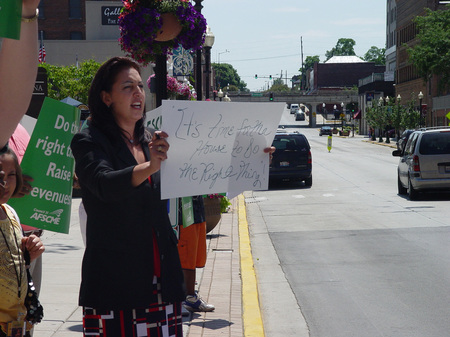
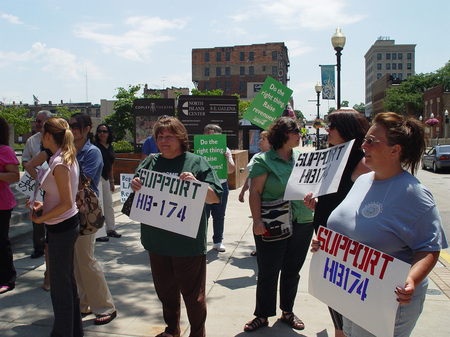
"The governor spoke today about the Illinois budget, what we believe is the most urgent issue facing our state. That broken budget is now a full-blown crisis. Each day we hear of new, devastating cuts to schools, health care, human services and public safety in every part of the state. Basic services for every Illinois resident are on the brink of collapse, more than 100,000 jobs providing those services in the public and private sectors are threatened, and lawmakers will return to Springfield in February to an even bleaker picture. We have to confront this crisis--not with more painful cuts and payment delays, but with a balanced approach that includes responsible tax reform. Responsible reform like House Bill 174 will raise adequate revenue and make taxes fairer. It is essential to protecting public services, jobs and our economy, and it has to be Job One."
A White House draft memo has been leaked which proponents of moving the Gitmo detainees to the Thomson Correctional Center may find encouraging. According to Talking Points Memo, the memo doesn't indicate the White House has made a final decision on whether to move the prisoners to Illinois but it is a sign that Thomson is being given serious consideration by the Obama Administration.
Interestingly, the memo states that the prison, if used to house the detainees, wouldn't be limited to just former Gitmo prisoners. The memo says it would be used to "alleviate the Bureau of Prisons' shortage of maximum security cell space and could be used for other appropriate purposes." Thomson is a big prison and Illinois prisons are also overflowing so this is a wise use of the jail. It could be used to both relieve the overflow of prisoners in other jails and also close the prison at Guantánamo Bay. Andrew Breitbart's Big Government has the memo.
Perhaps during the last few months of campaign season, attacking Democrats' advocates by saying that bringing terrorists to a maximum security prison in Illinois from which no inmate has ever escaped might fly. However, right now, in this economy, I predict that Congressman Mark Kirk and Co.'s claim that by transferring Gitmo prisoners to the Thomson maximum security prison in Illinois will mean endangering Americans and letting the terrorists into "America's heartland" will fall flat. Strangely enough, Rich Miller rounds up all the facts and is still skeptical:
Prisons bring in revenue by employing people to build the prison and run it and I'm not just talking about security. Prisons need people to do the laundry, people to cook the food, people to drive trucks in and out of the facility and a whole bunch of other things. It's a stimulating. That's all in addition to the people who actually build the prison.
Nobody has ever escaped from a maximum security prison. Ever.
Again, let me stress, these terrorists won't be taking that seat next to you at the local bar. They will be in a maximum security prison of which nobody has ever escaped. There is no security concern that these terrorists will escape. Hell, I've got a hunch that they'll even be more secure there than in Cuba.
Also, there are already terrorists in American prisons, 340 to be precise. Surprise!
As Miller notes, the locals actually SUPPORT bringing the terrorists to the Thomson prison.
Well, I'm not skeptical. Not only is Kirk endangering his candidacy by making an attack that is largely false, it's also famously false. People are aware of what the real story is, which makes Kirk look like a partisan liar.
We got an email from Jonathan Goldman about his candidacy for state rep in the Democratic primary for the 10th district.
I suspect when the email was sent they didn't figure it would be the suburban Republican who would do the item on it. But he makes some points I would like to take a closer look at. You can find what was in the email here.
Work to put Illinois' fiscal house in order. "We need to get serious once and for all about fixing the State budget, rather than lurching from one fiscal crisis to another. We need to restructure our tax policies based on ability to pay and address our structural deficit so that we can pay our bills on time and fully fund our pension obligations," said Goldman.
So bottom line, who is going to pay more? Who is going to pay less? As for the pension system, do you think the current state pension system should be available to folks who go to work for the state three years from now?
I've argued in the past in favor of term limits, and addressed the concern that the government bureaucracies, or career staffers, would simply come to dominate government, and that legislators, seeing their pending unemployment, would spend the bulk of their time in office jockeying for private sector jobs or higher office. (The response was that, of course, legislators are kind of putty in lobbyists' and bureaucratic operators' hands now). I do think that the argument around unintended consequences is a good one and worth keeping in mind.
Larry at Archpundit sums it all up in a characteristically succinct line:
Does it happen in Illinois too-sure, but experienced legislators are the best defense against determined lobbyists.
While I agree with Larry (and the Rich Miller piece he cites) that term limits could likely end up having unintended consequences, like shifting power to the executive bureaucracy and lobbyists who are permanent residents of state government, I don't think this rules out term limits completely. It only rules out unreasonably short term limits (like Michigan's).
What makes a state Representative "seasoned" or experienced enough to know the players in government and how to move a piece of legislation? A combination of natural instincts, political influence, and relationships with legislators built on mutual respect and trust. Those latter two can only develop with time. So having a one-, two-, or three-term limit on legislators (particularly with no similar limit on the governor) is not a good idea.
But what about five, or ten? At some point, there is diminishing return, and legislators accrue power based on their seniority and immobility out of proportion to their legislative prowess or willingness or desire to move legislation at all (Cf., Phil Crane).
As I stated in that earlier piece, lobbyists thrive on long-standing personal relationships, not cyclical bullying. Who do we see going down for scandals with lobbyists? Is it more often some fresh faced legislator with no influence? Or their relationships with powerful, long-serving legislators? Tom Delay, Ted Stevens, Randy Cunningham, Dan Rostenkowski, potentially Charlie Rangel--these are scandals that come about because people have accrued power over time, not the result of powerful lobbyists preying on the uninitiated.
I understand the point of view of those, like Larry and Rich, who oppose term limits: there is a distaste for "naive" reformism that paints with a broad brush. But surely limiting one person to a decade in office as one piece of reform to chip away at dynastic politics would do more good than harm. The organization put Bilandic in there to replace Daley; even with a strong organization "controlling" the office, eventually the bench depletes and elections can become more competitive.
You might have seen Syron Smith in a post on The Capitol Fax blog earlier this month as the subject of a "Question of the Day". At this moment we look at Syron Smith as he runs for state representative for the 32nd District. He is to run against Andre Thapedi who currently holds that seat. Thapedi is a "rookie" having assume the seat of Milt Patterson who stood down at the end of his term having not run for re-election.
He ran against Thapedi last year in the primary and was forced to run as a write-in candidate after his petitions were successfully challenged by Thapedi. If your petitions to run for election are rejected then that only means that you won't be on the ballot, but most of us already know that right. All the same this time Mr. Smith is coming to this election ready!
This video is by CAN-TV personality Marc Sims. Also watch part 2 & part 3.
Check out friend of Mechanics and neighbor to me Josh Kalven of Progress Illinois discussing the state budget (along with Mechanics contributor Richard Lorenc's boss John Tillman of the Illinois Policy Institute) on Chicago Tonight:
Well, if you want to save video poker and the funding for the capital plan, I think it is still possible, but you would have to try and do it during the veto session and time is running short.
A "solution" would have to provide a better cut to the state and a better cut to local governments. If a local government was able to get a better cut I suspect they would be less likely to vote it down. It's one thing if video poker could pay for one cop, it's different if it could pay for five.
The Solution
Take the machine owner cut of out the system by having the state lottery own and operate the machines.
I had the pleasure yesterday, in between e-mail and a client meeting, to take in the 7th Annual lunchtime media briefing by Chicago Metropolis 2020. CM2020 is a non-profit organization originally established by the Commercial Club of Chicago "to promote long-term planning, better regional cooperation, and smart investments in the Chicago region and its people." The briefing, attended by a number of notables on the Chicago journalism scene, promised presentations on criminal justice reform; campaign finance limits; housing policy, early childhood education, and the Burnham Plan Centennial.
Adele Simmons, VP of the Burnham Plan Centennial, combined a general welcome with an overview of the mission of the Centennial, which is to carry on the legacy of legendary planner Daniel Burnham by focusing on innovative regional solutions for the Chicago metro area, saying, "The choices we make today will shape the future." While that statement might seem tautological at first, the emphasis was on bringing to the forefront of our decisionmaking the long-range, rather than short-term drivers.
No big shock, Jesse White is running for reelection. Who doesn't love this guy? He reminds me of at least five dozen relatives I have. And, yes, before everybody starts leaving comments about all the horrible people he's raised money from or how long it takes to get your license, I get it. I'm not saying he's the World's Greatest Secretary of State. More like the World's Greatest Grandpa.
So Andy McKenna is going to run for governor as a Republican.
Well if you want my post-mortem on his senate run back in 2004 you can go here. Suffice to say I wasn't real impressed with Andy's senate run back in 2004.
I guess I don't understand why he wants to run. Did he look at the field and see some sort of chance to win against guys with bigger organizations? Does he see a chance of winning against guys who in some cases have been running for months? If he does he is seeing something I must be missing (big time).
To win in this primary and to win in the general a successful candidate is going to have to be aggressive. In the primary you are going to running against candidates who have built up statewide followings, who have spoken at Republican events at all ends of the state. When they and finished speaking at these events they have had people think 'hey I wish that guy would run for governor'. I have heard Andy speak at more than one Republican event over the years, nice guy, but he wouldn't stand out at a convention of stereotypical accountants. I doubt anyone has heard Andy speak at a Republican event and thought "I wish this guy would run for governor."
SEIU's Illinois State Council--representing some 170,000 workers and a sophisticated political operation--endorsed Pat Quinn for Governor. Good news for Pat Quinn.
Will the other big labor growler--AFSCME's Council 31--jump in on Hynes' side? Quinn made a pitch to the Council today.
QUINN: I want to say a word about the American Federation of State, County and Municipal Employees. They're my good friends. They've been my friends since 1972, when I helped them organize the union and get recognized by the state of Illinois. ... I like all the leaders and members of AFSCME. I want to work with them on solving a tough problem. As Tom said, we need to have more revenue in our state government to balance the budget and pay for fundamental things like education and public safety.
A few days ago, a Tribune poll reported that many of us have thrown up our hands when it comes to political corruption. You couldn't hear the champagne corks popping, but you've got to figure that the status quo was celebrating.
And that's the real debilitating effect of the Chicago Way. That's the tragedy and the terrible sin of it. The political carnival is sometimes entertaining, the way crime stories are entertaining.
But it also makes us numb. It makes us feel powerless. The insiders who run our governments like their gangs or hereditary fiefdoms are organized around a single principle -- their self-interests.
And the rest of us? We're dispersed, divided, fighting each other about this program or that benefit, or this tax break or that "free" legislative scholarship, or a coveted spot in the city's magnet schools, or the jobs promised by the 2016 Olympics if the mayor wins his gold.
Up until Saturday, the Chicago Way had become a carnival, a laughing matter. Blagojevich was busy in New York selling his innocence harder than he was selling his autobiography, playing the Mad Hatter on daytime TV.
And his wife Patti was in her little black dress just like Audrey Hepburn. They posed, wide-eyed, holding hands, with Manhattan behind them, a movie poster.
But on Saturday, he paused to offer sympathy for the friend who could have brought him down, sympathy for Kelly's wife and three daughters.
They should be in all of our prayers too. And after, perhaps we could say another prayer, asking for an end to the numbness, and a chance to see things clearly.
A man is dead. And the Chicago Way is not a game.
While this may be hard to swallow from somebody who regularly refers to Mayor Daley as "Shortshanks" (whatever that means) and makes criminal underworld figures into cartoon characters, his point is well made. Chris Kelly's death is a reminder that when we talk about political corruption, we're talking about crime, and punishment.
Governor Quinn and the local leadership of AFSCME Council 31, which represents the largest proportion of state workers, have been unable to reach a deal that would avert over a thousand layoffs. The Governor was asking for concessions that the union said amounted to a 15% pay cut. This is a combination of cuts: deletion of promised raises, reduction of health care benefits and pension contributions, and unpaid furlough days. Quinn has announced that he will have to move forward with over a thousand layoffs as a result of the refusal of AFSCME locals to accept the cuts. Quinn sees the roaring budget deficits we all see. The assumption is that spending needs to be cut to reduce and eliminate this deficit; but it doesn't necessarily follow that cutting programs will have that effect. Cf., Adam Doster's "Civic Fed Rule."
And of course there is the fact that many state programs actually "save" the state, or the people, money from the services they provide. Either by addressing a problem that effects productivity (road congestion, child care for working class families, subsidies for health insurance that reduce sick days and unemployment), or by providing a service that indirectly raises revenue (subsidies for jobs programs; maintaining regulatory standards that protect consumer confidence). This isn't controversial; Illinois' conservatives would look at a list of state activities and approve of way more state activities than they disapproved of. Licensing, regulation of professions, capital projects that increase mobility, building institutions of higher learning, etc. We need correctional officers and child safety case workers; we need inspectors to check that our bridges aren't falling down, and to monitor water pollution levels. That's what a "state worker" is.
Knowing this, how about the fact that Illinois has the lowest state worker-to-resident ratio in the country? The problem is not the size of government, the problem is that politicians refuse to pay for the services Illinoisans demand. Cutting deeper into the bone won't make Illinois better; it'll make the quality of life worse. Even were our budget to be balanced, basic services will disappear. We know we're talking about basic services because Illinois has a tiny state government:
If Illinois state budget is "bloated," as many charge, these numbers would seem to indicate that the state's employees are not the cause of that bloat.
You know, I don't really believe the idea that a competitive electoral race is a good idea because it can make the candidates more liberal or conservative depending on their challenger. I mean at best it's only a temporary shift. Once the politician gets elected (especially in the Senate), there's no more pressure to appeal to a liberal or conservative base and there's plenty of time to work toward the actual agenda, not the agenda that won the election.
But I do think that elections do have their value, as Rich Miller of The Capitol Fax Blogargues today in The SouthtownStar. Miller argues that Illinois State Comptroller Dan Hynes' challenge to Governor Patrick Quinn is a good thing because it will at least sharpen Quinn's campaign skills. I think Miller is making too big a leap of how popular Quinn is but that's beside the point, he's on to something with the campaigns. The difference between learning to campaign better and moving farther on the political spectrum during the campaign season is that the result is only actually real with campaigns, not with policy stances. The better campaigning can't be faked, the becoming more liberal or conservative can be.
From an AFSCME news release on their meeting with the Governor today:
AFSCME Council 31 executive director Henry Bayer issued the following statement today after meeting with Governor Pat Quinn:
"This meeting was held at our union's request to urge the governor to rescind the state-employee layoffs he has threatened.
"I told the governor that layoffs will harm vital services that Illinois residents rely on. They will also hurt families and our economy by throwing thousands of men and women out of work.
"AFSCME continues to believe that the only solution to the state budget crisis is comprehensive tax reform that raises significant new revenue. Only with new revenue can Illinois invest in public services, create jobs and pay the state's bills.
"The administration must present to the body of local union presidents representing state employees any proposals that would require reopening our contract. That body will meet in Springfield in early September. Any decision regarding changes to the contract will ultimately be made by our members themselves."
An update to the column you see on your right there: Governor Quinn will sign the reforms to the FOIA and Open Meetings Act passed earlier this year by the General Assembly.
Quinn's office could not be reached Sunday after sending out an advisory indicating his plan to "sign legislation regarding transparency" today in Chicago. Attorney General Lisa Madigan, whose office helped draft the Freedom of Information Act legislation, is to appear.
The measure will plug many loopholes in the FOIA law and establish a public access counselor under the attorney general to issue binding opinions in records disputes.
Roll Call may have the answer although I'm pretty sure his campaign is over (before it officially started:
At least two well-placed sources who were working with Kennedy on his potential bid said they have been out of communication with him for several weeks and they do not expect him to run for office. What's more, several Illinois Democrats said they had heard nothing from Kennedy or his associates in recent weeks.
The Chicago Sun-Times reported that Kennedy also recently suffered four broken ribs during a recent water skiing accident in Hyannis Port, Mass. Kennedy's aunt, Eunice Kennedy Shriver, also passed away this week.
This isn't the first time that Kennedy has openly considered a race for federal office then ended up not pulling the trigger on a campaign. He also considered running for Kirk's House seat, as well as this Senate seat in 2004.
Government transparency: realm of nerds? Or power politics?
America's post-war political tradition has been one of transactional politics. People measure their government less on ideology and more on "results", typically meaning, "what they provide". One of the side effects of this is that advocates for government transparency--who come from all points on the ideological spectrum, in equal degrees of vociferousness--are seen as process-oriented and, well, nerds. Transparency in government, however, isn't just something for good government hobbyists or hard-bitten cynical journalists. "Realists" on transparency argue that the desire to know everything the government does ignores the reality that in order to get things done, Serious People need to negotiate behind closed doors (Cf., privatizing parking meters; Chicago's stimulus list). Transparency--the state erring on the side of openness and making all of its institutional processes immediately available for public inspection--doesn't necessarily need to make government operations impossible. Quite the contrary, actually; foreknowledge of public scrutiny could act as a form of disarmament. Over time, the presumption of openness could disarm cynics and foster a mode of interaction between the state and private actors that eliminates the competitive pressure to hide things from the public.
Or, instead of using ridiculous jargon like I did in that last sentence, I can use a series of cliches; if Information is Power, then true and full transparency is an immediate way to give Power to the People.
Recently, two major government transparency issues have come (close to) the public eye: an amendment to the state Freedom of Information Act (FOIA) and the City of Chicago's new TIF transparency website. A look at these two issues below.
Former Congressman Dan Rostenkowski (once the chairman of the US House's Ways & Means Committee) back in 1989 was chased down by some senior citizens protesting legislation, Medicare Catastrophic Coverage Act. They complained that they had to pay more taxes for the additional benefits. Rostenkowski seemed more rattled by the citizens than some of the Senators facing their own angry mobs in the current health care debate.
If only we had those types of contentious townhalls here. I can't argue about the people putting their politicians to the fire!
Things are finally looking up for ol' Dan Seals. Chris Cilizza has the scoop:
Seals Far Ahead in IL-10 Survey: Dan Seals, the Democratic nominee against Rep. Mark Kirk (R) in 2006 and 2008, holds a wide lead in the 2010 Democratic primary, according to a survey done for his campaign and obtained by the Fix. Seals takes 63 percent of the vote compared to to just eight percent for state Rep. Julie Hamos and two percent for attorney Elliot Richardson in a hypothetical Democratic primary matchup. The survey, which was conducted by Anzalone-Liszt Research for Seals campaign, also showed Seals -- not surprisingly -- as by far the best known candidate in the Democratic race with 83 percent name identification. Hamos, who won the endorsement of Rep. Jan Schakowsky (D-Ill.) last Friday, has a meager 18 percent name identification. And, roughly two-thirds of voters agreed with the statement that Seals had earned the right to a third run for the seat while 23 percent said it was time to give someone new a chance. With Kirk leaving the 10th to run for Senate, Democrats have a very good chance of taking over this North Shore district.
I find this bit in a story in today's Chicago Sun-Times on the Cash for Clunkers program surprising:
Illinois ranks sixth among states in the number of cash-for-clunker dollars going to buyers: $2.44 million. It follows No. 1 Michigan ($3.4 million), Ohio ($2.93 million), California ($2.64 million), Minnesota ($2.62 million) and Texas ($2.5 million).
That puts us ahead of states like Wisconsin, Oregon, and Washington --places where I'd assume there'd not only be enthusiasm for environmentalism and/or fuel efficiency but also a lack of conservative skepticism toward the program. Personally I can't think of any really good explanation for any of the states I mention except maybe Oregon which is basically bicycle central. But for the rest, what's the deal? Why is Illinois, whose biggest city has a fair (but far from perfect) public transport system doing more trading than these other ones? Do that many people have more SUVs to trade in?
When Rod Blagojevich ran for Governor, his website was "Rod For Us". Alexi Giannoulias is running as Alexi For Illinois; the Illinois Comptroller's race, which will be an interesting little battle among the next generation of Illinois pols and operatives, Raja Krishnamoothri is running. And it's Raja For Illinois.
If Alexi Giannoulias is our Senator, Raja Krishnamoothri is our Comptroller, Lisa Madigan our AG and Dan Hynes is our Governor, then we will have the Baby-Faced Elected Officials All Star Team. Seriously, look at Giannoulias' splash page. I wanna pinch those cheeks. That big boy tie. Aww.
Of course, noted dentist (and he has something to do with the state legislature too) David Miller is also eying a run. Miller is known for among other things his championing of payday lending reform and having a name that makes google searches for him basically impossible. Also, were he to win and Raja lose, he'd have no trouble fitting into the starting line-up of aforementioned Baby Faced All Star Team.
Levi Moore who is the "statehouse examiner" at examiner.com talks about the position of Illinois Lt. Governor's office. It's up for election next year and currently it's vacant since our current Governor, Pat Quinn, ascended to the office of Governor upon the removal of Rod Blagojevich in January. Vacant because apparently there is no provision such as the US Constitution's 25th Amendment to provide for succession to the Lt. Governorship.
I saw on Eric Zorn's blog in a recent post that there have been proposals to either eliminate the Lt. Gov. post or at the very least allow gubernatorial candidates to be able to select their running mates. You know almost similar to the process that a Presidential candidate make to select a running mate who will run with him as the Vice-Presidential nominee. Currently voters choose the ticket for both Gov. or Lt. Gov on a primary ballot and the winners of this primary become the Gubernatorial ticket in the general election.
Here's another Zorn post from this past May on this very subject. That is the arguments to eliminate this position were outlined, but one minor thing keeps Lt. Gov. post alive. This office and another non-essential office, Comptroller (the office that Sen. Roland Burris was elected to in the late 70s to become the first black to win election statewide in Illinois) or even Treasurer, are used as stepping stones. To create a minor-league of sorts for those who have aspirations for higher office in this state.
In Illinois, you might be considered a big deal if you run the offices at least of Secretary of State or Attorney General. While it was noted on Zorn's blog again that no one went from state Attorney General to Governor, I do know that two recent Governors, Jim Edgar and George Ryan, were elected directly from the office of Secretary of State. Both of those offices have significant staff and responsibilities.
BTW, the office is significant only that the Lt. Gov. is second in succession to the state Governorship when a Governor dies, incapacitated, or removed from office. There is some responsibility given to the office although these responsibilities may only be provided by the Governor himself (or herself) of course that is provided that these two individuals who had no choice since the voters essentially put them together have a decent working relationship.
Once upon a time before the enactment of the 1970 constitution of Illinois, Lt. Gov could actually preside over sessions of the state Senate. There wasn't always the position of Senate President unless you want to count the position of President Pro-Tempore. Remember the structure of government in most state matches somewhat loosely the structure of the federal government, especially as established in the US Constitution. Thus up until 1970 the Lt. Governor had a responsibility similar to that of the Vice President of the United States and the state Senate had their own President Pro-Tempore just like the US Senate.
Anyway, the structure of state government in Illinois is what it is today and there are those who advocate for the restructuring of offices or even how they are elected or still the elimination of that position. Perhaps it was a mistake to put both offices up for election in a primary and keep them together in a general election. Perhaps it was a mistake to remove the Lt. Governor's role as the presiding officer of the state Senate.
Still I wouldn't advocate for it's elimination. There are probably better more numerous aspects of government that can be cut that maybe a couple of statewide offices. Perhaps Cook County government could use some contraction in executive elected officials or there have been discussions of say consolidating school districts in the state.
Still, there is a virtue to having offices that may not have the importance of either Governor, Secretary of State or Attorney General that may allow an aspiring politician to move up in state politics. The minor-league system or bench that allows a very ambitious pol to make of their position what they will and not merely draw a paycheck. In doing so such a person hopefully with have the ability to advance themselves as a future candidate for much higher office.
Can it be so? Via Rich Miller's Capitol Fax Blog, video of House Minority Leader Tom Cross (Oswego) emerging to say that pending caucus meetings, a budget agreement has been reached:
For info on the caucus meetings, head over to the Illinois Policy Institute's Tweet Illinois; legislators will surely be tweeting.
Speaking of PI, and the budget, Josh & Friends (specifically, Adam Doster, I hasten to add) provide a nice history of how we get where we got with this years budget in Springfield.
They hit on the tactical mistake Quinn made at the outset--sadly, it seems that trying to propose something that asks all major power players to make sacrifices for the general good is the quickest way to failure.
But by crafting a compromise budget, Quinn found himself without any political support from those constituencies that can actually move an agenda forward in Springfield. His plan to reduce pension benefits for incoming state workers, increase employees' pension contributions and health care payments, and require state employees to take four unpaid furlough days frustrated public employee unions. Social service providers also criticized the proposed cuts to their critical programs.
Not all the blame, of course, is Quinn's. On House Speaker Mike Madigan's role:
House Speaker Michael Madigan had different ideas, however. Convinced, apparently, that a 67 percent income tax hike would endanger members of his majority at the ballot box next year, he pushed a modified version of Gov. Quinn's initial tax hike proposal. This measure temporarily raised the income tax rate from 3 percent to 4.5 percent while permanently doubling the EITC. But beyond saying that he himself would vote for it, Madigan made little effort to whip up support for the bill, knowing full well that no GOP members were willing to make the measure "bipartisan." As a result, the temporary plan went down in flames by a vote of 42-74-2 on May 31. The Meeks plan passed the House Education Committee that same day, but never came up for a full vote in the House.
Anders Lindall, a spokesperson for the American Federation of State, County and Municipal Employees (AFSCME) sent us these photos from Monday's "send off" outside Rep. John D'Amico's offices at 4404 W. Lawrence Ave. UPDATE: I mistakenly thought the first pictures were from the D'Amico event. They are actually from the "send off" outside of Representative Linda Chapa LaVia's office (83rd District) in Aurora. The bottom two, which I just added, are from the D'Amico event.
About 30 people gathered outside Representative Deb Mell's office in the 40th District at 3657 N. Kedzie Ave. in Albany Park today, chanting and circling her office in an effort to get her to support House Bill 174. The event was one of about 40 "send offs" held across the state -- three of which were held in Chicago --organized by the American Federation of State, County and Municipal Employees (AFSCME), a union representing 1.6 million wokers, including caseworkers, nurses, corrections officers, child care providers, EMTs and sanitation workers, and the Illinois Coalition for Immigrant and Refugee Rights, among other groups statewide. Organizers and marchers are pushing for state representatives to sign HB174, which AFSCME believes modernizes the state's tax structure by, along with other measures, raising the Individual Income Tax rate from 3 to 5 percent, and the Corporate Income Tax rate from 4.8 to 5 percent.
Mechanics followed the protestors -- most of whom work for the Illinois Department of Children and Family Services -- outside of Mell's office from the time they started at 11:45 a.m. to the time they left about two hours later. Here are some highlights.
Looks like Kirk will run for Senate and Illinois GOP chairman Andy McKenna, a failed Senate candidate in 2004, will not oppose him. Right wing blogger Paul Kroenke had this to say about Kirk:
Pre-Cap-and-Tax* was a time when I would have backed Kirk wholeheartedly. He talked the talk on fiscal conservatism, and at a deeper level than most. He's lost my confidence for now, but he's got some time over the next year or so to once again start walking the walk. Whether he does or not is up to him, but from where I sit, he's our next US Senator in any case. Given his tendency to follow the polling (backup in the "coward" link) I figure it's probably best to start hoping to have some effect at that level sooner rather than later.
I don't know the contours of the Illinois GOP activist base outside of Chicagoland well enough to know if Kirk's positions on social issues and Cap'n Trade will sink him with the base and keep him from raising the money and volunteers he'll need to counter Democratic support in Cook County (the most Democratic big county in the country). In Chicagoland, GOP activists tend to be anti-government, with pockets of "pro-life" activism (as differentiated from pro-Life sentiment, which is everywhere, obviously); this is also where the organized money is, so regulatory issues rate fairly highly, too. In the exurban areas--Aurora, Elgin, Joliet, Carpentersville--there is a not insignificant collection of immigration reform activism going on as well. Kirk's opponent will have to dampen support in the well-off Cook County townships by playing to support of Obama while boxing Kirk in with his positions on immigration and the environment to keep the exurban activists at home. Also, raise lots of money.
Predictions now are pretty worthless. We know one thing for sure: if the GOP nominates a moderate for the governorship, Kirk will be the "top of the ticket" and the GOP's right wing will be wholly unrepresented on the ballot.
*This is the new "framing" of what was called cap-and-trade, or what I prefer to call Cap'n Trade.
Here in Chicago, it's easy to forget how big Illinois really is, and unfortunately, how the same state budget cuts affecting us are also affecting people living 300 miles southwest of the city, in cities like Alton, Edwardsville and Collinsville, which are all considered suburbs of St. Louis but are in Illinois. This column by the St. Louis Post-Dispatch'sPat Gauen -- about state budget cuts affecting the little guy and gal -- made me get some watery eyes. As Gauen eloquently writes:
In our mind's eye, we often think of people in need of such services as looking strange and acting oddly. When we notice them, it's usually at a physically safe distance through some kind of glass -- a car windshield, perhaps, or a restaurant window or a television screen.
Looking at ordinary Sharon is emotionally dangerous, because the glass you're using could be a mirror.
So I posted something earlier about Mark Kirk's chances in a GOP primary, and in the comments made clear the fact that I wasn't defending his vote on cap-and-trade--it's not an issue I really know much about, nor do I claim any particular knowledge about Kirk's intellectual honesty in voting for it--and stressed that I certainly wouldn't consider myself a Kirk "supporter". With each passing election cycle, in fact, I find there are fewer and fewer politicians worth straining my fingers typing in support of; a function of my advanced, jaded, late-20s worldview, I'm sure.
However, as the widely acknowledged leader of Local-Chicago-Political-Writers-Who-Are-Also-First-Generation-Iraqi-Assyrian-Americans, this will no doubt get me in trouble with my fellow Assyrian-Americans, because Congressman Kirk has been outstanding in his support of minorities in Iraq, particularly the targeted and harassed Assyrians and Chaldeans of the so-called "Nineveh Plains" region. Kirk has fought tirelessly on behalf of those minorities, taking the US ambassador to task for not acting on programs created by the US Congress to ensure local security for those populations, and championing and passing an amendment to an appropriations bill ensuring funding for local security force to protect internally displaced people (IDP).
"Congressman Mark Kirk is most certainly a champion who believes we cannot allow Iraq to fail. His measure will help to ensure that Iraq remains ethnically and religiously plural by aiding IDPs in the Nineveh Plain" said Michael Youash, Project Director of the Iraq Sustainable Democracy Project (a special project of the Assyrian Academic Society). ISDP is a Washington-based policy institute providing research and analysis on the situation of Iraq's most vulnerable minorities.
Those in the know know that Kirk's district contains an enormous Chaldo/Assyrian-American population; the Chicagoland Assyrian Diaspora population is considered the largest in the world, with its roots in Andersonville, and its biggest population centers in West Ridge ("the old neighborhood"), Lincolnwood, Skokie, and the suburbs north of there. You may also know us from our many cable access television shows.
Rep. Kirk has taken his advocacy on behalf of Assyrians and internal refugees in Iraq well beyond the typical politician's talk-big pandering and actually accomplished things that have made life for the internally displaced peoples materially better.
Not that this has any bearing on whether he could survive a GOP primary or the conservative rectitude of his vote on Cap'n Trade, just something that warranted mentioning. It's only fair to point out something good about a guy you shrugged off as just another politician. Also, I don't want to get served the last bowl of kubba at our next monthly meeting; this is a mark of great shame in my culture. (Not really).
We've had a very surprising week as far as 2010 is concerned. The big surprise was that Lisa Madigan is staying put at Attorney General. This seems to be the week where those who were just waiting to make their moves are making them essentially.
Well depending on your perspective, this report of Roland Burris not seeking election to his Senate seat might be surprising. Perhaps some of us might believe that his ego might cause him to run for a seat many of us certain that he will not even succeed in a primary.
But since he's choosing not to run for the US Senate, then that opens the field up a little. Otherwise if Burris remained in the race, it wouldn't be difficult for me to say that the Republicans could pick up this seat.
Well now it might be a little difficult to predict. We have Mark Kirk for the Republicans and that field has yet to form. While for the Democrats we have a Kennedy, our state Treasurer who just so happens to be friends with the current President of the United States, and a Black woman who heads the Chicago Urban League. Right now the interesting field might be on the Democratic side but I won't predict who might be able to take this seat.
What say you? Who might be likely to be our next sitting Senator after 2010? Is that person in the race or have we ever heard of that prospective Senator?
Let me start by saying I went to this being rather skeptical about the issue to say the least. Walking up to the protest I felt my skepticism would be well justified, looking at the pins some of these folks were wearing and some of the signs they were holding I was confident these were folks who felt all prisons were bad and that there was no reason to put someone into a limited access prison....
Yep, these folks would never be able to appeal to my Republican law and order sensabilities...
Then I made the mistake of talking with a couple of the protesters.
it turns out they were not against all prisons. I had quite the little discusion with one of them and she made some intelligent points about how keeping someone in Tamms as long as some of these folks are kept there doesn't do the state, prisoner or the correction system any good. Not sure if I agree with her, but they are legitimate questions that need to be asked.
I suspect on most issues we would disagree and I suspect their vision of incrasaration and corrections is different than mine.
But even from my perspective some questions come up. For what we spend on Tamms are we getting our money worth? Could the same thing be done on a smaller scale at an existing jail in the system? We have a tight budget right now is this really the best way for DOC to be spending money? Why are prisoners spending years at a jail that was not intended to be used for stays over a year? I think there is a need for a prison for the 'worst of the worst' but is this the most cost effective way to do it?
I think these are the sort of questions the Tribune should be looking at with even a quarter of the vigor they are going after the U of I with right now.
For such a slight woman, AG Lisa Madigan sure was a big gorilla. Her deciding to stay put has set in motion a series of decisions not dissimilar to what we saw after Senator Obama became President Obama and Congressman Emanuel became Chief-of-Staff Emanuel. Rep. Hamos was a likely candidate for the Attorney-General seat had Ms. Madigan chosen to run for the governorship or the Senate. Staying put means Rep. Hamos has a decision to make regarding her own future. Is there a statewide seat for her to pursue?
"Over the past few months I have met with Democratic and community leaders and heard the concerns of voters across Illinois. In the coming days I plan to revisit those supporters and ask for their best ideas on how I can work for the people of Illinois. I look forward to hearing their ideas and input as I discuss my next steps with my family."
I'm not going to speculate on what she'll do, because I honestly have no idea whatsoever, and we all know what statewide seats exist as competitive (Treasurer, Junior Senate, Comptroller, and Governor) and I see no reason why she would be more likely to run for one and not another; I know her as being active on health care and transit, and there's no "natural" office for that.
There's a bunch of "nested Ifs" as we say in logic: If Hynes runs for Senate or Governor, then that leaves his seat open; the Treasurer's seat will be competitive, as Alexi is running for Senate; maybe she'll want to take on the Senate race. If Jesse White decides to make a full-time return to tumbling, then she could go for Secretary of State.
There's one thing we can all agree on: DuPage County State's Attorney Joe Birkett has just lined up to run against Lisa Madigan again, which could end up being his third straight statewide loss. He's flirting with Oberweis territory there.
It'd be great if there was one person or group of people we could blame for the budget impasse (I guess, on a grander scale, the people to blame would be our legislators--but then again, we elect them, so there you go), but the problem is more with the system that creates disincentives for political courage. Paul Simon wrote about this in his book Our Culture of Pandering, a great book with an unfortunate cover (no better way to say "cutting edge solutions" than a bow tie and a rocking chair). But while legislators jockey to avoid being the first ones to plunge into the abyss of a tax hike, our communities face serious disruptions.
Yes government creates many stupid programs; but by far the vast majority of things we spend our money on we spend our money on because there is some direct or indirect benefit to the entire community. Unemployment benefits keep people spending money and keeps them off the street. Substance abuse programs and clinics keep drug addicts from descending into criminality. And programs like CeaseFire keep people alive.
Right now bullets are flying fast on the South and West sides, where a majority of this city's black and brown populations live. This weekend, depending upon whose numbers you listened to, there were somewhere between 22 and 63 observed incidents of gunfire ripping through parts of Little Village, Englewood, North Lawndale, Austin, Bethany Yards and Brighton Park.
This isn't "throwing money at deadbeats". When violence explodes in a neighborhood, that affects the entire city. We can't keep pretending we live in vacuums where as long as we're doing okay, nothing else matters. The individual only makes sense as part of a community that sustains them. Understanding that as a first step may make it easier for people to stop posturing about "cutting spending" as though that's a solution to every problem.
This is why stuff like the Progress Illinoiscrowdsourcing project are so important. Seeing where services are falling apart might make it more clear just how fragile the social fabric can be.
The good folks over at Progress Illinois are doing yeoman's work: they are tracking just how the budget impasse in Springfield is in fact harming actual real people, not just abstract line items. They are mapping the programs and organizations impacted, and asking for your help in tracking just who is being hurt.
TV typically only carries a few seconds of action from an event. One or two pictures in print media are all that we can usually expect. This is not a rap on those media, just acknowledgment of their limits, especially in an economy this stressed.
Since I was downtown at the Responsible Budget rally last week, I thought I'd post this short (3-min.) clip, which gives more of the real size and flavor. It was the biggest rally I've ever seen for a tax increase. No doubt there are still places to cut the budget, but that doesn't negate the reality of needing to do something responsible to prevent the hurt that will occur if the draconian cuts threatened take place.
The video includes the remarks by Bill McNary of Citizen Action as well as those of working mother Gloria Gonzalez. You may have better luck viewing without interruption if you go directly to YouTube.
I watched another protest at the Thompson Center today. This time the folks protesting seemed to less folks who might lose a paycheck due to the budget cuts and more folks who will lose services due to the budget cuts.
I know that the states deficit is too big to be addressed by budget cuts alone so some sort of significant revenue enhancement is going to be needed to prevent cuts to all sorts of things in the state budget that are going to be penny dumb and pound really stupid.
Fortunately I am in position where the proposed tax increase is going to cost me more than a the price of a pizza a week (it was used on one of the posters at the protest to illustrate the cost to the average family), so before I give the state some more of my money every year I have a few conditions I want to put on the state budget.
If this is going to happen I know we need to put some Republican votes on the tax increase and that will likely lead to some primary challenges to some Republicans. Why, there are folks in this state who think we can just cut our way out of this or if we just eliminated the pork we would be fine. Some people in the Republican party feel any tax increase is evil and must be stopped.
So if the Republicans are going to put votes on a tax increase they should reasonably expect something in return. You can't basically ignore the Republicans for most of the session and then ask them to help save your bacon without having to give them something in return.
I think Redistricting Reform is a good first step, there are a few other changes I think we should push for as well.
As for the stuff the governor is looking for like recall, I would say that is not really a pressing issue. The deficit that keeps on growing is the problem.
So fine raise my taxes, they may take away my GOP card for that. If you are going to let them do it, lets get something else for the people of Illinois that isn't going to really cost anything in return.
Oh yeah, and remind the voters in 2010 what party was running things when we got into this mess...
The state of the Illinois budget continues to be at the first stage of grief, denial. What we are denying is that some form of tax increase is inevitable.
What Illinois has, and would have no matter who is governor, is this: (1) a structural deficit, because our current tax structure just doesn't generate enough to fund the total state budgets and pension obligations at the rate we spend; (2) years of avoiding this through creative accounting such as fund sweeps and, in effect, using the pension funds as a credit card; (3) an overall tax system that is regressive, and arguably one of the more regressive in the nation; and (4) a huge revenue shortfall due to the recessionary economy, which has dramatically lowered revenues from income, from sales, and from the transfer of real estate. This last is what tipped the deeply troubling into the truly alarming.
The Daily Heraldjust went up with a piece about the state government and why all the "cut spending" talk is likely just more nonsense that will gut government services for working and middle class families.
"You could shut down state government tomorrow and release 45,000 inmates, and say we're not going to provide any protection for abused kids, and we're going to turn our backs on the mentally ill and the developmentally disabled, we're going to close all the state parks, we're going to shut down all state services, and you would still have an $8 billion deficit," Lindall said. "Those who say that you should cut, it just doesn't square with the facts. There's no way to cut yourself out of this hole."
I'm all for seeking and destroying inefficiency, but public spending generates the services that make communities safe for business and families. Slashing it will have negative effects on our economy--first by further harming demand (layoffs) and then by degrading the infrastructure and services that keep people productive members of the economy.
Not all public services are created equal--but laying off working people is not the solution to a collapse in demand in the economy.
"I think they should lay off all the state troopers. I think they're a total waste of taxpayer money," Tobin said. "We have too many cops and state police have proven time and time again they're glorified Keystone Kops. We won't miss them one bit."
Tobin said lawmakers should also make state employees pay more into their pensions and pay more for retiree health care.
The Caucus of Rank and File Educators has filed charges against the Chicago Board of Education under Title VII of the Civil Rights Act, claiming that the "turnaround" policy of the Renaissance 2010 initiative has amounted to discrimination against African-American teachers in the Chicago Public Schools. According to a CORE release, there are 2,000 fewer African-American teachers in CPS today than there were at the beginning of the Renaissance/Turnaround process in 2002.
Title VII prohibits formal or practical discrimination in hiring and firing practices--so even where a system is formally fair, if the practice or operations are discriminatory, legal action is possible.
In a statement, CORE co-chair Karen GJ Lewis said, "Since the beginning of the year, I've met black teachers who are working as substitutes. They are in tears, not just about the loss of their jobs but also about the loss of their status in the community. These school and position closings are insidious and Draconian. They are based on only one measurement -- test scores -- which say more about socio-economic status than they do about teaching and learning."
Copies of the complaint were not immediately available. A spokesperson for the Board of Education declined to comment.
In 1998, the first prisoners were transferred from prisons across the state to Tamms CMAX, in Southern Illinois. This new "supermax" prison, designed to keep men in permanent solitary confinement, was intended for short-term incarceration. The IDOC called it a one-year "shock treatment." Now, ten years later, over one-third of the original prisoners have been there for a decade. They have lived in long-term isolation--no phone calls, no communal activity, no contact visits. They only leave the cell to exercise alone in a concrete box 2 to 5 times per week. They are fed through a slot in the door.
Given how much Schakowsky has flogged her early support of now-President Obama, I wonder if his close relationship with state Treasurer Alexi Giannoulias, the other prominent Dem candidate (besides the--supressed chuckle--incumbent) weighed on her decision? Having months of leaked quotes stating that President Obama preferred his former basketball buddy would surely be humiliating. That is 100% speculation--I'd bet the President will avoid getting involved in any public way. But this is home state and his former seat; how absent can he really be?
UPDATE, 6/9: After getting some feedback from readers, my speculation doesn't seem to be the case. An interesting argument was made that, in fact, spots in Alexi Giannoulias' record--the Broadway bank loans to shady characters--could be a headache for the administration or state Democrats. That stuff was hashed through in '06, but obviously given the intervening humiliation of a Democratic governor getting indicted, it could have new teeth. In any case, the prospect of facing two immensely rich dudes (Chris Kennedy and Alexi) is more logically the overwhelming reason for Rep. Schakowsky's decision.
I was probably a little hard on John Kass my last time out on KassWatch, but I couldn't help it; he can be incredibly annoying (many of you would say the same about me I'm sure; see? Circle of life). What can I say? He gets under my skin. That's what he's trying to do, so I guess that means he's good at his job.
Anyway, I avoided touching on Kass' frustrating piece on the Sotomayor nomination because I think it deserves a longer consideration and it's an issue that I know will gin up a lot of emotion, so it deserves to be addressed seriously, instead of just me poking fun at a guy who loves the smell of his own ink.
So how about a lighter topic?
I am completely at a loss to figure out what the point of Kass' latest column was. It's about...uh...Patti Blagojevich being more manly than Eminem? Or a better washed up celebrity? I'm not sure that Eminem is washed up though; and I'm certain Patti Blagojevich is not a washed up celebrity because she was never a celebrity, and certainly wasn't one long enough to be considered "washed up". Eminem went out at the top of his game and has been producing records and making zillions of dollars. He just released a record that will definitely go zintuple SpacePlatinum. I realize that he's just trying to have a spot of fun and the piece isn't really meant to be taken too seriously--after all, it's about Eminem getting a face full of Sasha Baron Cohen's hairy ass, and Kass subsequently being put off his raisin bran--but there's an equivalence problem here.
There's no relationship between the Eminem incident/stunt, which happened at an awards show, and Patti's appearance on I'm a Celebrity, Get Me Out Of Here (which the Tribune's Jeff Coen abbreviated on his twitter feed as IAC...GMOOH, which I think would be pronounced Yak Gmooh, which we can all agree is a much cooler name). I think Kass is trying to call out the Blagojeviches for trying to "taint the federal jury pool" (yet he failed to make the obvious pun there) but couldn't get to his word count, so he thought he'd comment on how gross it would be to get touched by a hairy dude ass.
Ultimately, Kass decides that Blagojevich achieved her objective of tainting the jury pool while the Eminem stunt succeeded only in making him, Kass, nauseous (funny that an ass in the face for ten seconds would make him nauseous, but seeing a woman eat a tarantula for money wouldn't).
Kass:
"All I can say, it's a good thing Borat didn't try it with 50 Cent," said my friend Big Paul. "If Borat came flying out of the sky with little white wings and touched his [you know] on 50 Cent's forehead, you know what would happen?"
So I think I figured it out. This column is one of Kass' lifestyle pieces where he gets to talk to his imaginary friends.
"Imagine if he tried it with Joe Walsh?" a guy named Tony asked. "What if he tried it with Ted Nugent?" another guy said.
We imagined Borat stumbling, pincushioned by Ted's flaming arrows. Or Ted stringing Borat's dried tendons on his guitar, as a haunch of salted Borat turns nicely on a spit over hot coals, Ted whetting his bowie knife, humming "Cat Scratch Fever."
Nice creepy revenge fantasy by proxy you had there fellas. But really--it was just a dude's ass. When I'm sitting on the bench at the gym tying my shoes, I get about five dude-ass walk-bys. It doesn't make me want to flay them and make jerky out of them. It makes me want to move my face.
Maybe Kass wanted to accomplish two things: taunt Patti for appearing on YakGmooh, and remind everybody that he has friends (and as an added bonus that he, Big Paul, and A Guy Named Tony think dudes' asses are gross). All in all, a successful outing.
It appears that at least for today the Illinois House has not acted on HB0007, the shell bill being used to carry the key campaign finance reform provisions of the ethics package. Because hardly anyone in Chicago has actually seen what is being debated and reported on, I have included here in several places the link to the actual bill.
I traded e-mails with my state rep, Julie Hamos, today, trying to keep up on what's going down, and advised that I'd probably vote against the bill if I was there, if it was a pure up-or-down. Often, any progress is better than none, but if Cindy Canary says a bill is "phony reform," I'd be pretty reluctant to give it my stamp of approval, because Ms. Canary lives and breathes the real thing, rip-snortin', no-holds-barred, tell-it-like-it-is passion for The Change We Need around here. And sometimes a half-measure is not half a loaf, it acts as a block to real reform, sometimes while making matters even worse.
I know this isn't exactly Roland Burris yelling at Chris Matthew or anything, but I do wish that our local news outlets--the Grown Up Important ones--would spend any meaningful time covering Springfield for something other than budget fights and corruption scandals.
Thankfully, there's Progress Illinois, which has been keeping a close eye on the effort to reform the usurious payday lending industry. They've got some bad news for us today:
On Tuesday evening, the industry won out again as the House Executive Committee rejected Rep. Julie Hamos' (D-Evanston) SB 1435, which would have established reasonable interest rate caps and fair finance charges on these largely-unregulated loans. Eight members of the committee voted "Present." "It's a big disappointment for those who have been working hard on the issue for years," Hamos told us from the House floor yesterday.
I'm not going to attempt to make any annoying puns or sly references to recreational drug use; just wanna say that the Medical Marijuana bill, called the Compassionate Use of Medical Cannabis Pilot Program Act, narrowly passed the Senate yesterday 30-28-1. There are lots of people suffering from chronic illnesses who could use the relief that marijuana provides. This is a good move by our state government, so kudos. Here is the roll call vote. Check out the IPI's Tweet Illinois feed to follow legislators' chatter.
Given the rapidity with which marriage equality has gained acceptance in a country that has for years been called essentially conservative (or "center-right"), this gives me a glimmer of hope that decriminalization is just down the road.
Amy Seidenbecker has worked for Illinoisans for three years. They are her employers via the Department of Human Services, specifically the Family Community Resource Center (FCRC) in Uptown. She's a Human Services Caseworker. Amy's job, in a nutshell, is to make sure people who need assistance--"We have integrated caseloads, which means all types of cases, and I like that; I have seniors, disabled people (mentally and physically), working poor, unemployed, underemployed, and homeless," she told me--are able to get assistance. This is what we mean by "government spending"; making sure that Amy is there to provide the services that keep working families' heads up above water, to keep them productive, hopefully healthy, and integrated into our economy.
As you can guess, Amy has not gotten rich as a DHS caseworker. Despite the caricatures of "public employees" getting fat on their collectively-bargained salary, as you can guess, Amy earns a living wage for the city of Chicago, where she also lives. She's a college graduate who went to work for the DHS for stability and "in order to do something directly helping people." Hers is a job that most reasonable people would agree needs to exist, to keep the social safety net that prevents catastrophe in good mend. She adds value to our community.
A Sun-Times exclusive has Burris on tape with impeached former Governor Rod Blagojevich's chief fund raiser and brother, Rob Blagojevich, promising a check a month before he got his appointment in December.
Burris has previously stated, in an affidavit to the House panel investigating Blagojevich's impeachment, that he had had no contact with Blagojevich or his representatives but for a single conversation with Blago attorney Sam Adam Jr. He later amended his affidavit to say that he had had fund raising conversations but only to say he wouldn't contribute.
The Sun-Times story did not have a transcript of the audio. Burris' story is evolving, which usually means there is a cover-up going on; but just the fact that he made a pledge to donate money to Blagojevich in November, before the election, and later he was appointed Senator, after the firestorm of Blago's arrest, isn't enough to call "pay to play" or "corrupt bargain" just yet. Probably, though, we can call him a liar.
Bill Ayers and his wife, Bernardine Dohrn, for many reasons, are distasteful to the left as well as the right. Not the least of which was their role in destroying the class-based coalition on the left in the 1960s and introducing the era of rich white kids competing for radical chic points in academia. Now they're trying to waste our time with their views on race, with a book annoyingly titled Race Course: Against White Supremacy. Don't get me wrong; being brown, I also am "against white supremacy." I'd just rather not attend any "race course" taught by a guy whose daddy was the CEO of Commonwealth Edison, and sat on the boards of Northwestern University and the Tribune Company, and who never spent a day in the clink for something anybody not benefitting from "white supremacy" would have done decades for.
"Fifty-seven percent of white voters did not vote for Obama....That was the impetus for writing this book. We've got a big job to do to change those numbers."
I tried to figure out how to take those words out of context--that maybe she wasn't being fairly quoted. The ellipsis is only to exclude exposition from the reporter--that's the quote. Seems pretty clear. My follow-up questions for Bernardine Dohrn would have been along the lines of, what percentage of white people voting for Mr. Obama would have been acceptable to them? Forty-nine percent? Fifty percent plus one? Seventy five percent? What percentage of white people voted against John Kerry? What percentage of white people voted against Bob Dole in 1996? Didn't Mr Obama win the election? Do she and Mr Ayers believe that only white supremacy kept him from winning 400 electoral votes?
Obviously his race was a factor for lots of voters, including a lot of racist voters. But it was obviously not a major factor, given his lopsided victory over possibly the whitest guy in America, the Arizonan Scotch-Irish husband of a liquor magnate heiress. But radical chic has nothing to do with material reality, it has to do with impressing your friends at cocktail and cheese parties in Hyde Park.
State Representative Julie Hamos (D-Chicago/North Shore) has started a petition to build public support for contribution caps. Currently Illinois is the Wild West of campaign finance, with no real meaningful restrictions of any kind--only disclosure requirements. Hamos wants limits of $2,400, a significant decrease from the current limit of $Infinity.
She's sent an email out to her list asking people to sign the petition and pass it on. (No doubt such an effort also beefs up her reformer cred as she probes a run for Attorney General in the Democratic primary.)
Contribution caps are a favored tool to limit the influence of single individuals or organizations on state policy, but they aren't quite foolproof. A couple Tribune reporters looked into the impact such caps would have had on curtailing Rod Blagojevich's (alleged) corruption, and found it lacking (h/t to Rich Miller at TheCapitolFaxBlog):
Here's one more irony from the downward spiral of Rod Blagojevich: The former governor, brought down by an insatiable hunger for campaign cash, could have played by tight fundraising rules and still had plenty left over to clobber rivals.
The anything-goes campaign finance system in Illinois has become a prime target for reformers, who argue that restricting donations would help level the playing field among candidates and restore confidence in cleaner government.
But a Tribune analysis of tens of thousands of contributions from the last decade illustrates the limits of plans designed to rein in fundraising inequities in a state where the candidate with the thickest wallet usually wins.
Please click through and read the whole Tribune piece, because there's also a good argument made about how the contribution caps could minimize the influence of the House and Senate leaders, who currently hold most of the power in Springfield and raise money by wheelbarrow full, sometimes in 6-figure clips.
Here is the first speech I would give after announcing that I was going to run for governor:
I am a man of faith, I am the pastor of a large church in Chicago, a large Christian church. I know however there are people of faith who do not support my canidicy because of my views on some social issues.
I want to take this opportunity to reach out to them and point out how the faith we share can point us in a new direction as a state...
I am reminded of the word of the profit Ezekiel 16:49
"Behold, this was the guilt of your sister Sodom: she and her daughters had arrogance, abundant food and careless ease, but she did not help the poor and needy"
-- Nothing there about the sins we more commonly associate with Sodom, but "she did not help the poor and needy", the same sin this state has been guilty of for to far long....
We have children in this state who are underfed, undereducated because of the neighborhood they were born in. We fail these children as a state and perhaps more importantly as Christians. I call on all of you to work with me to solve this problem. Christ spoke much more about how we treat the least among us than and of the issues that divide us.
You may feel uncomfortable with my stands on other issues, too comfortable to support or vote for me, fine I can accept that.
But what I can not accept as a Christian and as a leader in this state is a desire to ignore these issues and do nothing. That is why I decided to run for Governor as an independent, not to attract voters because of party labels but to attract voters who agree that something needs to be done. That the status quo can not be maintained, that we need to act as a state more like the Samaritan and less like the Pharisee.
Don't know if he is going to run for governor, but if he does, I would toss the gauntlet down and toss it hard.
The arts have been brutally hit by this severe economic downturn. The creative sector of the economy is caught in a double-bind. It's suffering from lower revenues like many industries, because consumers treat art as discretionary spending rather than a necessity. But arts also have taken a hit because, in recessionary times, private donors, who provide up to 40% of arts funding, tend to scale back their generosity more for arts than for, say, a soup kitchen. Government, too, has been yanking back its dollars.
The result has been that artists are losing jobs fast and furiously. The National Endowment for the Arts ("NEA") estimated that roughly 129,000 U.S. artists were unemployed during the fourth quarter of 2008, a rate twice that of other professional workers. Unemployment in the arts is also growing faster than in other sectors - many artists are simply calling it quits. In the fourth quarter of 2008, the national artist workforce shrank by 74,000 workers.
The Economist looks at efforts to curb Illinois corruption through campaign finance reform. The thrust of the piece is basically that it's a good idea, a good start, the right direction to go in, but a hard goal to accomplish. I think that's partially right, fixing corruption in Illinois means ending under-the-table-financial-transactions but it also means stopping other ways to pay people off, like giving them high paying jobs (as we've seen both Blago and most recently our new senator).
And in that, the Shakman Decree is a step in the right direction too. The patronage system IS Chicago politics. It's so deeply rooted in the city's culture that it's implied that any politician that's come through Chicago has some dirt on his hands. Even Obama, one of the cleanest politicians of our time (for whatever that's worth), had Rezko. So campaign finance reform is a start but even overhauling it would be a baby step. Think bigger.
It's become almost cliché that mass transit was "saved" last year through a sales-tax funded revenue scheme, amended by Gov. Blagojevich to include, among other things, free rides for seniors. Something, anything, needed to be done to keep the trains and buses running, and my state Rep. Julie Hamos (D-Evanston) rightly got credit for brokering a deal between Springfield factions who didn't often play well with others. However, I suspect that most of those lauding the fix don't actually ride mass transit very often.
Given typical political schedules, I doubt many opinion leaders have spent as much time as you and I have standing on windy, freezing, sometimes-scary platforms, held hostage in tunnels or "slow zones," or stranded in the Twilight Zone of a bus stop for 40 minutes on a route that's supposed to provide service every 15. I wonder how many legislators have picked up a copy of Metra's February newsletter, On the Bi-Level, which spells out how their lack of capital funding for the last 5 years now imperils the very rails on which we ride.
State senator Martin Sandoval, acknowledging what has become clear, that last year's so-called save of mass transit was only a band-aid that avoided yet one more "doomsday" scenario, and after first criticizing the recent "mini-capital" bill as allotting insufficient monies for transit, has called for a three-part solution to address transit funding on a permanent, not stopgap, basis:
Gimbu Kali in this video discusses the possibility of concealed carry in Illinois. It's a good discussion even with the typical cliche in support of concealed carry. That is gun control makes it easier for the criminal element to have guns and victimized those who aren't armed.
What do you think? Should citizens of Illinois be allowed to carry a gun for their own self-defense?
Environment Illinois wants Bisphenol-A (BPA), a pesky synthetic hormone that's everywhere, and also, oh proven toxic, banned from baby bottles and sippy cups. Looks like they're halfway there. A House committee passed HB2485, which keeps BPA out of some children's products, two weeks ago. The Illinois House will vote this week to keep BPA out of children's products, but Max Muller of Environment Illinois warns in an e-mail today that "lobbyists representing BPA's out-of-state manufacturers are trying to kill the bill before the full House vote. The fight over a ban on BPA is a stark case of high-powered industry lobbyists versus children's health."
The group is asking for people to take action by clicking here. You can also read background information on the topic here.
The 15-member Illinois Reform Commission convened by Gov. Pat Quinn, after plowing through an extremely rapid and ambitious schedule of meetings and hearings, today announced, in press conferences both in Chicago and Springfield, its preliminary proposals designed to reform multiple aspects of Illinois's culture of political corruption. Although scheduled to work through the end of April, the IRC wanted to get its key proposals, targeting "Pay to Play," into the legislative hopper before the consideration of bills gets set in stone.
I like this idea of gun safety education, but reading this story from Newsradio 78 it appears Daley doesn't even want that! Most of us already knows Daley's position. Guns are bad no matter what and I suppose one can conclude that if Daley had his way no one would even know what a gun is.
Well let's start with the legislation in question:
State Rep. Annazette Collins (D-Chicago) said she believes that education is the key to gun safety, and said a hands-on approach is the key to taking away the mystery and allure of guns.
"Downstate they teach you that guns are meant for hunting, for protection," she said. "Here in the urban cities, all they see are guns on TV and they gun down people."
...
Collins said she suggested gun education to help gain passage of House Bill 48, a measure that would require universal background checks prior to the purchase of guns and would ban private handgun sales.
Like was already stated Daley was opposed to it:
"It's the silliest position I've ever heard taken," Daley said.
Daley said putting guns in the hands of more children is the last thing the city of Chicago needs.
"It would be different if they have an interest and the family takes them so they're going out hunting," he said. "Don't you think we should concentrate on math, science, reading, attendance, keeping children in school, after-school programs? I think the representative should put her priorities in order."
Daley said there is already too much gun violence on Chicago's West Side, and said he believed Collins' proposal would only fuel it.
"If (she thinks) more guns on the West Side is going to help those people, she is greatly mistaken," Daley said.
I could agree, but Daley seems to assume that anyone with a gun=automatic criminal. That's not true, but it has been argued that gun control can only benefit those who choose not to obey them anyway. A person who is without a gun to protect themselves or their home might largely be defenseless against a criminal who would do great harm to them.
The Mayor doesn't appear to have great faith in this idea of a responsible gun owner. If Daley doesn't have faith in the citizen then does he have faith in his police? They carry guns and every now and again we hear stories that might cause people to lose faith in the police. Such as this story about the cop who loses it at a bar and he's about to go on trial.
Anyway, let's hear from you. Might it be beneficial to teach gun safety to young people? If we can educate them now, perhaps, they might be more reticent in pulling a gun on anyone. Hopefully they'll know that this isn't Hollywood and a gun is a very dangerous tool.
Let's not misunderstand guns are dangerous. They certainly don't belong in everyone's hands, but is it smart to not even allow some people an opportunity to understand gun safety?
Via 2nd City Cop who titles their entry "Common Sense Rejected".
That's what Mary Mitchell is saying in her column today:
An investigation by the Chicago Reporter, a monthly investigative publication on race and poverty, found that the state agency has refused to enforce about 1,800 of 21,000 expungement and sealing orders mandated by state judges.
...
Earlier this week, Illinois Attorney General Lisa Madigan demanded the State Police immediately conduct an audit to determine the exact number of orders at issue, to comply with court orders and to devise a strategy to reach those people impacted by this issue. "They are not following the law. I am curious about their reasons," Madigan said during an interview. "We've sent off a letter to the director trying to find out what is going on."
Four years ago, Illinois lawmakers who represent districts with large African-American and Latino populations were celebrating legislation that was designed to make it easier for ex-offenders to re-integrate into society.
It was a hard-fought victory.
Expungements and the sealing of criminal records of people with low-level felony or misdemeanor arrests or convictions were viewed as critical to urban communities where unemployment figures were double-digits long before the country sank into a steep recession.
If you're up on a Saturday morning at about 10:30 AM watch some cable access programming. You might see what's going on, especially if there programs may have either a lawyer or a politician as a guest.
That was when I figured out that for a lot of blacks this is a huge issue. Usually the callers are guys who may ask questions about a conviction that they had in their youths. This conviction is holding them back in their lives and perhaps this conviction can be expunged from their records.
Here's what else was found in the investigation:
• • Statewide, about 1,800 of the 21,000 sealing and expungement orders issued after the amendment, between 2006 and 2008, went unenforced.
• • An additional 900 or so orders went unenforced before theamendment, starting in 1991, when some ex-offender advocates believe the practice began.
• • Statewide, 5 percent of the 412 court orders issued in 2008 went unenforced.
• • Paul P. Biebel Jr., presiding judge of the Circuit Court of Cook County Criminal Division, got overruled about 13 percent of the time in 2007.
Our ousted ex-governor figured into this article. Larry Trent, the current director of the State Police was appointed by him in 2003. According to Mitchell, Trent may have himself picked up some bad habits. Another thought from Mitchell:
Because African Americans account for about 61 percent of Illinois parolees, it is the group most impacted by the arrogance of this state agency. So, it is quite ironic that it was black community leaders who publicly supported Blagojevich during the corruption scandal that jettisoned him from office.
The failure of the Illinois State Police to expunge and seal criminal records when ordered to do so by a judge also has likely resulted in people who honestly thought they had complied with the law losing their jobs after a background check.
Also, since applying for an expungement costs $60 -- a fee that many applicants are hard-pressed to come by -- the state agency has effectively scammed these applicants when it refused to obey the judge's orders to seal or expunge the records.
Now that we have Gov. Quinn in office and an environment that seeks to break from the past, I hope that we can see some change on this issue. Yeah I know the best way to avoid this is to not commit a crime, however, for those who have paid their debt to society, they should be able to expunge a crime from their record that was only a past offense. Especially if it was a minor one.
And we need for the state police to follow the orders of judges!
The saying goes, "If common sense were so common, more people would have it." When it comes to gun control policy, plenty of people in Illinois seem to "have it" according to the most recent poll by the Illinois Campaign to Prevent Gun Violence. In a press release issued earlier this month, the results of the poll clearly demonstrated the overwhelming support of so-called common sense gun control laws to be adopted in Illinois.
The focus of the poll was on the basic tenets of logical gun sales and ownership restrictions. Among all Illinoisans, over 90% support closing the "private sale" loophole. This would require any private transaction of firearms be reported so the buyer could undergo required background checks. Surprisingly, support for expanding the universality of background checks polled around 85% of Republicans, 79% of gun owners, and 70% of NRA members. To see the full poll results, click here.
Legislation has been introduced before the Illinois House as H.R. 48 and is currently undergoing debate. The timeliness of this legislation seems particularly appropriate as the Chicago Tribune reported that 9 shootings were reported yesterday, largely due to a temperature increase. Coupled with the remarkable frequency of fatal gun crimes in Chicago last summer it would seem that passage of this legislation would be a forgone conclusion. However, there are those that seem intent on expanding ownership rights despite the fact that 1,000 citizens of Illinois die each year from gun crimes. Most recently, 5,000 attended a rally was held in Springfield on March 10th to support the reversing the Illinois ban on concealed carrying laws. Several downstate members of the Illinois House of Representatives openly stated support of allowing concealed firearms to be carried Illinois.
Apparently common sense is not quite common enough.
Check back here over the next week as Gaper's Block continues its coverage of gun control legislation.
As expected, Governor Pat Quinn has proposed increasing the state personal income tax to help close the impending budget shortfall. According to the Chicago Tribune, the current tax rate of 3% would increase to 4.5%. Paired with the hike is a tripling of individual exemptions, from $2,000 to $6,000. In addition to the standard exemption increase, several new measures would be introduced to help alleviate the impact on lower income families. Past governors of both parties have unsuccessfully pushed to raise the abnormally low tax, so proposing this increase is not a particularly unique or partisan issue. However, Gov. Quinn should take some added measures to comfort a population battered by incompetent state and local government.
While Chicago became notorious for it's highest-in-the-nation sales tax rate after Cook County increased its percentage, it is easy to forget that the majority of the sales tax percentage is, in fact, the state's portion. (For a breakdown on the Cook County sales tax rate click here.) To help smooth the transition, Gov. Quinn should allow the state to decrease the sales tax assigned to Cook County. Doing so would help stimulate activity in the largest consumer base in the state while simultaneously easing the burden on the largest collection of lower income families.
Possessing more than 5 times the population of the next largest county, Cook County is clearly a substantial "donor" county when tax receipts are compared to state spending received. Because the county pays more than it receives in state funding, residents are forced to pay a host of regional taxes that unfairly place the burden of providing basic services that benefit the whole state. Further exacerbating this imbalance is that this condition is not isolated to state funding. For example, despite accounting for approxiamately 80% of the state population, the Chicago area receives only 45% of the federal transportation dollars targeted towards Illinois. (Coincidentally, that is the Chicago area's share of the transportation dollars contained in the stimulus package.)
The lack of a state income tax increase has hampered a state government over-reliant on volatile sales taxes and gimmicky lotteries. While Cook County residents are resigned to accept that their tax dollars will inevitably help fund other counties that could otherwise not provide the standard of living shared by all Illinoisans, state legislators should give credit where credit is due and relieve the Cook County area of the embarrassment and burden of the highest sales tax in the country.
This morning, the Environmental Health Committee of the Illinois House will hold a hearing on HB0422, the Illinois Clean Car Act. This bill, cross-introduced in the Senate as SB 1941, on which hearings are occurring in the Energy Committee this morning, essentially gives Illinois the same automobile mileage/emissions standards as California, phasing in from 2012 to 2020.
Environmental groups such as the Sierra Club and others have made this a priority for this year, on the theory that if enough large car-buying states adopt these higher standards, manufacturers will make all their cars cleaner, not just the products destined for California.
While a similar bill came up short last year, advocates have higher hopes this time around, with public awareness of the importance of lowering greeenhouse gas emissions growing. Significantly, on Feb. 19, House Speaker Michael Madigan switched his status on the bill from "co-sponsor" to "chief co-sponsor." All things being equal, this would indicate that the bill is a priority and has strong leadership backing.
In the Illinois state senate, there are only four sponsors: Jacqueline Y. Collins, Iris Y. Martinez, Michael Noland, and Kwame Raoul. The Illinois Climate Action Network working for this bill is urging constituents to contact their state senators and ask them to co-sponsor SB 1941.
Today, IL-05 Congressional candidate Tom Geoghegan filed a lawsuit against Governor Pat Quinn, claiming Quinn has failed to uphold the Seventeenth Amendment to the United States Constitution. I could parse the suit and bore you to tears, or you can check out the complaint yourself here (PDF).
It's an interesting strategy for Geoghegan to go after Quinn on reform. It's debatable whether Quinn should lose his street cred as a reformer just yet. The newly sworn in Quinn has only just started to make heads or tails of the mess left by everyone's favorite impeached, potty-mouthed Elvis fan. Should Quinn really be spending his time and political capital throwing out Burris and forcing a special election when the primary is just under fourteen months away? Should this be a top priority while our state is basically on the verge of shutting down?
Certainly, if Geoghegan is successful in forcing special elections for appointments permanently, the people of Illinois are better off. But I wonder if this leaves Geoghegan better off politically? Will voters in IL-05 see this as an attack on Quinn? Will the five billion other IL-05 candidates jump in on this issue and accuse Geoghegan of attacking Quinn?
And the biggest question of all: Do voters in IL-05 even care? I guess we'll find out soon enough.
Quinn, who called Burris an "honorable" man, is now asking state lawmakers to set a special election, but a similar bill stalled in the legislature late last year and led to Burris' appointment by the impeached Gov. Rod Blagojevich.
Under Quinn's proposal, within 72 days a primary would occur -- and there would be another six weeks until a special general election is held. In meantime, Quinn would appoint a temporary senator, but to avoid picking a favorite, he said he would only appoint a caretaker, not someone who would run in the special election.
When asked if Burris could be that temporary senator, Quinn said: "I don't think so."
His plan doesn't come without caveats. For one, there's always the possibility that the Senate seat could switch parties and, for another, it could prove rather costly (the most common projection I've heard is around $50 million). But I say it's worth it as it's more democratic and less opportunistic than the present system.
By the way, if Obama's seat goes Republican it'll be the first time in the 20th century, as best I can tell, that a president will have seen his party lose his seat while he's in office. Harding's Republicans held his Senate seat when he was elected president in 1920. Jack Kennedy's Senate seat stayed in Democratic hands. Vice presidential seats have flipped. Gerald Ford's house seat went to a Democrat in a special election after he was confirmed as Nixon's second veep. It would be pretty embarassing for the Republicans to pick up Obama's senate seat but if in the unlikely event Burris manages to stay in until 2010, can anyone doubt that's likely? That would be one more legacy of this weird season.
"In January, I wrote a piece published in the New York Times about the need to hold a special election to replace not just Barack Obama, but all Senate seats that are vacated. I didn't write this for political expediency, but to point out that this was a century-old constitutional reform made to take power away from large, monied special interests. We don't need a new amendment. We just need to follow the one that's there: the 17th Amendment.
"Once again we see our political system at the local, state and federal levels flooded by the influence of big money. Banks receive trillions in bailouts while working people lose their jobs, health care and homes. We are in desperate need of reform in this country; let's start by holding elections to fill vacant Senate seats."
Listening to the rhetoric from the state senate chamber in Springfield, you might think that we should consider ordering a few million caplets of Prozac from Canada.
Let's refrain, shall we?
I won't go so far as to say it's the state's finest day -- it most certainly wasn't -- but former Governor Blagojevich's unanimous conviction on impeachment charges today should be a proud moment for anyone who believes that the General Assembly has the sworn duty to remove a governor when he or she has lost the confidence of the people.
I never thought I'd find myself thinking this, but I agree with what Senator Meeks of Chicago said on the senate floor earlier today. "This is not a sad day for me," Meeks said. "This is a great day. We are not ruled by angels. We are not ruled by super-humans. We have, unfortunately, as our leaders of our state, city, country, people with flaws -- human beings, just like the rest of us who are prone to mistakes. We have leaders who make errors. However, when those errors drift into criminal activity or abuse of power -- when that happens and a leader oversteps his or her boundary, what a joy that we don't have to form a militia, that we don't have to form an army -- an upstate army and a downstate army -- and go down to the second floor, and get grenades and guns, and bomb the governor out of the second floor."
"What a joy we have a process," Senator Meeks said.
I know Fox News is the television equivalent of a sandwich-board-wearing street crazy, but I couldn't resist watching paunchy propagandist Neil Cavuto's show to see State Rep. John Fritchey discussing the Governor's intensely delusional "media blitz." Boy am I glad I watched -- because Geraldo Rivera absolutely lost his mind. Can he read? Can he use a phone? Does he know that the Governor's approval ratings were nearly in the single digits BEFORE the revelations about the Senate seat?
The Illinois legislature is impeaching the Governor on behalf of the pharmaceutical lobby because of a botched importation fiasco from nearly five years ago? And when he's called on the fact that he doesn't know what he's talking about, he flips his shit.
Our embattled Gov. Blagojevich's recent jawdropping media blitz is worth a listen, for anyone who hasn't had the pleasure. Among the many interesting tidbits was the Guv, on his own, bringing up the parallel of impeached President Nixon, but comparing himself, instead, to Teddy Roosevelt. Did anyone else find it bizarre to hear an elected Democratic governor saying, "I like to see myself more like a Teddy Roosevelt Republican?" Note to Guv: the last politician to claim that mantle was John McCain. How did that work out?
It may be true that Blagojevich has not yet reached the "pray with me, Henry" stage. But the bunker mentality of the last days of the 37th president seems a far more apt match than the populist progressivism of our 25th. Teddy Roosevelt, instead of opposing tax increases across the board, argued for a more progressive tax structure; instead of raking in millions from favor-seekers, Roosevelt railed against the role of special interests, corporations, and money in politics. Consider these words from TR's famous "New Nationalism" speech in Kansas nearly a century ago:
If our political institutions were perfect, they would absolutely prevent the political domination of money in any part of our affairs. We need to make our political representatives more quickly and sensitively responsive to the people whose servants they are. [A] step in this direction . . . [is] a corrupt-services act effective to prevent the advantage of the man willing recklessly and unscrupulously to spend money over his more honest competitor. It is particularly important that all moneys received or expended for campaign purposes should be publicly accounted for, not only after election, but before election as well. Political action must be made simpler, easier, and freer from confusion for every citizen. I believe that the prompt removal of unfaithful or incompetent public servants should be made easy and sure in whatever way experience shall show to be most expedient in any given class of cases.
The Huffington Post has obtained a copy of H.R. 1, the economic stimulus package. On first glance this section restricts how Illinois will receive federal money:
SEC. 1112. ADDITIONAL ASSURANCE OF APPROPRIATE USE OF FUNDS.
None of the funds provided by this Act may be made available to the State of Illinois, or any agency of the State, unless (1) the use of such funds by the State is approved in legislation enacted by the State after the date of the enactment of this Act, or (2) Rod R. Blagojevich no longer holds the office of Governor of the State of Illinois. The preceding sentence shall not apply to any funds provided directly to a unit of local government (1) by a Federal department or agency, or (2) by an established formula from the State.
Check back here throughout the next few days as we go through the stimulus package and its implications in Chicago and Illinois.
I attended the Rockford School Board's meeting on Tuesday and witnessed their unanimous approval for the first charter school in the city. The Legacy Academy of Excellence will be a K-5 school for "at-risk" students.
Charter schools are public schools open to any families who wish to apply. Charters design their own curricula, hire their own teachers and need to meet certain student achievement standards set forth in their agreements with state and local officials. If they don't meet these standards, the school must close, and students return to their local traditional public school.
In other words, Legacy will have freedoms that other public schools lack. From flexible work rules that allow charters to hire and retain the best teachers, to their independence to design curricula without mandates from Springfield or Washington, charters are fundamentally different than traditional public schools, and results in Chicago and elsewhere prove their high worth.
The Illinois Technology Partnership, directed by none other than Mechanics contributor Aviva Gibbs, came together to advocate for public policies that democratize the most cutting edge technologies and to connect students, small businesses, and professionals to those technologies.
Chicago and Illinois politicos are starting to creep into the digital age. I remember being interviewed by Tracy Swartz for the RedEye about blogging in politics and involuntarily laughing when she asked how important blogging and the Internet had become to local politics. This was in 2006, and I imagined Bernie Stone with a MySpace account and I lost it. But as the IL-05 race is demonstrating, technology is infiltrating our calcified politics and, hopefully, making our public servants more accountable. We're fortunate to live in the early stages of this new technology infrastructure, while it is still pretty democratic. And groups like ITP, hopefully, can help keep that infrastructure democratic and un-institutionalized.
Jump the jump to watch the eye-opening panel ITP held on online marketing and your privacy.
When I first learned what the Capitol Fax was years ago, I remember thinking, "Does every state have a Rich Miller?"
After years of reading the Capitol Fax, the answer is clearly "No."
I've often given Miller props for his various "journalistic dis tracks" of the D.C. political press, but here he turns his pen* on his absolute favorite target, our Governor. Blagojevich's love for himself and his annoying tendency to turn every public policy dispute into some kind of paean to his manhood has manifested itself in his confounding refusal to even temporarily step aside for the good of the state. He thinks it means he's a tough guy if he clings to the trappings of office while the world mocks his refusal to face material reality. Rich makes it impossible for him to lie to himself that way:
Frankly, conviction is almost as certain as the governor's removal. Former Gov. George Ryan is serving essentially a life sentence for some dinky little crimes in comparison to this governor's alleged lawlessness. Plus, the feds didn't have thousands of surveillance tapes on George like they do with Rod. As Hawk Harrelson would say: "He gone."
Then there's Patti Blagojevich, who is likely behind Fitzgerald's "Door Number Two." Offering to resign now and throwing himself at the mercy of the system might spare the governor's wife from imprisonment....Does Rod Blagojevich really want his much-hated father-in-law Dick Mell to raise his children?
Cut your best deal and resign, governor. Spare the state and your family from this tragicomic circus. Man up and go away.
Damn.
*Our kids will feel comfortable saying "keyboard", but I'm not there yet.
Even after the Friday ruling by the Illinois Supreme Court made it pretty apparent that Roland Burris would be seated in the U.S. Senate, I continued to hear over the weekend scenarios by which various aspirants to fill Barack Obama's vacancy could still get there by way of a special election. The Chicago Tribune has been clamoring for one, putting the onus on, variously, presumptive governor-to-be Pat Quinn or Sen. Dick Durbin to somehow accomplish that.
I seem to like visual aids so how about a pair of videos and them some other pertinent articles.
This video with State Journal-Register reporter Bernard Schoenberg talks about the significance of yesterday's vote but offers one tidbit as to why this occurred. It's probably safe to say the Governor caused this by his combativeness and distance from the General Assembly. Better yet some could charge his lack of a relationship with the state House of Representatives or even his feud with Speaker Madigan.
I would honestly like to see more pieces with regards to the Governor's temperament. I like to compare him to former New York Gov. Eliot Spitzer. Yeah they did get caught up in different types scandals but the questions that were raised about Spitzer as far as temperament could almost parallel the Governor's. If Spitzer had friends in the NY establishment who knows he might still be Governor although his crimes were serious.
The next visual aid is a very artful video of Illinois' state House of Representatives debating whether or not to impeach the Governor. I almost wonder if these speeches could inspire some of you to make a political run!
Want to know about two state reps who didn't vote for this impeachment resolution. Milt Patterson voted no and Elga Jeffries voted present. You don't have to look far to see how they framed their decisions especially if all you have to do is go on this site to Merge. The links are all there.
Also we're at the end of the current General Assembly and this is probably the last new business that will be taken up by the outgoing 95th General Assembly. Next week we will see the new General Assembly convene and be sworn in. That also means that there will be another vote on Blagojevich's impeachment and then send it on towards the state Senate. Clout City talks about that more!
You know what might happen when the state Senate convenes next week with a new Presiding Office in John Cullerton? I understand that the Governor's role is to convene and inaugurate the state Senate, but what will happen if he chooses to sit this one out? Might the state Senate inaugurate itself? Could the Lt. Governor, Pat Quinn, inaugurate the state Senate? Might the state Police force the Governor to preside over the state Senate?
Well we do know that the state Senate will preside over the "trial" of the Governor, but what might the continuation of this drama bring?
BTW, I got most of these questions or scenarios from last night's edition of Chicago tonight with such columnists as Carol Marin, Laura Washington, and Greg Hinz.
Those who know me know that the only thing I enjoy more than discussing state and local politics is discussing the American Revolution era. And the only thing I enjoy discussing more than that is the literary value of "The Sopranos," the show that killed the novel.
The simple solution to resolving the dispute is to read the statutes in question using the standard rules of statutory construction that wherever possible, statutes should be read to give meaning to all provisions, to be consistent, and to avoid absurd results. Using these rules, it is clear that White is obligated to sign the Certificate of Appointment. For whatever their reasons, none of the parties has chosen to focus on these principles.
The two key provisions of the Illinois Statutes, 15 ILCS 305/5, are as follows:
Sec. 5. It shall be the duty of the Secretary of State:
1. To countersign and affix the seal of state to all commissions required by law to be issued by the Governor.
2. To make a register of all appointments by the Governor, specifying the person appointed, the office conferred, the date of the appointment, the date when bond or oath is taken and the date filed. If Senate confirmation is required, the date of the confirmation shall be included in the register. [Italics added.]
According to White, the Certificate of Appointment is not a "commission" so all White need do is make a register of the appointment, which he has done. White's interpretation, however, does not give meaning to the distinction drawn in the statute between the Secretary of State's need to countersign and affix the seal to a document (the commission) versus the record keeping obligation to register the appointment. The Secretary of State's register is the official record of the State of an appointment, but the certified commission is the proof of the appointment. These are two distinct functions, and the only consistent way to read the statute is to honor this distinction, not read the "commission" provision out of existence as White proposes.
You should go over there and read the rest, but the legal analysis is pretty good. It makes sense -- of course we have no idea how the state Supreme Court should rule.
I don't begrudge White for not being willing to certify Blagojevich's appointment. It may well be proven that White didn't follow the law in this instance, even if a Senate appointment by the currently impeached governor was very unpalatable. Perhaps White made the best move he could in preventing an unpalatable appointment. This story is somewhat unprecedented.
Still it looks like despite being turned away by the U.S. Senate or even Jesse White, as the Secretary of State wasn't willing to affix the state's seal to this appointment, Burris might get his U.S. Senate seat.
It goes without saying that the special election to fill Illinois' 5th Congressional District is hot. Practically every major political consultant is looking to get involved, and since the district was once home to Dan Rostenkowski, Rod Blagojevich and Rahm Emanuel, great things will be expected of the next person to fill the seat.
Click the link below to see the slides of a presentation I made last night to the activist group North Side Democrats For America:
The House impeachment committee has released its report, and, yikes. I think the Hunka Hunka Burnin' Gov has not long for the office.
In the Committee's opinion, the unsworn information the Governor's counsel introduced does not refute the notion that the Governor was scheming to obtain a personal beneift for the Senate appointment or that he was dispatching individuals to negotiate on his behalf. Whether those subordinates succeeded in their endeavor, or whether they even carried out their directives, does not change the fact that the Governor asked them to negotiate on his behalf.
(h/t to Rich Miller for his furious typing -- the document is not copy-and-paste-able. Thanks, House.)
The report does a good job of explaining why they CAN impeach Blagojevich despite the (temporary) absence of criminal-trial caliber evidence. (Also, they quote the Federalist papers.)
Then-Speaker of the U.S. House of Representatives, Gerald Ford, once famously said that an impeachable offense is "whatever a majority of the House of Representatives considers [it] to be at a given moment in history." Supreme Court Justice Story remarked that impeachment applies to offenses of a "political character" and are "so various in their character, and so indefinable in their actual solutions, that it is almost impossible to provide systematically for them by positive law." Alexander Hamilton, in an essay known as Federalist No. 65, wrote that impeachable offenses "are of a nature which may with peculiar propriety be denominated POLITICAL, as they related chiefly to injuries done immediately to society itself."
For those out there who caught vapors when I mentioned that impeachment was about votes, not criminal standards of evidence.
Keep up with the hearings, as Senator-Designate Roland Burris is testifying.
Do you think a special election should have been held to fill this seat?
What Senator Durbin quoted you as saying about the role of race in the Senate deciding not to seat you does not match some of the rhetoric coming from members of the Illinois congressional delegation. Who is right?
Do you think the issues surrounding the governor have an impact on your ability to serve in the Senate?
If the governor is removed from office before you are seated in the U.S. Senate, will you give up your claim to the seat?
If after you are seated in the U.S. Senate and a special election is held, would you give up your seat to the person elected?
If you were on this committee would you vote to remove the governor from office?
Were you surprised it was not the governor who approached you first about filling this seat?
I suspect they are going to ask most of these questions, if not all of them.
After Barack Obama's election as president, many names were floated as his possible Senate replacement, but Burris' wasn't among them. Burris wasn't even Blagojevich's first choice after the governor's arrest for trying to sell Obama's Senate seat to the highest bidder. Blagojevich first offered the job to U.S. Rep. Danny Davis, who declined. He had better sense than to let Blagojevich use him as a political pawn.
Rich referred to Burris as Blagojevich's "human shield." Zing.
I just want to point out the yeoman's work being done by Josh K. over at Progress Illinois covering the Burris appointment, particularly this video scoop.
Impeachment is only a legal statement of charges, analogous to a criminal indictment. The Illinois House investigative committee is currently trying to decide what suffices to send this to the Illinois Senate for trial.
Statements to the effect that Illinois has "no standards" for impeachment wrongly suggest unbridled legislative discretion. Few impeachment statutes offer bright line tests. But Illinois has a constitution and a long history of due process. Even the constitution's vaguest clauses did not arise in a vacuum. A basic principle of constitutional construction is to look at the document as a whole so as to exhibit some consistency. Besides the clause empowering the House to impeach, numerous other provisions, as well as an historical look at impeachment, provide some guidance. I'd argue that some functional equivalent of "high crimes and misdemeanors" be applied. Based on evidence I've seen so far -- and none of us have seen it all, as Mr. Genson correctly reminds us -- that standard can likely be met.
Over the weekend, I ran into a former coworker, a great union organizer at one of the largest unions in the state. After exchanging some pleasantries, he couldn't resist ribbing me.
"Hey, how about your buddy Blagojevich?" He was referring to the fact that despite intense collective hatred of Blagojevich by the union's rank and file and staff back in 2006, I still voted for (and wrote in favor of) Blagojevich's re-election. After decades of Republican dominance over state government, it seemed a no-brainer to support the party's standard bearer. But now, of course, I had no answer and could only shrug. What could I say? Blagojevich has made fools of millions of Illinoisans, me well included. Partisan attitudes like mine have permeated media, with reporting often reduced to simply repeating (or "evaluating") partisan-generated "narratives." Our public intellectuals and opinion leaders, with not unimportant exceptions, have succumbed to the false equivalencies that enable moral relativism.
The Sun-Timesis reporting that Governor Blagojevich will appoint former Comptroller and AG Roland Burris to Senator Obama's open Senate seat. The news is expected to come at a press conference at 2 p.m.... UPDATE:
...and now Secretary of State Jesse White is saying he will refuse to certify the appointment, and the Senate Democrats have issued a statement saying they will not accept Burris. Sorry, Roland.
You can follow impeachment proceedings of the investigative committee here. If Blagojevich's Kipling-quoting, "I will fight" speech caused you fits of sleeplessness, worried that you'd be subjected to two more years of bouffant-topped lunacy, Rich Miller is here to pet your hair and tell you it's going to be okay:
Everybody, calm down. This nightmare will soon be over. I try to avoid cable TV news shows, but I tuned in this week to watch some of the talking heads grossly overreact to reports that U.S. Attorney Patrick Fitzgerald won't cooperate much with the General Assembly's attempt to remove Gov. Blagojevich from office....The talking heads were babbling wildly over whether that meant Blagojevich might remain in office for the rest of his term.
Not a chance.
ETA: Miller refers to Blagojevich's administration as a "rein of error." Don't know if he coined that, but I hope so.
Since the headlines started on the 9th of December I just felt like this vid of Alan Keyes is so relevant now. Remember him? Keyes was vying to become U.S. Senator against a future president-elect back in 2004!
Are you finished laughing yet?
Yeah well I'm sure most of us didn't have much faith back then that he could clean up the state, although four years later it seems Illinois might get a little closer (notwithstanding the conviction of George Ryan and the arrest of our current governor Rod Blagojevich).
Sometimes I wonder at this point, are we upset about the corruption of this governor or do most of us want to see a good fight? It looks like we're going to see a good fight. The Governor isn't ready to let go of his office yet. He may not be ready to let go of his office even if the current charges against him are proven true.
Now to talk about the current situation. The Governor will still have to answer the complaint against him, and the investigation into alleged pay-to-play schemes continues. All the while a "Special Investigative Committee" has convened to determine cause(s) for the impeachment of the Governor.
"I'm not going to do what my accusers and political enemies have been doing and that's talk about this case in 30-second soundbites on 'Meet the Press' or on the TV news. Now, I'm dying to answer these charges. I am dying to show you how innocent I am. And I want to assure everyone who's here and everyone who's listening that I intend to answer every allegation that comes my way. However, I intend to answer them in the appropriate forum in a court of law. And when I do, I am absolutely certain that I will be vindicated."
On the seventh day of Christmas, my true love gave to me:
Seven Taps a-Tapping
Six Burges a-Breaking
Five Bleeping Blagos
Four Trucks a-Hired
Three Rezkos Flipping
Two Singing Scooters
and an Eddie V. Who's Pleading Guilty
Governor Blagojevich's attorney can't believe the Governor is not being afforded "due process" and "equal protection," though one wonders if he isn't aware that Governor Blagojevich is being treated the same way any other sitting Governor of Illinois would be treated in an impeachment proceeding -- and that the impeachment itself is the "due process."
This is a political activity. Impeachment is about votes, not legal standards and tests.
Illinois' leadership crisis continues, as Speaker of the Illinois House (and Chairman of the state Democratic Party) Michael J. Madigan has begun moving impeachment proceedings forward, beginning with this resolution:
10 RESOLVED, BY THE HOUSE OF REPRESENTATIVES OF THE
11 NINETY-FIFTH GENERAL ASSEMBLY OF THE STATE OF ILLINOIS, that a
12 Special Investigative Committee be created for the purpose of
13 (i) investigating allegations of misfeasance, malfeasance,
14 nonfeasance, and other misconduct of Governor Rod R.
15 Blagojevich and (ii) making a recommendation as to whether
16 cause exists for impeachment
Here's an interesting bit:
19 RESOLVED, That the Special Investigative Committee is
20 empowered to adopt rules to govern the proceedings before it in
21 order to ensure due process, fundamental fairness, and a
22 thorough investigation; and that the Special Investigative
1 Committee shall have the power to administer oaths and to
2 compel the attendance and testimony of persons and the
3 production of papers, documents, and other evidence, under
4 oath, by subpoena signed by the Speaker of the House of
5 Representatives and attested by the Clerk of the House of
6 Representatives when the testimony, documents, or evidence is
7 necessary for or incident to any inquiry relevant to the
8 business or purposes of the Special Investigative Committee,
9 and to punish any person for the neglect, refusal to appear, or
10 failure to produce papers or documents or provide evidence
11 commanded by subpoena or who, upon appearance, either with or
12 without subpoena, refuses to be sworn or testify or produce
13 papers, documents, or evidence demanded of him or her; and be
14 it further
That subpoena power just may be enough to nudge the Governor to a decision to resign.
While the clear facts of this case make it clear that the Governor should at least "step aside" as the Illinois Constitution seems to allow him to do, I am a little concerned at the ability of an unelected prosecutor to grab worldwide headlines and make startling claims ("political crime spree") before a single indictment has even been handed down. Suppose Blagojevich is found not guilty?
While in this case it may be deserved, I don't know about the precedent it sets.
Reason.tv's Michael C. Moynihan talks about the long history of corruption in Chicago politics and the current troubles of Illinois Gov. Rod Blagojevich with Terry Michael, former press spokesman for the Illinois House Democrats and former press secretary for Sen. Paul Simon, and Mike Flynn, Director of Government Affairs at the Reason Foundation.
ILLINOIS GOV. ROD R. BLAGOJEVICH AND HIS CHIEF OF STAFF JOHN HARRIS ARRESTED ON FEDERAL CORRUPTION CHARGES
Blagojevich and aide allegedly conspired to sell U.S. Senate appointment, engaged in "pay-to-play" schemes and threatened to withhold state assistance to Tribune Company for Wrigley Field to induce purge of newspaper editorial writers
CHICAGO - Illinois Gov. Rod R. Blagojevich and his Chief of Staff, John Harris, were arrested today by FBI agents on federal corruption charges alleging that they and others are engaging in ongoing criminal activity: conspiring to obtain personal financial benefits for Blagojevich by leveraging his sole authority to appoint a United States Senator; threatening to withhold substantial state assistance to the Tribune Company in connection with the sale of Wrigley Field to induce the firing of Chicago Tribune editorial board members sharply critical of Blagojevich; and to obtain campaign contributions in exchange for official actions - both historically and now in a push before a new state ethics law takes effect January 1, 2009.
Since the presidential campaign was decided on November 4, the name Tony Rezko has largely vanished from the national news. That is because, as BuzzFlash repeatedly reported from our perch in the Windy City, the Rezko case (overseen by Patrick Fitzgerald) is not about Barack Obama, but rather the Feds in hot pursuit of the allegedly "pay to play" Democratic Governor of Illinois, Rod Blagojevich.
Last month I posted a blog that spring-boarded off an article from this website I like to read, LewRockwell.com. The main thesis of this article is that the government by its nature isn't "liberal" and it doesn't do what it is supposed to do.
Well, needless to say, LewRockwell is a libertarian website that would say that there are some functions that government assumes but these functions are better served by the market. Well, the reason why I write this post isn't at this moment to argue about what offers the best services: private entities or the government.
I wanted to somehow relate that article with the state of government -- well, mostly in the city, since city government is delivering most of the services we rely on. We could expand this topic to talk about county government or state government. But let's focus on city government for now.
It has often been said that the residents of the city of Chicago will tolerate a certain amount of corruption as long as city services are delivered and government is well run. Never mind what the U.S. attorneys or anyone else might discover as far as something illegal in city government.
But perhaps someone should ask the question: What does good government entail to those of you who live in the city? Or indeed I could ask about any aspect of government in Illinois. What is good government?
A better question: What do you expect from your government?
By all accounts, Cong. Jesse Jackson, Jr. is on the "short list" of possibilities to fill Barack Obama's vacated U.S. Senate seat for the next two years. Some newspapers and activists have been actively lobbying for Gov. Blagojevich, who has sole discretion in the decision, to appoint Jackson.
The '08 election taught us many things, not the least of which was the role of digital media and digital advocacy. Whether it was a text message announcement, unprecedented online fundraising and volunteer networking, the speed-to-market of a YouTube video, or this blog, we saw traditional tactics playing out on a whole new plane.
At a certain point, it's hard not to take these efficiencies, products, and services for granted. Like anything else, be it mobile access or internet taxes, technology is subject to public policy debate, and should be.
Lots of local groups count tech policy advocacy among their efforts, and one new nonprofit group has made it its core mission -- the Illinois Technology Partnership.
I'm very fortunate to serve as the organization's executive director, and wanted to take this opportunity to share some ITP opportunities with my bloggie friends.
You can find info on recent policy positions, events, news, and our partners onour Web site. As a quick reference, here is the basic gist of what we do:
ITP monitors and assesses legislation and shares that information with our members, policy makers, and the public. By working together, we can ensure that next-generation technology will thrive and Illinois tech consumers will have access to the cutting-edge products and services they demand.
It's free to join to receive tech updates and advocacy action alerts. And get this -- if you sign up this week, you're automatically entered to win an iPhone. Cool, huh?
And hey, if you're in Springfield this week for veto session, stop by our reception -- Tech & Tonic-- and hear more about what we do.
It's now been 11 days since the carbon monoxide leak which sent over 80 Prussing Elementary School students and staff to the hospital. While officials from Chicago Public Schools have partially answered some questions, and CPS CEO Forrest Claypool has informed that he will be visiting the school to field more questions on Nov. 16, many parents remain irate at the CPS response to date. More...
It's not surprising that some of Mayor Emanuel's sympathizers and supporters are confusing people's substantive disputes with the mayor as the effect of poor marketing on his part. It's exactly this insular worldview that has gotten the mayor in hot... More...




 Nate Silver is one of America's sharpest political analysts, so when he writes a piece like

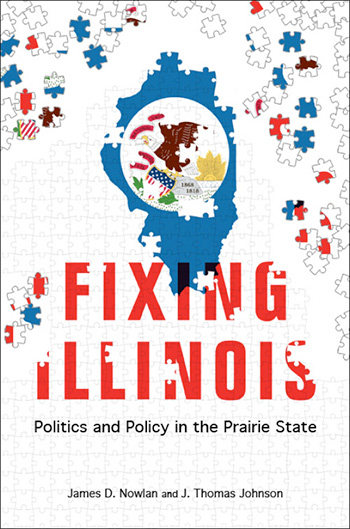 To say Illinois is in a broken state and needs fixing is to state the obvious. The state has a
  A coalition of groups throughout the state has announced the creation of the campaign
 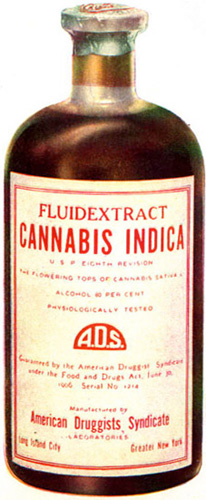 House Bill 1 may not be the top priority for the General Assembly when it comes to passing legislation before the summer recess, but it's on its way to Gov. Pat Quinn's desk and, with it, medicinal marijuana appears to be on its way to legalization in Illinois.
 If you're registered to vote in Chicago, you won't just be selecting candidates. In addition to national, state and local office holders, you will also directly vote on at least four ballot measures: one that could alter the state constitution, one that could lower your monthly electric bill, and two non-binding, advisory votes of debatable significance. Depending on where you are registered in Chicago, you may even get to vote on additional neighborhood-specific questions.
 "Do you want a beer?" Rebecca Reynolds, campaign manger for Will Guzzardi, shouted at me from across the back room of Cole's bar on Milwaukee Avenue. "I usually buy so many beers for people during a campaign, but I haven't this time. I need to catch up!" Last week, 20 days before Election Day, the Guzzardi campaign, an agile, grass roots operation that is fighting for its life against the Berrios family and the Chicago machine, held one of its final fundraisers. Between the craft brews and the Guzzardi supporter wearing magenta velvet, a campaign button and stilts, the mood could best be described as jubilant.