Gapers Block published from April 22, 2003 to Jan. 1, 2016. The site will remain up in archive form. Please visit Third Coast Review, a new site by several GB alumni. ✶ Thank you for your readership and contributions. ✶
A downstate lawsuit filed shortly before Thanksgiving sums up what's wrong with Illinois government right now. Hitting local radar via a press release suggesting an action by SEIU Healthcare, the request for a temporary restraining order against the State was brought by more than a dozen public employee unions, including lead plaintiff AFSCME Council 31, nurses, and police officers, over the State of Illinois's failure to pay for health insurance for state employees.
The suit may have been overlooked here due to more sensational events, or because lawsuits against the State over its fiscal mess are no longer news; half a dozen have been filed, and court orders are part of how Illinois keeps spending money despite no budget in place. However, unusual in this case is the judge's language used in granting a TRO. In his order, Judge LeChien wrote on Nov. 25 that the inability of "the Governor and the General Assembly to perform duties makes essential services and assistance headed for a chaotic bust." The court charged both the executive and legislative branches of Illinois government with adopting a "fiddling while Rome burns posture" that forces the courts to act.
Earlier this month, fast food workers in the Fight for $15 walked off their jobs in 150 cities throughout the country. Here in Chicago, workers at McDonald's, Taco Bell and more left work and engaged in civil disobedience in front of the McDonald's at 87th and State Street. Nineteen protestors were arrested, and they were joined by figures such as State Representative Luis Gutierrez and U.S. Representative Jan Schakowsky.
Fight for $15 is a national movement of workers in the service sector, mostly in the fast food industry. Their main demands are a $15 minimum wage and the right to form a union.
For six months in Chicago, there may be a rare, once-a-decade opportunity to get some answers. If that sentence seems magniloquent, that's because I had to start big since the subsequent sentence is, "That opportunity is the 2015 Chicago municipal elections."
That opportunity is the 2015 Chicago municipal elections. Chicago is defined by confluence; in the first instance, literally, as sitting at the confluence of Lake Michigan, the Chicago River, and the Chicago Portage, the connection between the Great Lakes and Mississippi watersheds. Soon after, the nation's railroad flowed together there; now, it's the confluence of the nation's air travel and trucking. Today, it is also a confluence of some of the country's biggest challenges.
Income inequality, gentrification, rising housing costs, under-resourced schools and creeping privatization, under-served mental health services, police brutality, street crime, segregation, environmental justice, exploitation of undocumented workers, police militarization, un- and under-compensated care work, wage theft, unemployment, over-crowded jails, hyper-criminalization, lack of government transparency, and crumbling infrastructure. These issues intersect on the orange-lit streets of the Great American City. Chicago is a beautiful city and livable city. It is also suffering.
The term "sex worker" is a very broad one as it refers to anyone who works in some sort of industry related to sex. This includes prostitutes, escorts, professional dominatrixes, porn performers, burlesque performers, phone sex operators, strippers and go-go dancers. This is a catch-all term for the people who work in this industry.
It is important, before proceeding, to understand just how broad the term sex worker is to cover all of the people who work in that industry. It's also worth understanding that it's not just women who are sex workers; there are also men and people who identify as trans* who are sex workers, even though the dialogue about the industry seems to usually focus on just women.
In a precedent-setting decision, the National Labor Relations Board in Chicago ruled Wednesday that college athletes who receive scholarships to play for private universities qualify as employees under the National Labor Relations Act and have the right to unionize.
Emma Bell Bern and Joanna Rudenborg, labor organizers with Peet's Workers Group, came out to the picket line Tuesday in solidarity with UIC faculty. (Photo/Emily Brosious)
This two-day walkout marks the first faculty strike in UIC's history.
UICUF said it has been trying to bargain for a fair and equitable contract with the board for over a year-and-a-half but has not seen progress on key issues such as living wages, multi-year contracts and a system of promotion for non-tenure track faculty.
Members of Northwestern University's football team are seeking to form the first ever college-athlete labor union, potentially signaling a major shift in college sports.
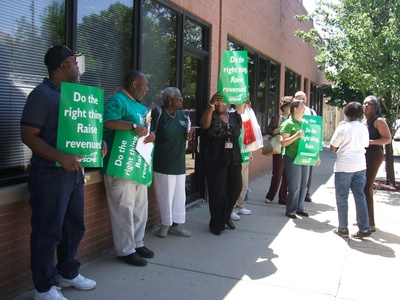
Petitions were delivered on Monday to the Chicago Board of Elections in order to place a non-binding referendum on the March ballot that would encourage companies to raise the minimum wage to $15 an hour.
The referendum would only affect business that make $50 million a year, according to a press release from Raise Chicago Coalition.
The current minimum wage in Illinois is $8.25 an hour, one dollar higher than the national minimum wage.
Chicago Whole Foods workers call for Thanksgiving off. (Photo/Emily Brosious)
Dozens of workers and organizers protested outside Whole Foods Market in Boystown on Wednesday evening as part of a day-long strike calling for fair labor practices including fair scheduling with a day off for Thanksgiving.
Striking Whole Foods workers were joined by members of the Workers Organizing Committee of Chicago, OUR Walmart and other citizens concerned about what they see as an increasing number of retail shops choosing to stay open during Thanksgiving.
Rail Service workers at Bedford Park-based Mobile Rail Solutions walked off the job this past week and are picketing at Union Pacific's Global 1 location in Chicago to protest recent firings, which organizers say were motivated by the workers' push to unionize.
According to Chicago IWW, from July 26 through July 29, management at Mobile Rail Solutions, which operates specialized trucks to service locomotives in rail yards around the city, illegally fired three workers and is threatening more firings in retaliation for workers' active unionizing efforts and recent OSHA filings.
The Hyatt Hotel Corporation has been under fire for its unethical employment practices, firing housekeeping staff and replacing them with low-wage workers, relying on temp agencies, and dropping workers who take their lawsuits to court. Additionally, the housekeeping and maintenance staff experienced labor abuses with heavy shift loads and an array of hazardous duties that ranked Hyatt workers with the highest percentage of injuries among hotel companies. The resolution hopes to bring an end to wage abuse, mistreatment of workers and accountability for the Hyatt Corporation. According to a UNITE HERE spokesperson, "In the long struggle folks have been without a contract for four years. Now we are just focused on moving forward."
The recent agreement will lay the foundation for a productive partnership that includes wage increases and a more generous benefits package that will be in effect until 2018. Employees are hoping for "substantial back pay, quality healthcare and pension benefits," says the UNITE HERE spokesperson. The contact includes Hyatt locations in Chicago, San Francisco, Los Angeles and Honolulu.
CPS principals and assistant principals accused of falsifying information to qualify students for free or reduced lunches after internal investigation. [Joel Hood, Chicago Tribune]
Local governments are feeling out how to enforce "Green" and LEED standards in the courts. [SSRN Papers]
Union janitors protest granting of contract to firm that laid them off last night at Mayor's Office, push for ordinance to hold contractors accountable. [Progress Illinois]
The President's "Midwestern Problem." [Whet Moser]
The media is reporting, occasionally breathlessly, on the "standoff" and "contest" between the Board of Education--a proxy for the Mayor, who appoints it and controls it--and the Chicago Teachers Union, the democratically-elected collective bargaining representative for 24,000 public school teachers.
I watched an interesting debate over the weekend unfold on Twitter between a young academic in education policy and an award-winning teacher and activist. They were arguing about the supposed intractability of teachers and parents over the pro-privatization reforms of groups like Stand for Children and Democrats for Education Reform (DFER). The academic was striking a "reasonable" pose:
You're going to have to compromise. That's politics. There are two sides with competing goals, let's get an agreement.
On Saturday, June 2, Noemi Hernández led a group of over 30 community supporters to confront her former employer at Gislex Bridal, located in the Little Village Discount Mall. Noemi is a member of the Arise Chicago Worker Center who first came to the center with concerns about working conditions at the bridal shop. After talking with Worker Center organizers, they discovered she was owed over $9,700 in wages from her 10 months working at Gislex. Because the store's owner pays its workers $55-60 per day for a 10 hour shift, five days a week, Noemi was earning about $6 per hour, far below the $8.25 minimum wage in Illinois, and no overtime. After Noemi presented a letter from Arise expressing concern about the wages and working conditions at Gislex, the employer fired her. The owner, Maribel Flores, has refused to meet and has not returned phone calls from Arise, prompting Noemi and the Worker Center to hold a more creative action to get the employer's attention.
A bit about Chicago's teachers voting to authorize a strike should talks with the Chicago Public Schools (CPS) break down:
First, a strike authorization is not a call for a strike. Unions are, by statute and traditionally, democratic institutions. Leadership is elected and by-laws approved by the membership. Some organizational decisions require a direct vote by membership (e.g., election of the union leadership) and some through representative bodies--in the case of the Chicago Teachers Union (CTU), the House of Delegates, composed of delegates elected by members. Because public sector employees are not covered by federal labor law, they are regulated by state laws. So state statutes give public sector workers the right to organize and determine the rules by which they operate. Thus, members delegate authority to the union leadership and other bodies--for example, negotiations are conducted by a negotiation committed chosen by the membership. Similarly, the membership delegates authority to call a strike action by vote. That is what happened; the membership voted to permit leadership to call a strike should one become necessary.
Chicago's teachers voted nearly unanimously to permit a strike should negotiations fail. Ninety-two percent of members voted, and ninety percent of members (but ninety-eight percent of those voting) expressed support for a strike should one be necessary. The analog would be Congress voting to give the President authority to conclude a trade treaty (called "fast-track") without having to return to Congress for ultimate approval; except the strike authorization was more democratic, since all members were permitted to vote.
Beginning today, over 20,000 Chicago teachers will vote on whether or not to authorize their bargaining committee to call for a strike should negotiations with the Board of Education over new contract terms fail. For authorization, 75% of non-retiree union members would need to approve. The voting takes place over three days. This high threshold is the result of legislation passed last year. As state public employees, teachers' collective bargaining rights and terms are governed by state, rather than federal, law.
The legislation in question, known as SB7, was passed after intense and stealth lobbying efforts by Stand for Children, a well-funded non-profit that operates at the state level to encourage entrepreneurial changes to public education that incrementally privatize school systems. Stand for Children co-founder Jonah Edelman famously bragged at a conference that they used access to important and influential political figures like Rahm Emanuel and Michael Madigan, and insiders like Jo Anderson to tighten restrictions on the Chicago Teachers Union. Part of the strategy was to take away one of the union's more potent tools, the strike threat. Unable to take away the right to a work stoppage, Stand settled for a 75% approval threshold.
Now, it is looking like Stand's strategy might backfire, if teachers ultimately vote to authorize a strike. After all, the question teachers will vote on is whether to authorize a strike, not whether to go on strike. Arguably, winning an authorization vote by 50%+1 would not be a real show of strength. A significant portion of teachers would have expressed their opposition to a strike, and maintaining the strike, once called, would be exceedingly difficult. The organizational capacity teachers build by being forced to get over 75% means a resilient strike, should things come to that, and a battle-tempered organization prepared to push hard during negotiations.
Besides the mechanics of it, there are the underlying social conditions that are bringing this to a head.
Matt Farmer, local activist, musician, attorney, columnist and LSC member, spoke at the CTU rally last week with an interesting conceit: subjecting Board of Education member (and big time Barack Obama fundraiser) Penny Pritzker to a withering mock cross examination. Farmer, like many CPS parents, is incensed at the double standard deployed by the city's elite leadership when it comes to what their kids deserve and what working class children deserve. Watch:
Last Wednesday, the Chicago Teachers Union held a rally in preparation for contract negotiations beginning later this summer. Karen GJ Lewis, who was elected president of the CTU in 2010 after a hard-fought, close election against the incumbent, mayor-friendly leadership, sums up the frustrations teachers feel as they've been made scapegoats by school-privatization special interests like Stand for Children.
Last year, Stand for Children and affiliated interest groups pushed through SB7, designed to restrict collective bargaining rights and weaken teachers' negotiating position. Part of that strategic attack on public school teachers was a requirement that 75 percent of union members vote to authorize a strike should contract talks fail.
Nearly 6,000 members of the approximately 25,000 member union showed up to the rally on Wednesday, and as the video below shows, they were fired up. That 30 percent of union members could be motivated to turn out, march, and rally to show their unity should have been a chilling image for the Mayor's contract bargaining team. If talks fail, the CTU may very well have the leadership in schools across the city to secure a strike authorization vote; and if 75 percent of teachers vote for a strike, that will be a resilient strike.
Despite the recent announcement that the G8 summit will be held at Camp David, not Chicago, the city can still expect protesters to descend for the NATO summit being held May 20-21.
Since history tends to be instructive, its lessons bear repeating.
"We often forget the connection to history," said Tracy Baim, who knows very well how the city of Chicago handled protests over 100 years ago. "We're still fighting a lot of the same battles."
Baim is the daughter of Joy Darrow — related through marriage to Clarence Darrow, the crusading "attorney for the damned" in such controversial cases as the Scopes Monkey Trial and the Leopold and Loeb murder case. In 1902, Darrow eulogized former Illinois governor John P. Altgeld as "a soldier in the everlasting struggle of the human race for liberty and justice on earth."
Altgeld, since hailed as one of Illinois' most progressive governors, was once reviled as John "Pardon" Altgeld for pardoning, in 1893, the three surviving prisoners sentenced to death for Chicago's Haymarket bombing. Altgeld was widely vilified and his decision effectively ended his political career, a choice that perhaps represents a moment of integrity triumphing over political expedience.
There was quite the hullabaloo this week surrounding a Facebook town hall meeting Mayor Emanuel put on Monday. Late Sunday night I received an email from a teacher at a neighborhood CPS high school saying that the event was happening at that school and they needed enough teachers, parents, and community members to show up. Any interested teachers were told to RSVP immediately. Here's what was in the original e-mail:
A spokesman in the department of communications at CPS contacted me to request hosting Mayor Emanuel's Town Hall Meeting Monday, January 23rd at 5:30 PM at [Name of High School]. A condition and concern however is that there must be a minimum of 15 or 20 people in the audience. The audience should include teachers, parents, students and members of the community. This email serves as a poll to determine how many of you might commit to attending this event. I also need your support to communicate this event to students who might be interested in participating. I am copying the LSC and PAC officers to soli cit parental attendance.
I ask that everyone receiving this email who can commit to attending this event email a confirmation back to me ASAP. You do not need to email me if you cannot attend.
Many concerned teachers jumped at the chance to join in a conversation in a relatively small venue where we could question our city's leader about his controversial education policy. People began mobilizing immediately. It seemed like a fantastic opportunity, almost too good to be true.
It was. Very early Sunday morning, a follow-up email was sent saying:
There has been a huge misunderstanding. Mayor Emanuel WILL NOT be physically present at [Name of High School] for his town hall meeting today. The event will be streamed over the internet. Individuals interested in attending this view only event are welcome to view the event in one of our computer labs. Please see the message below from the CPS department of communications spokesperson.
I recently discovered that my alma mater, New Trier High School, did not make AYP (Annual Yearly Progress) mandated by the No Child Left Behind (NCLB) Act this year. (See here for the letter sent home to parents). Yeah, that New Trier. The one with all the awards, the trophies, the students going on to Ivy League schools, and the highest SAT/ACT scores in all of Illinois for open-enrollment schools. It's the same school where all those kids from Chicago protested in front of a few years back with Rev Meeks to highlight the unfair school funding practices in Illinois. It's the one written about in the infamous book (and still an enthralling read 20 years later) by Jonathan Kozol, Savage Inequalities. It's produced some big shots like Donald Rumsfeld (sorry about that one, world.)
Oh, and Happy Birthday NCLB! You just turned 10 this past Sunday. Now the only question is... when will you die? Because NCLB has proven to be a failure of epic proportions. Quite a few articles have come out to commiserate, oops, I mean commemorate, the occasion including Fairtest.org's NCLB Lost Decade Report, and this Wapo piece by Valerie Strauss, and this blog by education great Diane Ravitch.
As a little bit of background, the No Child Left Behind act was signed into law back in January of 2002 and was the first major piece of legislation to come through Congress after the 9/11 attacks. Looking back, many Congressmen admit they probably wouldn't have agreed to the bill, on either side of the aisle, if they weren't focusing so hard on appearing united after the terrible events that past September. (In many respects, the passing of NCLB was Shock Doctrine at its finest.) The act itself set a timeline to hold schools "accountable" by testing grades 3-8 every year and punishing schools that did not meet their AYP. The punishment generally involved withholding much-needed federal funds, and after a certain number of years on probation, the school would be eligible for disciplinary actions such as firing all the staff, handing the management of the school over to a private charter school operator, or closing down the school. (Starting to sound familiar Chicagoans?)
I am not a gambler. I hate the uncertainty of betting money on something unpredictable. It makes me feel jittery and off-balance. I have a teacher personality in that respect. I like structure and routine. That is different from say some day trader who takes risks on a daily basis. I'm sure those Type A, go-getter-guys are really good at those risky, high-profile jobs. Some people thrive on uncertainty and the chance to make it big. Kinda like they like cocaine. Same chemical in the brain, no?
I don't work that way. And you know what? Thank god I don't! That's the reason why I chose teaching as a profession, at least in part. See, some of what makes me good at my job is that I provide a little space of stability for my students coming from chaotic, troubled backgrounds. If one of those day traders were to do my job, I'm pretty sure they would not only fail miserably, they would probably scare the children.
Recently, in Chicagoland, a story hit the papers about a teacher committing suicide. She wrote in her suicide note that the major reason for this drastic act was work-related. According to her colleagues, this woman took her own life because of the bullying and fear she experienced at her school.
As I discussed this event with a friend who is a current CPS teacher, he mentioned that in the comments section of the article many non-educators were shocked and horrified at this tragic happening but were also quick to assume that the woman must have been "soft" or had some kind of underlying mental health problem. But, he quipped, when many CPS teachers heard about the incident, they just shook their heads and said, "Yeah, I can see that happening."
Truth is, so could I. When I think back to my measly one year of teaching at a horribly-run CPS elementary school, I can very easily imagine that scenario unfolding with a number of my colleagues and yes, even with myself.
I am one of 300 Chicagoans going to Washington for a three-day convergence of thousands of people from across the country called "Take Back the Capitol." We will bring the power of the people to bear on Capitol Hill to say that the time has come for Congress to start representing the 99 percent of Americans -- We the People -- not just the richest 1 percent in the country.
The U.S. House of Representatives, after all, is supposed to be The People's House. But millions of people are out of work, wages are in steep decline, and income inequality is at its worst since the 1920s. And what is Congress doing in the face of this suffering? Failing to pass a jobs bill that would put people back to work. Meanwhile, Wall Street and K Street exert more influence over our elected representatives than ever.
Peter Eichstaedt can't help it. He has to write about what everyone else ignores.
Over the next couple days, he'll be promoting two of his recent books through discussions at the University of Chicago (details below). Both touch upon "humanitarian disasters" that, despite their toll on human life, go largely unnoticed by the media. One of these books, Consuming the Congo: War and Conflict Minerals in the World's Deadliest Place, ultimately began with his time working for the Uganda Radio network and the Institute of War and Peace Reporting.
"The daily news media focus only on the event of the day, and rarely any context. Why is something happening? As if things happen in a vacuum. It's not that difficult, truly, to put a couple of paragraphs or sentences about background in some of these stories but most news reporters don't."
When confronted by the fighting he found in Uganda, he realized he was on his own in finding out what was going on. What he learned was that, although a relatively low percentage of the world's supply of some minerals necessary for our most necessary and addictive technology (cell phones, laptops, etc.) comes from eastern Congo, this region has suffered a staggering human cost: the greatest loss of life since World War II.
Consuming the Congo painstakingly details the ins and outs of the tribal conflicts in the region, the flight over minerals, and the complicity of not only the corrupt Congolese government, but of all those who have allowed this tragedy to continue.
Details:
Consuming the Congo — discussion, book-signing, Q & A
Friday, 4 November, noon-1:30pm.
Pick Hall Lounge
University of Chicago
5828 S. University Avenue
Pirate State: Inside Somalia's Terrorism at Sea — discussion, book-signing, Q & A
Thursday, 3 November, 6-7:30pm
International House
University of Chicago
1414 E. 59th Street
For additional information click here, or email jbender@uchicago.edu.
The Chicago Teachers Union has filed suit before the Illinois Education Labor Relations Board requesting injunctive relief to stop the Board of Education from conducting school-by-school "elections" to lengthen school days.
Specifically, the suit alleges that the Board, which is teachers' employer, is committing unfair labor practices in egregiously violating their contract with the districts 30,000 teachers.
Specifically, working conditions and wages and pay are supposed to be negotiated by the teachers' collectively and their employer. Since both sides are subject to the contract, it would be inappropriate for either side to try to negotiate such a condition on an individual basis.
Today begins a week-long strike for employees of the Hyatt hotel chain, in Chicago as well as Los Angeles, San Francisco, and Honolulu.
These workers, who have been without a union contract for two years, allege that Hyatt is particular among hotel chains for its unfair treatment of laborers. Union president Henry Tamarin was quoted as saying that "Hyatt is one of the most abusive hotels in their treatment of housekeepers and has the worst record on subcontracting."
In addition to decrying the outsourcing of jobs to agencies that will provide laborers who will work for even less pay, the housekeepers cite the American Journal of Industrial Medicine to support their claim that Hyatt mistreats its workers.
While this may be the initial strike scheduled to last a week, it wasn't the first altogether. A brief picket in July turned ugly when the hotel switched on 10 heating lamps. Located under the awning to warm guests in the winter, on July 21st they instead heated up already hot picketers on a sweltering day (heat index 109 F).
Although Hyatt spokesman Farley Kern claimed that "Unite Here regularly engages in extreme rhetoric and gamesmanship during contract negotiations. This dishonest attempt to misrepresent the work environment in our properties is well over the line," the action of whoever turned on the heat lamps — and of those who chose to leave them on only until they realized the media was picking up on it — speaks to the contrary.
On August 25, Saint Francis Hospital in Evanston was fined $23,800 by the Occupational Safety and Health Administration (OSHA) for employees being exposed to patient blood.
According to Robert Malgieri, spokesman for HEART/AFSCME, the employees at St. Francis Hospital contacted OSHA due to their own concern for employee safety.
The 13-page complaint issued by OSHA states that St. Francis has failed to inform housekeeping staff of tasks that would result in exposure to bloodborne pathogens, have materials for bloodborne pathogen training in an appropriate language for the employees, explain what would be the plan for St. Francis Hospital if an employee was exposed to bloodborne pathogens, failed to explain what tasks would result in possible exposure to bloodborne pathogens, did not tell staff of methods that could prevent exposure, and that employees were not given a session to ask questions during the bloodborne pathogens training session.
Bloodborne pathogens include the Hepatitis B virus, Hepatitis C virus, and HIV as well as viral hemorrhagic fevers such as Ebola and Lassa fever.
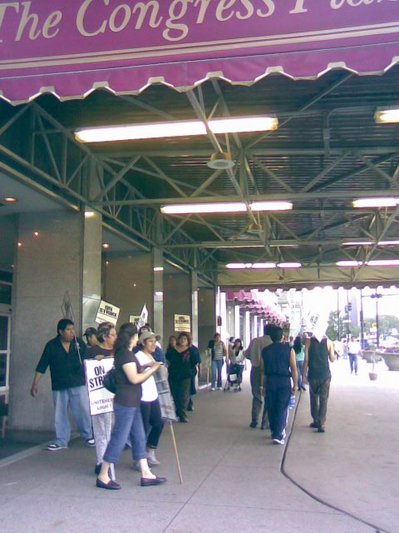
I did not know where I wanted to go with the story on the Congress Hotel strike when I first started doing some research. I knew it had been eight years, strikers are typically still on the picket line and little of the negotiations are known. I wanted to treat it more as a piece of objective journalism instead of throwing my opinion around as I tend to do. So if you could follow me below I will divert and offer it here.
Two GB alums, Richard Lorenc formerly of the Illinois Policy Institute and Kenzo Shibata of the Chicago Teachers Union, squared off at the Bughouse Square debates this past weekend. The question was, "Should public employees have collective bargaining rights?" Both did extremely well. I'm proud to call both men friends. Enjoy.
Service Employees International Union (SEIU) Local 73 President Christine Boardman had harsh words to say about Mayor Emanuel, calling him a liar and his claims that he is working with labor leaders to find solutions to the city's stubborn budget deficit. According to a report by Dan Mihalopoulos in the Chicago News Cooperative, Boardman accused the Mayor of "spinning the press like crazy," and "not telling the truth," about his cooperative attitude towards labor, characterizing his rhetoric as "B.S." B.S. is American slang for "bullshit" by the way.
Quite an accusation; it certainly tracks with previous reports about Emanuel's general approach to labor relations, which amounts to "there's a new sheriff in town," along with "the art of media control." Taking the long view, it also jives with Emanuel's having reportedly encouraged the administration to "Fuck the U.A.W.," during the auto bailout and engineering the passage of the labor-hollowing NAFTA bill in 1993.
The local media has been characterizing Emanuel's approach as "getting tough" on labor. But of course, this is a non sequitor. Mayor Daley was hardly friendly to labor, particularly over the last ten years, with the exception of some of the building trades. The city labor force has declined by about 6,000 since 2002. The Mayor race-baited labor unions during the Wal-Mart fight and poured enormous effort into undermining the teachers' union. Unions are on their heels across the country and had little clout under Daley and even less under Emanuel.
Boardman's accusations may just be a function of her frustration rather than an accurate accounting of Mayor Emanuel's approach to public employees. The totality of his record on labor relations--an economic and social issue, not solely a political issue--should not just be ignored, as though it has no bearing or provides no context. Emanuel has a record of targeting labor as a political foe to be dictated to, not a potential partner or constituency with legitimate policy concerns.
On Monday afternoon, union members joined with community members outside of Doña Mari #2 in Albany Park to protest stolen wages. Miguel Brito, a butcher at the grocer for 16 years, was paid below the minimum wage for many of the years he worked at the grocery store and is trying to receive the past three years of stolen wages, an amount that is $7,570 total. Brito is longer employed at Doña Mari.
As people marched outside of the store, carrying signs saying "Alto a los Abusos," which translates to "Stop the abuse," and holding large cardboard and aluminum foil butcher knives with signs saying "Stop chopping wages," some community members walked around the circle and continued their day, others tried to get into the store.
During the course of the protest, Doña Mari #2 had its open sign lit and most of the lights in the store appeared to be on, although the door was locked and it seemed as though no one was in there.
The goal of the protest, according to Adam Kader, program director for Arise Chicago, is to make progress in Brito's wages being paid back. Wage theft is illegal and employers can face penalties for not paying their employees their full-wages, including overtime. In addition to being paid below the minimum wage, Brito was not paid for overtime. According to Kader a Department of Labor claim will not be filed and all of Brito's stolen wages are not being asked to be paid back, only three years worth. Kader explained that to request all of the stolen wages to be paid back would slow down the process and require legal action.
Chicago's enormous structural budget deficit, which could reach $700 million next year, is due in part to the cratering of the economy, particularly the free fall of revenue from real estate-related taxes and fees. But it is also due to the symbiotic lack of political will by politicians and political appetite by voters (and interest groups) to make painful decisions to meet the problem. The problem, by the way, is obvious: the city (you and me, the people who live in the city, not the abstract City) made promises to our employees--particularly our public safety employees, cops and firefighters--that our revenue simply cannot meet, and will not be able to meet without tax increases as well as cuts and reforms.
According to the Civic Federation, the city has a $14.6 billion dollar pension liability that is unfunded. To meet this liability, the city can rededicate revenue committed elsewhere to pension funding, raise contributions from current employees and decrease future benefits or eliminate cost of living adjustments, raise taxes, particularly property taxes, or some combination thereof. Solely raising taxes, particularly property taxes, would be politically unpalatable as well as eventually regressive--renters are already beginning to feel a squeeze. If we want to meet our obligations, some reasonable and fair combination of reform of the pension system, rededication of existing revenue (i.e., cuts to services in one place to pay for liabilities), and increasing revenue is necessary.
Yet the focus by the city to date has been almost wholly on "reforming work rules," in other words altering public worker contracts. Such reforms may very well be necessary, but they alone will not put a significant dent in the structural deficit. Mayor Emanuel and his team know full well that even with history's most efficient city government and not a single unionized employee, we would not be able to meet our obligations. Chicago News Coop columnist James Warren astutely observed that this is the strategy is meant to make future potentially unpopular actions--i.e., revenue increases--more palatable. If the Mayor also stokes unwarranted hysteria about thieving public employees, so be it.
The City's budget rests on several revenue streams. In descending order of quantity, the most significant of these are sales taxes, utilities taxes, the "personal property replacement tax" (a convoluted tax that boils down to a corporate income tax), transportation and recreation taxes, and business taxes. Licenses and fees provide a significant chunk, as do--or rather, did--income from parking meters.
Between 2007 and 2010, these revenue streams declined immensely, the biggest being the transaction tax, which is mostly a real estate transaction tax, which declined by over 40%, or $120 million, in that time. To make up these shortfalls, Mayor Daley recklessly privatized city assets. These privatization schemes (and they were schemes) amounted to little more than major borrowing programs that take up-front payments to compensate for revenue shocks. In an interview with the Chicago Tribune, University of Chicago Professor Julie Roin characterized the supposedly bold privatization moves this way,
"Politicians are calling these deals privatizations, but what they really are is secured loans....Whether you collect the revenue and pay it out to creditors or just divert the income stream to begin with is just inconsequential in terms of the financial ramifications of the transactions."
Chicago News Cooperative's James Warren's editorial, "Warren: Rahm Exercising Art of Media Control" is not what you'd expect it to be. Or rather, was not what I expected it to be. When I see a headline like that in my reader, attributed to a well respected journalist, I expect it to be a critique. It's not; it's praise. Why would a member of the media praise a politician for controlling (really he means manipulating) the media? I'm not certain. From what I can glean, it is because Mayor Emanuel's use of this "art" will help him slay the "monsters," i.e., city workers' retirement money, et al.
Mr. Warren in his own words:
Chicago's Jardine Water Purification Plant, the world's largest filtration facility, helped make something crystal clear last week about the heat-seeking missile known as Mayor Rahm Emanuel: The Missile is playing a confidence game, all puns intended.
In response to an announcement on July 1 that state employees would not receive the 4 percent raise promised in their contract, the American Federation of State, County and Municipal Employees Council 31 has filed a federal suit saying that the withholding of the wage increases violates federal and state constitution provisions that bar against contract violation. According to WBEZ, Gov. Quinn said on Tuesday that the raises are not being given because the General Assembly did not appropriate the funds for the raises. However, the complaint also points out that Gov. Quinn cut $376 million from the budget through line-item veto and could have done something about the funds for raises. In the past, AFSCME has worked with the state to figure out how to deal with the budget crisis, salaries and employment for state employees.
Meanwhile, in Chicago, the Chicago Board of Education voted unanimously in June to rescind the 4 percent wage increases promised to teachers and staff members in their contracts and it was announced yesterday that CPS principals and assistant principals would also not receive their scheduled pay raise. (CPS principals and assistant principals are not unionized.) The contracts for both groups expire in 2012. With both agencies, there are large budget deficits--$715 million for CPS, $13 billion for the State of Illinois--but both unions have cited flaws with the budgets that are not allowing for their raises.
While AFSCME's lawsuit is waiting in court, CTU, along with Service Employees International Union Local 7 and 73, International Union of Operating Engineers Local 143 and 143b, UNITE HERE Local 1, International Brotherhood of Teamsters Local 700 and International Brotherhood of Electrical Workers Local 143 are waiting to schedule a meeting with the Board of Education to discuss negotiations, according to CTU spokeswoman Liz Brown. The two stories here seem to have a connection.
Illinois is tied for the third highest minimum wage in the country, only outdone by Oregon and Washington, despite that advocates are calling for an increase is a stagnant economy.
A coalition of organizations are calling upon elected leaders to pass legislation to increase the minimum wage one year after the bump up to $8.25 per hour. Working 40 hours a week for 52 weeks equates to a $17,160 salary - without taking time off.
In our work at Arise Chicago, we’ve lately noticed a dangerous new trend: employers are forcing employees to work as contractors, in order to subvert labor laws and their responsibility as employers.
Campaign #1
Margarita (pseudonym) worked for 2 years at a laundromat in the Albany Park neighborhood. She was paid $5/hour, worked over 40 hours a week but never received overtime payment, and worked seven days per week. When Arise contacted her employer to inform him of his legal responsibility to pay employees minimum wage and overtime, and to give employees one day of rest per week, he tried to shirk responsibility by claiming that Margarita was actually an independent contractor. Since Margarita could not make her own schedule, perform her work autonomously, nor bid out the work (the basic marks of a truly independent contractor), this defense was fairly preposterous. However, we are seeing a rise in savvy employers who force employees to sign contracts and incorporate, all for the privilege of toiling day in and day out for the same abusive employer, often at rates below minimum wage, and outside of the jurisdiction of OSHA, the Department of Labor’s Wage and Hour Division, and the other government agencies that enforce workers’ rights.
Recently Arise Chicago Worker Center Organizer & occasional GB contributor Jacob Lesniewski spoke about the rights of immigrant workers on Chicago Public Radio’s Worldview Show. Listen to the full episode here.
Today we'll reflect on May Day issues with a conversation rooted in the rights of migrant workers who cross our southern border.
Jacob Lesniewski is a doctoral candidate at the University of Chicago School of Social Service Administration. His research focuses on improving work conditions for immigrant and other low-wage workers. He's also an organizer for the group Arise Chicago, an Interfaith group focused on worker issues. And Oscar Chacon is Executive Director of the National Alliance of Latin American & Caribbean Communities knows as (NALACC). Oscar's dedicated to the pursuit of social and economic justice across borders, for migrant communities. Both participated last month in a conference at the University of Chicago titled, "Migrant Rights in an Era of Globalization: The Mexico-U.S. Case."
Sometimes a potential campaign at Arise Chicago reaches legal obstacles, an evasive employer, or incomplete evidence.
Alfredo and Rev. Marich
And sometimes, it all comes together Hannibal Smith from the A-Team style. Arise Chicago’s latest action to improve conditions of work in the carwash industry on Monday, February 28th was one of those moments when it all came together. Car wash worker Alfredo led a delegation of allies, including IBEW Local 134 member and Arise volunteer Denise Sebo, Ted Sautter and two brothers from the United Steel Workers, two Arise Chicago Worker Center members and staff to Four Seasons Carwash at 5900 W. Addison in Chicago. Alfredo joined the Worker Center because he was owed two weeks’ worth of wages and decided to take action.
After the “A – Team” leafleted and spoke to both workers and customers, the owner came, angrily demanding we move to the sidewalk, attempting to intimidate union allies taking pictures, and attempting to negotiate only with Adam, Worker Center Director. And then he caved, but not before attempting one last hail mary, that was quickly deflected by legal advisory board member Amy Epton and Rev. Claire Marich of Downers Grove, who is rapidly becoming the Mother Jones of carwash workers in Chicago. Rev. Marich states, "The work you do at Arise is so important and I am pleased to be a small part of it. It uses my chaplain skills of reading people in crisis situation, so I am beginning to understand it as a really exciting extension of my ministry." Alfredo says, “Bosses can’t abuse their workers.” He wishes for other workers to overcome fear to act and believes that his experience shows that. ”Si se puede.”
Indeed.
It couldn’t have worked out better. A worker taking action for justice. Religious allies. Worker members of Arise Chicago. Allies from the legal community. Union members.
This is what a movement looks like...
Alfredo joined by supporters at the car wash
- Jacob is an Organizer at Arise Chicago
This post is cross-posted from the Dignity at Work Blog a project of ARISE Worker Center.
This article was submitted by Michael Volpe. For his piece on a deadly South Side blaze, see here.
When protests turned into riots in Greece in response to necessary austerity measures many commentators in the USA said chaos wouldn't happen here when our own budgets would inevitably cut. Yet, passions have been enflamed in all corners to prospective budget cuts. Friday, the scene was at the Daley Plaza as organizers lead by the anti eviction campaign protested proposed cuts by the Department of Housing and Urban Development (HUD).
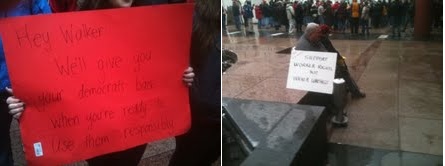
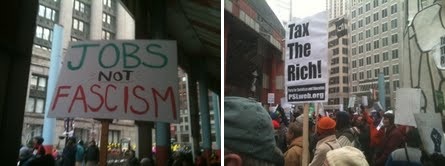
Saturday, the scene moved to the John Thompson Center where Chicago played host to one of dozens of union lead protests all protesting the plan of newly elected Wisconsin Republican Governor Scott Walker to cut most public employees benefits and limit their future collective bargaining rights. Despite constant snow and twenty degree weather, the crowd of nearly one thousand overflowed the square.
The signs were varied though singular in theme: solidarity, social justice, and anti Scott Walker and Republican party.
Dana Goldstein makes the important point that the public sectors workers targeted by Gov. Walker's union busting and given a reprieve are different on one major characteristic: gender. Firefighters and police offers, left out of the bill are predominantly male, and the teachers and others targeted by Mr. Walker and his Koch brother overlords are largely female. While the solidarity shown by firefighters and police in Wisconsin is pretty impressive, it's a pretty clear cut of sexism, and one that we at Arise Chicago find all too familiar. In our mission to seek justice and improve working conditions for all workers, we accompany union workers in their contract fights, organizing drives or other campaigns. More and more, the unionized workers under attack in this latest attack on are in traditionally female dominated occupations. Here at Arise, we're working with nurses, school teachers, and home health aides. These women (mainly) are fighting for their rights on the job in the face of attacks on their dignity and worth as workers, their commitments to those they service, and their supposed culpability in the financial crisis.
To be clear, it doesn't matter that those who are engaged in attacks on the freedom of association (collective bargaining rights) of women workers would claim that their attacks are unmotivated by sexism or gender bias. What matters are the results: systematic assaults on women in the "helping professions." What matters is that the women in these jobs, jobs which have been traditionally viewed as inferior women's work, were able to grasp a modicum of dignity at work through collective action are now under attack from the slick white puppet masters of propaganda and reaction, putting to rest at last the notion that the battle in Wisconsin, and the upcoming fights in Indiana, Michigan or Ohio have anything to do with fiscal austerity and balanced budgets.
- Jacob is an Organizer for Arise Chicago's Worker Center
This post is cross-posted from the Dignity at Work Blog a project of ARISE Worker Center.
It's pretty bananas. Mother Jones has some excellent background and explanation of what's going on. The bare facts are that Governor Scott Walker has proposed what unions describe as a "draconian" anti-union bill that would end collective bargaining in Wisconsin for public employees. Unions, students, and progressives have freaked out, occupying the capitol and holding continuous protests for over a weak. Everybody agrees--it's a really big deal.
So big, in fact, that many Chicagoans felt the need to put aside their still-aching wounds from the NFC championship game last month and make the trek up north to support the protesting unionists.
Wisconsin is known for being a very pro-labor state, having introduced many crucial labor reforms American workers now taken for granted--including, ironically, the right for public employees to bargain collectively. But Chicago is known as being the American labor city--our city has been the home to scores of epic labor battles, from the Haymarket Massacre in 1886 to the longest strike in the country today at the Congress Hotel. Wisconsin and Chicago both have unionism running in their blood.
Lara Lindh (not her real name) an early childhood education teacher at a public school on the Northwest side of Chicago in her early 30s, speaks slowly and deliberately. Her enunciation is effortlessly precise, as are her hand movements and color coordination. Her white blouse is covered with tiny bouquets of flowers that match the greenish-blue of her eyes and the mustard yellow of her upswept hair. She holds her left hand around her iced tea for the duration of our interview while gesturing, and punctuating, with her right. "Play is the work of children," she says.
Lindh is from Cincinnati and has been teaching for four years. Prior to getting her degree in early childhood education, she was a bartender and a political activist when she realized she wanted to go into a "caring profession." She says she considered becoming a pediatric nurse but went instead into teaching young children -- not entirely surprising for a woman who had a collection of over 6,000 children's storybooks before she even became a teacher. She was trained at Columbia College, one of the few schools in the country which teaches the Reggio Emilia approach, which seeks to build up the values of respect, responsibility and community through exploration and discovery, and Lindh swears by it.
She consistently refers to the students she teaches as "little personalities" or "little people," and on any one day Lindh says she will find herself in a room with up to 20 small personalities who may speak any mixtures of English, Spanish, Arabic or Polish. This explains why one of the books she brings with her to our meeting is The Black Book of Colors, a children's book entirely in black with no words but raised representations of sensations, such as feathers, meant to be experienced not through language but with the touch.
---
I'm lucky to teach in one of the few public schools in Chicago that is also embarking on an exploration of the Reggio approach in their early childhood classrooms but you know we're very limited by a few things that are happening in education. The way early childhood programs in Illinois are funded is through state funding, it's called Preschool for All. Five years ago there was a huge expansion of pre-school because the state was flush with cash, but today since the state budget crisis that's different. Year to year you just don't know if you're going to have a job, if your program is going to be open the next year. So that's how we are funded. We are part of the Chicago public schools so you know our buildings and all of that are supplied through mainstream funding.
As part of an effort to re-brand itself, Loyola University Chicago launched a clever ad campaign in 2006 called "Loyola Values," consisting of bold, simple ads that usually contained no more than one sentence. "It's Always Cooler By the Lake," reads one that can be seen on the sides of CTA buses, referencing the main campus's lakefront location; "Learn to Use Your Ethics As Much As Your Blackberry," implores another posted around campus.
Another can be recited by heart by almost any student activist on campus: "Social Justice Isn't Just for Rock Stars." The implication, of course, is that students should join celebrities in concern with the "least of these," to use a biblical aphorism. Indeed, there is a social justice component in the school's core curriculum, required for every student, and the school has one of the few masters programs in social justice in the country.
Which seems to make it all the more strange to some students that a vital part of the school community, the cafeteria workers, have recently come forward with tales of low wages, prohibitively expensive health insurance, dangerous working conditions, and an atmosphere of intimidation. A recent headline in the school newspaper quoting a cafeteria worker read, "You're talked to as if you're an animal."
As Mark and I are sitting in a Northwest Side coffee shop, the baristas make the unfortunate choice to blare a Black Sabbath album at a volume that makes it difficult for me to hear myself, much less Mark's stories from teaching. But despite the cacophony in the air around us, Mark is unfazed. A young white science teacher, Mark takes teaching in an all-black South Side high school very seriously; when I comment on the deafening roar of the music, he gives me a look that indicates he barely noticed it. He has given the topic of his school and his students his utmost attention--little can break his train of thought.
A native of a northern suburb, Mark went to school at an elite private university out of state, returning home to teach. He was first hired to teach high school in a rich, mostly-white neighborhood, but was pink-slipped; after substitute teaching for a year on the South and West Sides, he was hired at a high school on the South Side, where he now lives. Several times during his tenure as a sub, he taught at schools where a student had been killed the day before.
In his early twenties, he's about as young as a teacher can be. In conversing about his experiences, however, one could easily mistake his seemingly seasoned demeanor for that of an educator with a decade of experience.
Two of us Gapers Block Mechanics section writers were invited to the Chicago premier of Waiting for Superman, by filmmaker Davis Guggenheim. I am not sure if we got our invitations because we write for Mechanics or have blogged about education in other places. Regardless, we thought it might be interesting to post our thoughts on the movie separately.
In order to understand my viewpoint on the movie, I think I should provide some background about myself...
I am a Republican who is in favor of vouchers. I attended public schools though my undergraduate degree (In Dolton, IL for K-12 and then NIU for my BS); my graduate education is from two private universities in the western suburbs (Aurora and Lisle). I have a MS in MIS. I have taught for credit classes (part-time) at the community college level (Introduction to Windows, Introduction to Windows 95) and a database class for credit for the on-line component of The University of Phoenix. I currently work as a computer professional. Finally, because I think it is relevant to the discussion, I grew up in a union household: my dad was a union member and, at one time, the shop steward.
Chicago Math and Science Academy is a charter school on Chicago's far north side neighborhood of Rogers Park, an ethnically and economically diverse community that has struggled to have quality public schools. Community residents were pleased when the charter school was founded in 2004. Its first two graduating classes, in 2009 and 2010, had college acceptance rates of 100 percent.
I vaguely knew about the school because one of my choir members attended and graduated in its 2010 class. She spoke highly of the school and the teachers. She got lots of help from the school in applying for colleges and tuition assistance.
The school loomed larger in my life when it moved last year from its original location to a spot about five houses down from where I live. Chicago Math and Science Academy bought and renovated what had been a run-down shopping area. The renovation is an attractive addition to the neighborhood and I enjoy seeing the children and parents streaming around the school every morning. Although I had been inside the school once, I had never met its leadership or teachers. Nor did I know much about its philosophy. I just knew it was doing a good job. Chicago Math and Science Academy, as its website touts, is one of the top three charter schools in Chicago. It's clearly doing something right for the students and their families. This is clearly the good.
The bad is a function of the failure of the public schools to establish learning environments in which all children can learn. Into this void has entered a collection of for-profit charter schools that are only marginally accountable to local communities. Some would argue that this outside control, without having to mess with community politics, is why they are succeeding. Perhaps. But there is some weirdness here.
Chicago Math and Science Academy is a part of Concept Schools. According to its website, Concept Schools is a management organization founded in 2002 to support and develop charter schools that seek to integrate the best aspect of the Turkish and American educational systems. Concepts Schools have grown from two to 19 schools, of which 16 are in Ohio, and one each in Indiana, Michigan and Illinois. Concept Schools bring in teachers from Turkey, Russia and other European countries to help teach math and sciences. Currently, approximately 25 percent of the faculty are international teachers.
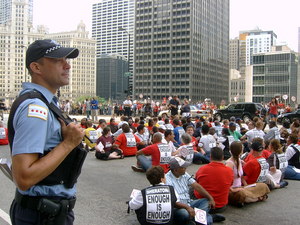
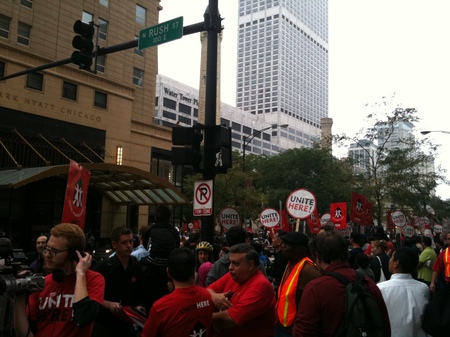
With arms linked and voices raised, some 200 sitting protesters lined a short run of hot pavement along Wacker Drive yesterday afternoon. A police officer used his megaphone to blast the crowd, which was illegally blocking the traffic usually bustling directly in front of the Hyatt Regency Hotel. The demonstrators were taking part in a massive civil disobedience action which occurred simultaneously in fifteen cities across North America. Their purpose was to draw attention to the Hyatt Hotels chain for allegedly forcing layoffs, cutbacks and unfair labor agreements on its employees.
But in a uniquely Chicagoan twist, the demonstration's organizers, a national union called Unite Here that represents over 15,000 hotel and food service workers in Chicago, decided that only 25 protesters would take arrest on Wacker Drive.
The hotel and restaurant workers' union UNITE HERE will be taking to the streets tomorrow, planning a massive civil disobedience in conjunction with other locals from around the country to pressure the Hyatt Hotels to budge on their contract negotiations.
Workers from Local 1, the Chicago branch of the union, and community supporters will be sitting down in traffic at Michigan and Wacker near the Hyatt Hotels corporation's national headquarters at the height of rush hour to protest what they say is unfair treatment of workers in the recession. They will join workers in Vancouver, Honolulu, San Francisco, San Diego, Santa Clara, Miami, Pittsburgh, Long Beach, Indianapolis, San Antonio, Los Angeles, Toronto, Monterey, Boston and Sacramento.
Hotel workers in Chicago have been without a contract since August, 2009, and recent relations have been tense--particularly at the Hyatt. In May, workers at the Hyatt Regency Chicago on Wacker walked off the job in protest of what they say was unfair treatment, including increased workloads and denial of access to union staff by management.
Back in June 2008, when Milwaukee's Miller Brewing Co. (an arm of London-based SABMiller) and Molson Coors Brewing Co. of Golden, CO, merged their US operations to become MillerCoors, Chicago was chosen as the location for the new company's headquarters. The newly formed venture was provided with $6 million in TIF funds to help cover the construction costs of approximately 150,000 sq ft of office space at 250 S. Wacker Dr. In turn, MillerCoors agreed to ensure that at least 325 jobs would be brought to the city within 5 years. When the company finally took possession of their new offices in late June of last year, Mayor Daley, 2nd Ward Alderman Robert Fioretti and MillerCoors CEO Leo Kiely feted the company's bright prospects in their adopted hometown.
A year removed from all those hokey jokes from Mr Kiely (check 2:20 in the vid) and co., it seems that trouble may be brewing between the corporate parent and about 400 workers from the Milwaukee brewing facility still in operation. The workers, represented by United Automobile, Aerospace and Agricultural Implement Workers of America Local 9, are beginning talks with MillerCoors as the current labor contract is set to expire on August 7th. Katie Drews, of Chicago Union News, notes in a recent article that "both sides have kept a tight lip about the process," but that current economic conditions and unaddressed budgetary issues from the merger could affect the outcome of talks.
While mainly all of the jobs brought to Chicago were white-collar positions, MillerCoors continues to operate its breweries all over the country. This is the first labor contract up for renewal since the merger of the two companies.
The American Federation of Teachers had its national convention this weekend. You can follow their proceedings here; it's a critical time for teachers nationally, as the one place liberals and conservatives seem to be agreeing on (if the Obama administration's posture is any guide) is that teachers are the problem and mass firings of experienced teachers is the best solution.
According to the Chicago Teachers Union twitter feed, newly elected President Karen Lewis was elected to sit on the national body's Executive Board, which is only natural given the size and prestige of the Chicago local (the CTU is considered the first teacher's union in the country, and is designated as "Local 1" inside the union).
Back in 2008, The Nation magazine's John Nichols named Alderman Joe Moore of the 49th Ward the country's most valuable progressive local official. The bestowing of this distinction upon Moore sent some Rogers Park residents into a tizzy. (Although the extent to which residents were actually upset is difficult to gauge--in the 21st century one yahoo's pissed-off blog post can become fodder for reports of residents foaming at the mouth, ready to march up Sheridan Avenue with pitchforks to Moore's office.)
Moore has always been a somewhat polarizing figure--folks tend to really, really like him, or really, really hate him. (Granted, this could be more of a reflection of Ward 49 residents than Moore himself.) Whatever your opinion on the man, though, it seems illogical to accuse him of not being a progressive.
But the MVP alderman took to the Huffington Post today to defend a vote for a company whose name makes most progressives recoil in disgust: Walmart.
A slate for union leadership run by the Caucus of Rank and File Educators (CORE) has defeated the incumbent United Progressive Caucus (UPC) leadership in a run-off election, and decisively. Approximately 60% of the teachers voting in the run-off (of a total of about 20,000 votes) chose CORE over the incumbents. CORE also swept all of the "functional Vice President" positions with the exception of one, the VP for "PSRPs", the clerical and support staff in the schools. The mandate for change is clear.
CORE began only two years ago as a caucus of teachers determined to push the union to take a more aggressive and adversarial posture on the issues of privatization, school closures, and to push the union to work more closely with community and parents organizations as a way to protect and improve public schools. CORE's leadership has been especially critical of Ron Huberman and Mayor Daley, indicating that the go-along, get-along posture of the CTU over the last decade will be coming to an end.
CORE forced a run-off after nearly out-polling the UPC in the first round of voting two weeks ago. Despite a contentious election, the other slates--the ProActive Chicago Teachers and the Coalition for a Strong, Democratic Union--quickly endorsed CORE and campaigned among their supporters to ensure an insurgent victory in the run-off. President-Elect Karen Lewis addressed the media this morning at King High School in Bronzeville. The leadership slate is rounded out by Jesse Sharkey (Vice President), Michael Brunson (Recording Secretary) and Kristine Mayle (financial secretary). More video to come.
Chicago teachers were out en masse yesterday, protesting against teacher layoffs and proposed expansion of class sizes outside of city hall.
Photos by Isaac Silver
A crowd of several thousand teachers were visibly fed up with the local and national discourse blaming them for Chicago's and the U.S.'s education crises. The most frequent target of their ire was Chicago Public Schools CEO Ron Huberman, who appeared on signs and at the end of chants calling for his departure from CPS.
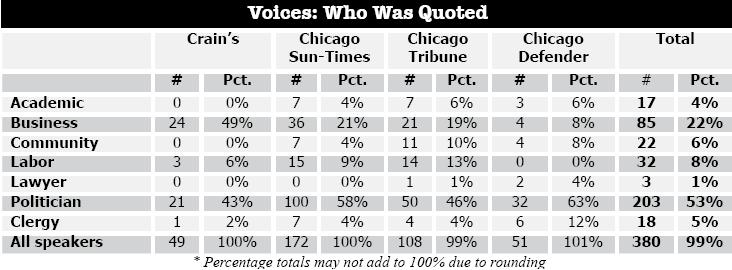
(Crain's) -- Hundreds of workers at the Hyatt Regency Chicago walked off the job Wednesday morning as union officials charged that hotel management has refused to change work rules governing housekeepers.
"Housekeepers are just fed up," said Annemarie Strassel, a spokeswoman for Unite Here Local 1, which represents 700 workers at the hotel at 111 E. Wacker Drive.
Downtown hotel workers have been working without a labor contract for nearly 10 months, but the work stoppage Wednesday was triggered by issues specific to the 2,019-room Hyatt, the city's largest hotel, Ms. Strassel says. Negotiators for Local 1 and Chicago-based Hyatt Hotels Corp. sat down at the bargaining table a couple of weeks ago after a several-month hiatus.
The primary gripe at the Hyatt Regency is that hotel management has installed heavier beds in the hotel's west tower and won't change work rules to lighten the load, says Tiffany Pullum, a housekeeper who has worked there about six years.
Hyatt is owned by the politically-connected Pritzker family. Penny Pritzker was President Obama's finance chair. A quick look at the Pritzkers' recent political giving after the fold.
The slate of the Caucus of Rank and File Educators, CORE, has forced a run-off election against the incumbent United Progressive Caucus slate, headed by President Marilyn Stewart. UPC has come under harsh criticism from the opposing slates for a perceived unwillingness to organize with teachers and parents to fight privatization, as well as for failing to adequately service the contract.
More than 30 boxes of ballots were uncounted as of Sunday night, due to a logistical failure on the part of the third-party American Arbitration Association, which was brought in to run the election. Preliminary results of the election were reported by observers early Saturday morning.These are not expected to considerably change the outcome.
In the preliminary count, CORE and the leader of their slate, Karen Lewis, ended up with only about 300 fewer votes than the UPC, out of nearly 20,000 cast; UPC took 32% of the vote to CORE's 31%. The third-place finishers, ProActive Chicago Teachers, or PACT, ended with about 16%. Between CORE, PACT, and the Coalition for a Strong, Democratic Union (CSDU) which endorsed CORE after the results were announced, there are enough votes to take the 50%+1 necessary to secure election.
CORE began two years ago as a reform caucus and has used parent-teacher organizing coalitions, legal pressure, and direct action to help prevent school closures and protest Board policies. Should CORE win the June 11th run-off, they would assume leadership over one of the largest teachers unions in the United States.
Teachers will be choosing between several caucus slates; the incumbent United Progressive Caucus, the Coalition for a Strong, Democratic Union (CSDU), Pro-Active Chicago Teachers and School Employees (PACT), the Caucus of Rank-and-File Educators (CORE), and the School Employees Association (SEA Caucus). Voting is open all day today and the results will be announced by the union's press secretary, Rosemaria Genova, "between 2am and 4am" according to a press release.
In Chicago's labor movement, Local 743 holds a special place. For years, reformers aligned with the Teamsters for a Democratic Union (TDU). In 2007, after a decade of struggling against a corrupt old guard leadership, a reformer slate successfully won election, and began instituting reforms--such as drastically cutting pay for local union officers and staff. Along with Local 705, 743 was held up as a model of what could be done with dedicated organizing--turning around corrupt labor organizations to uphold the ideal of democratic workplaces.
However, the slate's leadership soon met resistance from elements wanting to maintain leadership benefits, culminating in a formal complaint being filed with the Teamsters Joint Council after a procedural oversight by local President Richard Berg. The Joint Council, never friends to the TDU, responded by banning Berg and Vice President Gina Alvarez from the union for 5 years. Berg appealed the decision to the union's international President, James Hoffa, Jr. The decision came down last week: Berg and Alvarez would be removed, but the ban would be reduced to two years.
The news caused some heartache among the city's rank-and-file union activists, who have mounted seriously uphill struggles against some of the most corrupt union leadership in the nation here, and held up the TDU's work in Locals 743 and 705 as models. By most accounts Berg and Alvarez were staying firm to their reform promises of drastically reduced union staff and salaries and professional negotiations built on member democracy.
Still, according to the TDU website, Local 743's members will not be deterred by the setback, and plan to restore progressive, democratic leadership to the local:
Local 743 members are already meeting to launch a reform campaign in this fall's local union election.
"We're going to use our voice and our vote to make sure Local 743 is a union that puts members first," said Jean Moore, a member at the University of Chicago Medical Center.
The international workers holiday May Day used to be celebrated pretty much everywhere in the world except the U.S--an irony, given that the day commemorates the Haymarket Massacre that took place here in Chicago in 1886. In 2006, the immigrant rights movement resurrected the holiday in its country of origin, and thousands flood the streets in cities and small towns across the country every May 1.
Yesterday's marches come at a time when the national immigration debate is heating up. Arizona's recent harsh anti-immigration bill SB 1070 propelled larger crowds than usual into the streets around the country on Saturday. In Chicago, the bill has led to a protest at Wrigley Field urging a boycott of the Arizona Diamondbacks and the state of Arizona as a whole; at a civil disobedience for immigration reform at a detention center in Broadview, activists chanted "Illinois is not Arizona!" as they were arrested. Yesterday, Chicago Rep. Luis Gutierrez, Congress's strongest proponent of comprehensive immigration reform, was arrested with 34 others in Washington, D.C., at another civil disobedience in front of the White House.
At today's march, SB 1070 was mentioned frequently, as some of the photos below show.
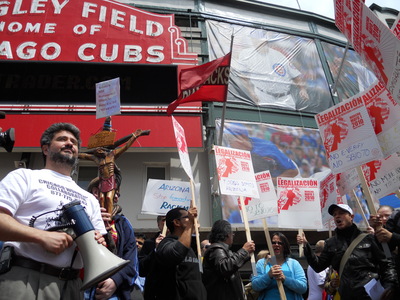
Immigrants Rights Activists Picket outside Wrigley Field.
Chicago is finally getting some spring weather. In Wrigleyville, thousands of fans are enjoying the weather and catching a baseball game. Jeering the other team has a long history in sports, but today over 200 supporters of immigrants rights picketed outside Wrigley Field to protest against the Arizona Diamondbacks and Arizona's anti-immigrant SB1070 law.
The law forces law enforcement in Arizona to stop "suspected illegal immigrants" and make them prove their citizenship in order to avoid arrest. Leone Jose Bicchieri, the executive director of the Chicago Workers Collaborative explained that the law would "only increase racial profiling in Arizona." Describing what the law tells police to do, "You better go out today and you better stop suspected undocumented immigrants. When you say, 'Well what does that mean?' They say 'well you know, suspected undocumentented immigrants.' That means dark people."
Immigrants and civil rights groups across the country have begun a nationwide boycott against the state of Arizona in order to pressure the state to rescind the law and to prevent other state from passing similar laws.
Victor Hernendez addresses a rally in the state capital in Springfield. Hernendez was a victim of wage theft.
You work assuming you'll be paid, but too often, workers are simply denied what they're owed. It happened to Kim Kambra who worked at Jericho Products in Springwood. "They didn't pay me. I worked over 55 hours a week and they paid me for one week out of the last 10 weeks. My house went into foreclosure and I lost the legal rights to my house even though I still live there."
Kambra was one of many Jericho employees who were not paid. Computer programmer Bill Van Dusen worked for 12 years at Jericho but for three months in 2008 and another three months in 2009, Dusen was not paid. "I had to use the money we saved for our kids' education to pay our bills."
Jericho went beyond not paying their employees. The company "stole our deductions for health insurance and child support. They collected that but didn't pay it to the proper person they needed to pay it to," according to Van Dusen.
However, Jericho's owners have been paid handsomely. Kevin Lynch, one of the owners of Jericho Products would have wild venison for his dogs and chrome parts for his car delivered to the company while three employees' homes went into foreclosure.
Think twice before you act a fool in a Chicago cab: the driver will soon be able to snap a picture of you to use if you get out of line.
The Trib is reporting that cameras will be installed in cabs around the city in an effort to curb crimes against drivers.
According to the article, in other cities where cameras have been installed, such crimes have dropped considerably. Already installed in some cabs, they've been used to easily solve crimes against Chicago drivers in the past.
Last fall, local journalist Kari Lydersen wrote a disturbing Chicago Readercover story on the dangers that faced cab drivers in the city, focusing on the case of Walid Ziada, who was beaten last January in Lakeview. His experience is fairly common: a 2009 University of Illinois-Chicago study reported one in five cabbies have been assaulted on the job.
In addition to the dangers of driving, most cab drivers make far less than minimum wage. According to a 2009 study by the University of Illinois Urbana-Champaign's Center for Labor and Employment Relations and the American Friends Service Committee, "cabdrivers are chronically overworked and underpaid close to the point of 'economic failure,'" working grueling 12-hour days and making an average of $4.38 an hour. Michael McConnell, regional director of the AFSC, called Chicago cabs "sweatshops on wheels."
Insanely long hours, miniscule pay, high risk of robbery, frequent acts of brutal violence--it's enough to make you think twice before complaining about the high price of your cab fare next time. Besides, you should probably straighten up now that your driver will have a snapshot of you.
Workers at Pete's Fresh Market claim their employer continues to harass workers involved in a union organizing drive, accusing management of spying on organizers and students at a meeting at UIC last week.
Last month, GB covered the fight between Pete's owners and pro-union workers in which former and current employees are alleging unfair labor practices, sexual harassment, and national origin discrimination, claiming multiple employees have been fired for trying to organize a union with the United Food and Commercial Workers (UFCW) Local 881. Pete's denies all the claims.
Representatives from the union and and supportive community organizations gathered in front of the Southwest Side Pete's at 43rd and Pulaski today and alleged that Pete's management spied on a meeting of the Mexican Students de Aztlan (MESA) at UIC with union organizers, videotaping their meeting without their consent in order to know what the union was up to.
Immigration activists wave American flags at a recent rally.
Immigration rights activists held a large rally Saturday at the Teamsters Local 705 hall in Chicago. Activists were calling on Congress to act on comprehensive immigration reform, and hoped that with the health care bill passed, that immigration reform would be next on the Democrats agenda in Washington. The loud and raucous crowd had immigrants from all over the world including South America, Asian, Africa and Europe.
It seems that immigration will be the next big issue for Democrats. The rally was joined by Senator Dick Durbin, the Senate majority whip and the second most powerful senator in the country. While one speaker urged Congress to ignore "cynics like Rahm Emanual who say that now is not the time for immigration reform," it seems as though they may not have to as Emanual is now stating that he supports taking action on immigration reform sooner rather than later.
A group of researchers released a report [PDF] this week finding that local low-wage workers are the victims of wage theft to the tune of more than $350 million a year, or $7 million a week. The researchers, primarily from the Center of Urban Economic Development at the University of Illinois at Chicago, surveyed over a thousand workers from low wage industries, including those paid "under the table," undocumented workers, and those considered "independent contractors". This shocking finding is just the most appalling; the study is rife with data demonstrating widespread criminal exploitation of employees throughout the Chicagoland area. A shocking number of workers are criminally denied vested rights in the workplace, including denial of overtime and breaks, a lack of accounting of wages owed and paid, and sleight-of-hand to avoid providing legally required vacation or paid time off. This failure to enforce these laws and protect these people is grievous, but not surprising: it is part of a pattern of coddling employers.
Labor Secretary Hilda Solis was in Chicago today, on a tour of the US promoting the Department's new "We Can Help" initiative. The initiative aims to raise public awareness of the national problem with wage theft by employers. Solis has announced she will be tripling the staff of the Department's Wage and Hour Division, and begin aggressively pursuing employers who steal from their employees. When Solis was confirmed in February of 2009, she announced that there was a "new sheriff in town" and pledged that labor law would begin to be enforced.
The Bush administration had focused their Wage and Hour resources on larger employers, but staff size was minuscule and the division was overworked and unable to pursue complaints seriously.
Wage theft costs Illinois workers hundreds of millions of dollars a year; in New York City the number is in the billions. It is a serious crime treated lightly ("They're lucky to have a job in the first place"), a function of the propaganda that employers are charitable "job creators" and everyone else fortunate vassals. Cities across the country are beginning to look seriously at local legislation to punish irresponsible employers who cheat their employees and undercut the vast majority of responsible employers.
Secretary Solis appeared in the East Terrace room of UIC's student center, overlooking Hull House, to announce the campaign. Pointing to the city's skyline, Secretary Solis reminded the crowd that it was the DOL's "moral responsibility" to advocate for those "work in those buildings by day, and clean them by night."
If you feel your employer has cheated you out of overtime, mandated breaks, or any wages, contact the DOL.
I think the Mayor may have a point about the state legislature's recent action to lift a requirement that Chicago Public Schools teachers live in the city:
"If you say government employees don't have to live here, I guess maybe elected officials don't have to live here, too. You could start a trend. I don't have to live in the ward. I don't have to live in the city. I can work on a contract. I firmly believe that is the essence of keeping neighborhoods strong."
Of course, agreeing with the policy means the city needs to take bolder steps to insure there is affordable housing in Chicago; Chicago has been shedding affordable housing units, bifurcating the city into the upper middle class and the poor. But given the sheer number of city employees, and the fact that city housing will always be more expensive than housing in many bordering suburbs, lifting the residency requirement will result in another exodus of middle class residents--and valuable tax dollars.
I'm not convinced of this position, though--is there an argument to be made that the residency requirement is overly onerous or unfair?
The bill was sponsored by Senator Heather Steans of the north lakefront. Below is the roll call vote.
Northern District of Illinois Judge Amy St. Eve has granted the request for a preliminary injunction against the Board of Education to stop them from enforcing a policy that would curb the ability of Chicago Teachers Union activists from campaigning for office in non-work areas and during non-work times in Chicago Public Schools.
Judge St. Eve's ruling was made on behalf of plaintiffs from an opposition caucus in the CTU, ProActive Chicago Teachers and School Employees (PACT). PACT is the caucus of former CTU President Debbie Lynch, who was defeated for reelection by the Unity Progressive Caucus and current President Marilyn Stewart. PACT argued that their First and Fourteenth Amendment rights were violated by schools CEO Ron Huberman's order. The preliminary injunction states that PACT's case has a reasonable likelihood of succeeding and that the harm union activists would suffer should the injunction not be granted would be "irreparable".
Huberman's policy would naturally favor the incumbent slate of the UPC, given their control of union personnel and finances, and considering the size of the electorate (some 30,000+). Opposition slates are not given access to membership lists or significant funds to run campaigns, making opposition an uphill climb as is. Huberman's non sequitor decision, with no precedent in recent school history, sure looks like a sop to the incumbent, perhaps in reaction to the organizing opposition groups such as PACT and CORE have done against CTU acquiescence to Board of Ed policy changes.
When Raul Real decided he and his co-workers needed a union, he knew his bosses wouldn't be happy. He didn't realize, however, that his organizing would eventually cost him his job and lead to his arrest at his former place of employment.
Real is one of a number of former workers at the Chicagloand grocer Pete's Fresh Market who are levying charges against the company including firings for union activity, threats based on immigration status, and gender and pregnancy discrimination. Company officials say they have engaged in no wrongdoing, and that the majority of workers have no desire to be represented by the United Food and Commercial Workers Local 881.
But workers who claim the company abused them have begun to speak out, pressuring the company to recognize the union. Real claims his organizing first led to his firing, and that his participation in a recent protest at a southwest side Pete's resulted in his arrest.
Warehouse Workers for Justice Rally Outside the Housewares Show at McCormick Place.
On Sunday, March 14, Warehouse Workers for Justice rallied outside the McCormick Convention Center, which was hosting the International Home & Housewares Show, to demand justice from Bissell, a vacuum manufacturer. Clergy, warehouse workers and community members rallied to call attention to Bissell's role in the firing of workers who were trying to organize a union.
Warehouse Workers for Justice was founded by the United Electrical Workers union and helps warehouse workers organize and fight for their rights. The group has had substantial support from churches in the Joliet area; Baptist, Pentecostal, Catholic and Unitarian Universalist have all provided support for the Warehouse Workers for Justice.
According to United Electrical workers organizer Mark Meinster, Bissell is one of hundreds of manufacturers that store their goods in the Centerpoint Intermodal Center in Elwood, Illinois. Since Chicago is the only place on the continent where all of the major rail lines meet, corporate America has made Chicago the third largest storage warehouse hub in the world, after Singapore and Hong Kong. The Centerpoint Intermodal Center is actually a designated foreign trade zone, so corporations like Wal-mart and Bissell do not have to pay duties on the products shipped through the center until they are shipped out of the center and toward retail outlets.
The companies that store their goods in the warehouses use a system of contractors and sub-contractors to employee temporary employees instead of full time employees. According to Meinster, "It's very easy for these employers to hide behind other companies in terms of liabilities for labor law violations. And that's what Bissell is trying to do here." Warehouse Workers for Justice have filed several complaints with the Department of Labor, and their attempts to meet with Bissell have been blown off. Which is why they felt it was important to take their message to the public, Meinster says. They want to "make sure those retailers [at the convention center] know that they are selling a sweatshop product."
Schools chief Ron Huberman continues to beat the drum of financial meltdown if there aren't drastic cuts to the CPS budget: yesterday he announced that classes should be increased to 37 students per teacher. The Chicago Teachers Union came just short of characterizing Huberman's scenario as a negotiating ploy:
Under the current contract, if CPS declares a budget "emergency,'' it can move to reopen negotiations with the CTU and seek union agreement to forestall $169 million in teacher raises or to impose furloughs.
"If this is a negotiating ploy, there will be no negotiations in the press,'' said CTU spokeswoman Rosemaria Genova."I can't begin to speculate what Mr. Huberman's objective was in terms of briefing principals. . . For a man who is promoting a 'culture of calm,' this is not the way to do it."
GEO President Charles Moss delivers petitions to UIC Chancellor's office.
The Graduate Employees Organization of the University of Illinois at Chicago is a union for graduate student employees. GEO members have been working this school year without a contract and are facing a heated battle with UIC's administration.
GEO has been attempting to negotiate a contract with the administration, but has reached a stalemate over a number of issues including guaranteed assistantships. They began mediation with the university and a neutral mediator last week.
On March 10, the day before they began mediation, members of the Graduate Employee Organization of the University of Illinois at Chicago delivered petitions signed by UIC community members urging the university to bargain in good faith and to take the mediation process as serious as GEO does. The petition urged the chancellor to direct the universities bargaining team to negotiate fairly.
Charles Moss, the president of GEO said that GEO, "takes the mediation process seriously. We would rather settle the contract through mediation than go on strike." Moss added that GEO organizers have been putting in a lot of work to obtain a fair contract.
A group of GEO members went to the 28th floor of the University building hoping to give the petitions to Chancellor Paula Allen-Meares. Allen-Meares was at a trustees meeting and the GEO members gave the petition to Assistant Monica Rausa Williams.
Linda Haluska, who works at the company's Glendale store, stocks the Health and Beauty Aids (HBA) section on the overnight shift. "On a nightly basis, when a truck gets in, I might have three pallets of cosmetic items to stock, which is about 50 boxes. That's quite a bit for one person." HBA is four aisles, and there are two aisles of cosmetics, each about 40 feet long. The pallets come in loaded with boxes of small items. "One aisle may have between 300 - 500 individual products: mouthwash, deodorant, toothpaste, bath and body wash, pads. And that's just one department."
This is the kind of more creative and simple policy change that a pro-labor government should be showing all the time. Using government to positively improve the quality of life--in a way other than showering employers with benefits in the slim chance they'll pass those benefits on to workers--is genuinely progressive, if not necessarily fundamental reform.
The White House is looking at a new policy that would give an advantage in bidding on government contracts to companies that offer generous benefits and good pay.
But business groups opposing the idea maintain it would shut out smaller businesses from competing for more than $500 billion a year in federal contracts and increase government procurement costs.
The policy is known as "high road" contracting and could draw the Obama administration into a larger debate over whether the government should use public purse strings to strengthen the middle class and promote higher labor standards.
Advocates of the plan include unions. They say too many jobs financed by government contracts come with low wages and limited benefits and support companies that violate employment laws.
The Economic Policy Institute, a liberal think tank, estimates that nearly 20 percent of the 2 million federal contract workers in the U.S. earn less than the poverty threshold wage of $9.91 per hour. As many as 22 million workers are employed by federal contractors.
A crowd of 100 gathered in Federal Plaza on March 3, to demand that Congress tax Wall St in order to provide for a jobs bill. The rally was planned while Senator Bunning was filibustering a bill that would have extended unemployment benefits. Now that Bunning has withdrawn his filibuster, organizers used the opportunity to point out how much more needed to be done.
Organizer Susan Hurly explained, "What they did last night to extend unemployment for 30 days is rather pathetic in the light of the crises that we are facing. We are here to say that we need more, we need a federal jobs program" with better and long unemployment benefits. She continued, "Wall Street broke it, they gotta buy it."
The Senate Soup Kitchen intended to highlight the need for a jobs bill.
The Chicago Teachers Union pension is statutorily separate from that of the rest of Illinois teachers, and for years performed better. The pension has performed poorly recently, and schools CEO Ron Humberman--a Daley lieutenant who ran the CTA for the Mayor after stints at the Police Department and emergency services--has been talking tough about the need for a drastic overhaul of how the pension is funded.
Last week, CEO Ron Huberman started his doomsday budget press conference by saying, "You are going to hear me talk a lot about the pension."
Pension costs have long been an issue for CPS, and costs have now skyrocketed to $587 million--three times what the district was required to pay into the teacher's pension fund just three years ago.
As a quick fix, Huberman hopes to convince lawmakers to simply reduce Chicago's additional payment by about $300 million, which would cut the nearly $1 billion deficit by about a third.
To stem the problem, various solutions have been proposed: higher employee contributions, raising property taxes, or rediverting the money in the city's enormous tax increment financing (TIF) districts back to the schools (the bulk of those funds were originally supposed to go to schools). Given that the Mayor's administration has performed dazzling feats of privatization in order to avoid raising taxes (or the appearance of raising taxes) employee give backs are the only tool available that can cut into the deficits the district faces. Typically, the CTU has been pretty easy to tame.
This year, however, may be different.
Catalyst notes, as Greg Hinz did earlier this week, that the effort by City Hall to change the pension funding system could be complicated by internal union politics.
Catalyst:
Stewart faces a tough re-election campaign this spring. In fact, her union caucus recently lost two seats on the Pension Board to the new, hard-line caucus called CORE (the Caucus of Rank and File Educators). It was a major victory for CORE, whose members say the Pension Board needs better watchdogs to protect it from a cash-starved district administration and prevent mismanagement. CORE still lacks a majority on the Pension Board, however.
CORE is but one of several opposition caucuses; former insurgent CTU president Deborah Lynch heads PACT; ousted former Vice President Ted Dallas is associated with the CSDU. Several other smaller groups are also clamoring for change.
Stewart is regularly accused of being too close to the Mayor and too unwilling to stand up to him on issues like Renaissance 2010 and the draconian "turnarounds" that have costs so many teachers their jobs and so many students needed stability. The prospect of losing the presidency of the 30,000+ member CTU may just be what is needed to stiffen her spine.
Similarly, the prospect of a hard line causing a more adversarial caucus to take power in the union leading up to his reelection in 2011 may be giving the Mayor pause in his effort to dismantle the public school system as the centerpiece of his urban education "revolution". The union election is in May. Keep a wary eye on the maneuvering between now and then.
On Wednesday February 24, despite a chilly 27 degree day, over 400 Northwestern University students rallied outside a meeting of the university's board of trustees to demand a living wage for cafeteria workers at the school. It was a high point in the student anti-sweatshop movement at Northwestern.
Tom Breitsprecher, a lead cook who has worked at the Northwestern University cafeteria for 31 years, said that this was the largest demonstration he has seen on campus since an anti-war rally in the early 1980's.
According to Northwestern University activist Matthew Fischler, the average cafeteria worker at Northwestern makes a measly eight to nine dollars an hour. This poverty is compounded with the fact that the health insurance offered by Sodexho still includes expensive co-pays and premiums that many employees can not afford. It becomes especially difficult for many workers who lose their health benefits when their hours are cut during winter, spring and summer breaks.
According to Breitsprecher, "Many workers on campus live in government subsidized housing. Even if they are offered a discounted health insurance plan, many can't afford the premiums. Many qualify for food stamps for their families... if the government subsidizes workers, aren't they really subsidizing a company that pays such low wages?"
It was in this context that I attended the The Public Square's discussion on Chicago charter school's on February 23 to hear James Thindwa, the former head of Chicago Jobs With Justice and current Civic Engagement Coordinator for the Chicago Alliance of Charter Teachers and Staff speak. The Public Square is a joint project between Chicago Public Radio and the Illinois Humanities Council's Cafe Society. The discussion was held at the Chicago Public Radio West Side Bureau.
Chicagoland Chamber of Commerce CEO Jerry Roper teamed up with outgoing Chicago Federation of Labor President Dennis Gannon in penning an editorial to encourage Mayor Daley to pursue the privatization of Midway Airport. One thing I agree with: years ago, Midway was a ghost town. The expansion of Midway is definitely one of the feathers in the Mayor's cap.
Or, at least, in his weird fedora/stetson thing. Photo via the Sun-Times.
The City Council authorized the partnership deal in the fall of 2008. However, due to the global credit crisis, the winning bidder could not arrange financing.
Today, conditions are significantly better, evidenced recently by two successful airport transactions in England: the long-term lease of London Gatwick Airport and the sale of a one-third interest in Bristol Airport.
Midway's lease value is bolstered by the fact that passenger traffic has rebounded and interest rates have plummeted. If borrowing costs rise in the future, as many predict, the value of the Midway lease could be negatively impacted.
We applaud Mayor Daley for working with business and labor on these partnerships. The parking meter initiative has been a great success for Chicago's businesses and the public and other cities are looking to replicate that success.
We hope the mayor relaunches the long-term lease of Midway soon.
On Jan. 22, William Kuntsler: Disturbing the Universe, a documentary about the legendary left-wing lawyer, premiered to a sold out crowd at the Siskel Film Center in Chicago. Directed by William Kuntsler's daughters Emily and Sarah Kuntsler, the film looks at the life and cases of one of America's most controversial lawyers.
William Kuntsler fathered Sarah and Emily late in life, and when he died, they were still young, so the movie became a way for them to know their father in a more adult way. It became a way for them to shed the simple childlike images of their father, and come to know him in a complex way.
The sold out Chicago premiere was hosted by the Next Gen, the young lawyers group of the Chicago chapter of the radical National Lawyers Guild. The theater was filled with activists, lawyers and law students. The amazing thing about the showing was how many people in the crowd had met or knew William Kuntsler.
National Lawyers Guild Next Gen members Sarah Gelsomino and Robert Luderman at the Chicago premiere of Disturbing the Universe.
Nowhere is the freedom of speech more curtailed than in the workplace. Americans are expected to check their Constitutional rights at the door, all for the privilege of generating profit for their bosses. Not only this, but the (uniquely American) doctrine of at-will employment gives employers even greater flexibility to retaliate against employees for their speech. There's even the appalling "duty of loyalty" employees owe to their bosses that restricts not only their business activities but what they may say about their employer publicly.
Target stores as a precondition to employment at their stores subject their new hires to indoctrination (it certainly isn't a two-way conversation) about labor unions and even pending legislation. Nobody is allowed to offer a counter-point or discuss with their fellow employees the potential benefits of unionizing. Why? Because it's "private property".
With the Citizens United decision, the Court greatly expanded the definition of free speech by directing legislators to err on the side of no regulation of action that could be considered speech. So why should "employees"--the vast majority of the population--be kept from exercising that right?
Public sector workers were once among the most abused members of the labor force. It was when Dr. King turned his attention to the working class--to fighting on behalf of the working classes of all races--that he became intolerable to the status quo.
He was standing with AFSCME workers in Memphis when he was murdered. Today the constant assault on the public sector workers is just an echo of the eternal assault by the right wing against the rights of the working class. Back then, it was the public sector workers that were dragging down the working conditions and wages of the heavily unionized private sector; today, the situation is reversed. Ignore the crocodile tears of the right wing ideologues about taxpayers' money. Breaking the back of workers' organizations is the ultimate goal of the right wing, wherever those organizations exist.
"They never thought of the children first," Lillie Gonzalez exclaimed to several hundred people's applause at Malcolm X college. The small, but feisty, Latino community activist was speaking at the Democratic Alternatives to Renaissance 2010 conference organized by the Grassroots Education Movement (GEM) and the Caucus of Rank and File Educators (CORE) on January 9, 2010. Gonzalez was "one of the lucky ones," who was able to stop the closure of Peabody Elementary School in 2009 in Chicago's Near West Side. The planned closure of the more than a century old school was a part of Renaissance 2010, Chicago's program to privatize its public schools.
"Renaissance 2010 and 15 years of mayoral control are 15 years of failure." Explained Kenwood Community Organization organizer Jitu Brown. Describing the conference, Brown stated, "we want to begin to project what we think should happen in our schools... Our vision, not a corporate vision."
President Obama's appointment of Arnie Duncan to the Secretary of Education made the conference particularly important. "The first thing that Arnie Duncan did as US Secretary of Education is fly to Detroit and promise Detroit Public Schools major federal funds if they were to adopt the Chicago model," Pauline Lipman, a professor at the University of Illinois Chicago, explained.
Lipman pointed out that, "Renaissance 2010 is a partnership between Mayor Daley and the most powerful financial and corporate leaders in the city. What is their goal?" she asked before answering "to train a low wage workforce and to support real estate development. That's their education agenda. Their strategy is to hand public school to private operators, undermine the teachers union, phase out local school councils, the only democratic community voice we have, and replace neighborhood schools with selective enrollment schools and gentrifying neighborhoods."
"They have a long term plan. If they don't kick you off this year, they will pick you off next year." Lipman explained.
In the 19th Century, wealth was distributed by height.
Some dispatches from the world of work:
*At the stupendous Working blog from In These Times, a few pieces: first, Kari Lydersen profiles the on-going effort of staff at the upscale Andersonville^ Ole Ole! restaurant to organize a union:
The Big Blue from Bentonville relies on its supply chain for its enormous profitability. The company constructs enormous regional distribution centers and automate their inventory system (in part using RFID technology) to load trucks with exactly the products that a store is selling, and their trucks are dispatched at regular times on regular routes, replenishing supplies steadily and precisely, allowing the individual stores to eliminate storage space in favor of floor space. It's an impressive system, designed by Chief Information Officer Linda Dillman, the unheralded genius behind the company's ridiculous profits.
The other, more important element behind the Bentonville Monster's profitability is their ability to maintain a razor thin margin across a huge breadth of volume. The profit per unit sold is small--but the amount sold is enormous. Obviously, having an innovative supply chain is a critical part of this. The other part is pulling out all stops to keep labor costs down.
The company pulls this off by applying intense pressure on store managers to keep labor costs down by setting unrealistic downward expectations of labor costs. While they expect sales to increase, they expect labor costs to decrease--which any small businessperson could tell you is the opposite of reality. As a result, store managers feel pressured to do things like force workers to work off the clock, through their breaks, and split their checks to avoid overtime payments. Reports of cashiers wetting themselves for lack of bathroom breaks or going into diabetic shock as a result of blood pressure dips pop up in lawsuits all over the country. The indignity of at-will employment.
Progress Illinois does an amazing job of putting stories into context and efficiently providing background and history on stories. A great example is the yeoman's work they did in cataloging the progress (pun, kinda) of the Republic Windows and Doors worker occupation story, which broke a year ago.
Reading a recent report on systematic wage theft, and with the unveiling of a "wage theft violator map" by the University of Illinois-Chicago and ARISE, I thought of the strong, negative reaction I've gotten the last few times I've written about the privileges of the well educated.
America, raised on the Horatio Alger archetype and a pop culture focused on the triumph of the individual, aches for meritocracy. So individuals get very prickly when confronted with their own privilege. The fact of our privilege makes us uncomfortable; while race separates us, class engulfs us. Jesse Jackson once said he was ashamed to find that he was relieved when, walking down the street late at night and hearing footsteps, he would turn around and see it was a white man. Perhaps--but what if it had been a black man in Brooks Brothers with a leather valise? What if it had been a Deliverance-style white guy with dirty overalls and no shirt? What if it was a juggalo? As a brown guy, I'm more afraid of juggalos than pretty much anyone else.
The Grassroots Collaborative issued a report last week looking at mainstream print media coverage of the Living Wage Ordinance that was passed by the City Council and subsequently vetoed in 2006. The research was done in conjunction with the Community Media Workshop and media researchers.
3. Balance was lacking in presentation of problems and solutions, or framing.
Essentially, the Collaborative argues that the policy ramification of the Living Wage Ordinance was reduced to the typical power-politics analysis of "unions versus business," ignoring the deeper issues of the effect of low-wage jobs in poor and minority communities, and disregarding the opinions of supporters of the Living Wage Ordinance where they did not fit into the pre-defined (by Mayoral forces) narrative.
The most troubling fact revealed by the study was that while 75 percent of those quoted in the articles surveyed were businesspeople or politicians, only 6 percent were community residents.
The SK Hand Tool strike is over, as Teamsters members voted Tuesday to end the job action and accept a contract -- with health care but lower wages -- from the company.
"They voted to both end the strike and sign the contract, and the contract included [a health care provision and] a return-to-work agreement," a spokeswoman for Teamsters Local 743 said Wednesday. The company is "going to call all the people back to work today and fire all the . . . scabs."
Some updates on union contract negotiations around town:
[CTA Tattler]: CTA bus drivers union weighs strike to protest layoffs
The union president, Darrell Jefferson, goes on to insist the CTA's budget deficit is actually $500 million, not the $300 million cited by the CTA. But the union will continue to resist any givebacks, including furlough days.
[Chicago Tribune]: Hotel workers authorize strike at downtown Starwood hotels
Chicago hotel workers voted Wednesday evening to authorize a strike at five downtown Starwood hotels.
A union spokesman said if contract negotiations drag on, similar votes could occur at downtown Hyatt and Hilton hotels. Union contracts covering 6,000 workers at 31 hotels in downtown Chicago expired Aug. 31, and the union has said a settlement is far from sight.
With a federal mediator in place at the end of the table, the Union and Management traded barbs as the contract stalemate continues. AFSCME continues to demand that management provide us with an updated wages proposal, which the county will not as the tax issue continues to drag on before the county board.
The existence of food deserts in Chicago is very real, and has a very nasty effect. The lack of any availability of affordable, healthy food in poor communities is probably directly related to the dangerously high rates of obesity among the poor, and the correlative high rates of heart disease and diabetes among the poor.
But the option of Big Blue is not the only option to solve this problem. There are more constructive solutions, ones that don't involve decimating the ability for small businesses and entrepreneurs to thrive, or exist; and ones that don't undercut the working conditions of the thousands of grocery and retail workers who have hard-fought benefits through their unions at unionized groceries.
The father of the American common school system, Horace Mann, once referred to the public school as "the greatest discovery ever made by man". I tend to agree, though the scientific method is up there, too: giving every child the same education and critical thinking skills is necessary to building the cognitive girding that a true meritocracy requires.
A public school system is also invaluable to democracy because they are in a sense immobile, essentially local, and connect families, workers, and youth in one place. It's easy to see why the public school system is a favorite target of reactionaries on the right: done right, it undermines the status quo by its very existence.
Despite the right's constant harping on the evil teachers' unions, there's no debate as to their positive impact on education historically. America's schools improved by every conceivable measure as unionization of the profession grew. In fact, teaching only became a profession because of teachers' unions. It's easy to forget now, but the schools were a patronage dumping ground in all but the toniest of schools for generations.
Despite the hysteria whipped up among parents and the free market fundamentalists, teachers don't go into the profession because they hate children and teaching. Teaching is an immensely stressful profession--consistently ranked among the most stressful. Teachers have to face roomfuls of children and adolescents in the most emotionally trying times of their lives, and they must manage to both educate them and keep them in line. The caricature of the teacher who puts on a movie and puts her head down to sleep is just that, and is the result of years of propaganda and little else.
Don't get me wrong; teachers' unions need reform. There needs to be a reasonable method for removing bad teachers; there needs to be room for innovation in curricula. And they need democracy.
Almost one year ago -- on December 5, 2008 -- 250 workers who had just been laid off from their jobs at the Republic Windows and Doors factory on Chicago's Goose Island secured their place in labor history. The workers refused to leave the factory until they received what was theirs: 60 days of federally mandated severance pay and compensation for accrued vacation time. While workers were told that Bank of America had cut off the factory's line of credit, the bank had received $25 billion in federal bailout money before the Republic closed.
Furthermore, for more than a month, workers had noticed management quietly emptying the factory in the middle of the night -- a corporate scheme that ended with Republic CEO Richard Gillman being held on $10 million bond and accused of stealing factory equipment and attempting to set up a new operation in Iowa.
Mechanics sat down with Lydersen, a staff writer for the Midwest bureau of The Washington Post and a frequent contributor to several other publications, including the Chicago Reader (where she recently had twogreat cover stories) and In These Times. Over drinks at Argo Tea, she discussed her book, the factory takeover and its lasting impact.
This is another example of the trouble the labor movement has. The private sector has carved out a legal regime that makes it easy and painless to bust unions and squash workers' rights to organize in the workplace. Because we don't allow our government to violate a worker's right to organize, it is much easier to organize in the public sector. As a result, we end up with high unionization rates in the public sector and low union density in the private sector. Since public employees get paid by all of us, it is easy to stir up resentment against public sector workers--why should they have it so good? Why should they get defined benefit pensions?
Rather than try to pull everybody up to the decent living standards that public sector workers get, conservatives advocate for dragging everybody else down to the lower living standards. Private sector jobs not covered by collective bargaining agreements, the argument goes, have their value determined "rationally" by the market, whereas union contracts "artificially" inflate wages and benefits. This is of course absurd; collective bargaining agreements are entered into voluntarily, just like any contract, and if using your size and bargaining strength to improve the deal you get is "artificial" then a certain big blue discount super retailer from Bentonville, Arkansas should be the archenemy of conservatives and libertarians everywhere.
Don't be surprised if CTA employees' refusal to give up what they've earned over years--decades--of work ends up being blamed for the fare hikes or service cuts. These workers are very convenient scapegoats. Easier to beat up on people earning the median income than force the powerful to pay their fair share, or make tough decisions.
Representative Alan Grayson Owns Republicans on Health Care
Representative Alan Grayson (D) - FL said that Repubs "want you to die quickly if you get sick" and called government's inaction on health care a "Holocaust". Republicans, of course, want to slap him on the wrist for his comments, by using the same mechanism used on ol' boy Ragin' Joe' Wilson.
Just as most 9-to-5ers were getting ready to call it a day on Thursday, members of the labor union Unite Here, Local 1, stormed North Rush Street and East Chicago Avenue, right outside of the Park Hyatt. Mechanics snapped these photos before 200 protestors were arrested as they sat across Chicago Avenue.
Union workers and supporters were protesting the Hyatt Corp.'s proposed cuts to workers' wages and health-insurance coverage. Workers have been without a contract since August 31, and the Hyatt Corp. is trying to make employees work 120 hours a month in order to qualify for health-insurance coverage, according to Unite Here, as reported by the Sun-Times' Sandra Guy.
Governor Quinn and the local leadership of AFSCME Council 31, which represents the largest proportion of state workers, have been unable to reach a deal that would avert over a thousand layoffs. The Governor was asking for concessions that the union said amounted to a 15% pay cut. This is a combination of cuts: deletion of promised raises, reduction of health care benefits and pension contributions, and unpaid furlough days. Quinn has announced that he will have to move forward with over a thousand layoffs as a result of the refusal of AFSCME locals to accept the cuts. Quinn sees the roaring budget deficits we all see. The assumption is that spending needs to be cut to reduce and eliminate this deficit; but it doesn't necessarily follow that cutting programs will have that effect. Cf., Adam Doster's "Civic Fed Rule."
And of course there is the fact that many state programs actually "save" the state, or the people, money from the services they provide. Either by addressing a problem that effects productivity (road congestion, child care for working class families, subsidies for health insurance that reduce sick days and unemployment), or by providing a service that indirectly raises revenue (subsidies for jobs programs; maintaining regulatory standards that protect consumer confidence). This isn't controversial; Illinois' conservatives would look at a list of state activities and approve of way more state activities than they disapproved of. Licensing, regulation of professions, capital projects that increase mobility, building institutions of higher learning, etc. We need correctional officers and child safety case workers; we need inspectors to check that our bridges aren't falling down, and to monitor water pollution levels. That's what a "state worker" is.
Knowing this, how about the fact that Illinois has the lowest state worker-to-resident ratio in the country? The problem is not the size of government, the problem is that politicians refuse to pay for the services Illinoisans demand. Cutting deeper into the bone won't make Illinois better; it'll make the quality of life worse. Even were our budget to be balanced, basic services will disappear. We know we're talking about basic services because Illinois has a tiny state government:
If Illinois state budget is "bloated," as many charge, these numbers would seem to indicate that the state's employees are not the cause of that bloat.
The Chi-Town Daily News' Adrian Uribarri reports on the expiration of the city-wide hotel contract between members of UNITE HERE's Local 1 and the city's downtown hotels. The negotiations have not gone well:
"The hotels are using the economy as an excuse to slow everything down," Strassel said. "We're willing to continue to negotiate, but at a certain point, we're going to hit a breaking point. Tomorrow's about putting the hotels on notice."
Strassel said the hotels are not only trying to cut medical benefits, but also overworking some employees as they lay off others.
De La Cruz, in Chicago's Pilsen neighborhood, was a small middle school, taking kids mainly from Whittier Elementary and sending them on to Juarez HS. Small--a few hundred students. To the Chicago Public Schools, under the auspices of the Renaissance 2010 program, that is a bad thing.
Because the school was small, the class sizes were, relatively speaking, small. But the teachers, being unionized, tenured, and with in many cases decades of experience teaching in that neighborhood, were expensive. That, according to Ren2010, is "under-utilization". Too few kids, too much school. Yet, of course, small school size is touted as among the benefits of charter schools--more personalized instruction and care from teachers.
De La Cruz, in a neighborhood with a high number of Spanish-speaking families, in a neighborhood periodically plagued with gang problems, is an award-winning school. It won the Spotlight Award from the state Board of Education. Not a decade ago. Not five years ago. In 2009.
So here was a public school where the kids were learning. The school was making progress. The school was small and the class sizes manageable. And it had to be closed.
Why? Why close a successful, small school in a working class neighborhood?
The residents, teachers, and students surely didn't understand. A heart-wrenching "hearing" last year in February featured parents and students astounded at the callousness of a Board of Education indifferent to local control, so sure were they in the magical wizardry of the "market" to fix education. Given what happened to De La Cruz, is Ren2010 about fixing public schools? Or destroying them?
The neighborhood, the Board argues, simply doesn't need a school.
The working men of SK Hand Tools, who make up a unit of the International Brotherhood of Teamsters Local 743, went on strike today. From the Chi-Town Daily News:
In May, Teamsters Local 743 charged SK Hand Tool Corp. with an unfair labor practice, alleging that the company unilaterally took away health benefits for its workers. Friday, the case ratcheted up a notch: The union followed up its earlier complaint to the National Labor Relations Board with another that said SK administrators wouldn't provide information on financial or health-insurance matters for collective-bargaining purposes.
The labor family has its problems. Among those problems is one particular group of relations--the Hogan Family.
Chicago Union News has a great piece on the on-going saga of Teamsters Local 714, run for years by the Hogans on the city's south side. The Teamsters' International body has been pursuing the Hogans for years and the local has been slowly parceled out to its sisters locals over that time in an effort to maneuver the Hogans out of power.
Teamsters Local 714 -- long the domain of the powerful Hogan family, and a repeated target of anti-corruption investigators -- soon will cease to exist in its current form.
Between 3,000 and 4,000 private-sector workers represented by the Berwyn-based group are being "re-distributed" to 10 other Chicago-area Teamster units: locals 705, 710, 727, 731, 743, 777, 781, 786, 301 and 330, a labor official told ChicagoUnionNews.
The remaining public-sector employees -- about 7,000 jail guards, suburban cops and others -- will be part of a reconstituted (and possibly renumbered) Local 714 focusing solely on government workers.
The move -- recommended by Chicago's top Teamster, John Coli, and other members of the executive board, and authorized by the top Teamster in the country, James P. Hoffa -- is an outgrowth of last year's "trusteeship" of Local 714.
From an AFSCME news release on their meeting with the Governor today:
AFSCME Council 31 executive director Henry Bayer issued the following statement today after meeting with Governor Pat Quinn:
"This meeting was held at our union's request to urge the governor to rescind the state-employee layoffs he has threatened.
"I told the governor that layoffs will harm vital services that Illinois residents rely on. They will also hurt families and our economy by throwing thousands of men and women out of work.
"AFSCME continues to believe that the only solution to the state budget crisis is comprehensive tax reform that raises significant new revenue. Only with new revenue can Illinois invest in public services, create jobs and pay the state's bills.
"The administration must present to the body of local union presidents representing state employees any proposals that would require reopening our contract. That body will meet in Springfield in early September. Any decision regarding changes to the contract will ultimately be made by our members themselves."
In case you haven't heard, the Tribune Company plans to pay out almost $70 million in bonuses to top staff this year, despite the company's financial problems. The figure being tossed around is about 700 staffers, which amounts to almost $100,000 a person, if distributed evenly. Also noted is that 9 of the 10 top suits (excluding Sam Zell) will be paid out $3.1 million of the total sum.
The Washington-Baltimore Newspaper Guild rightly criticized the Tribune for calling the bonuses "performance" money. It's gotten to a point with our country where it isn't even news anymore when a business that is losing money like crazy - GM, Citibank, AIG - still rewards their executives with millions of dollars in cash and unthinkable luxury treatment. Their message is clear: this is class war, and we're winning.
And yet, what do we see from the working class? Steaming resentment? Mass strikes? Boycotts? Sadly, all we seem to see are Palin supporters, O'Reilly followers, and dittoheads. Seduced by birthers, teabaggers, and swift-boaters, many of us in this country seem to have forgotten our roots. We need to start waking up and realize that maybe Barack Obama's abandonment of single-payer health care (from the get-go), his cowardly treatment of Wall Street's robber-barons, and his lackluster support for the now-toothless Employee Free Choice Act is not called compromise - it's called losing the battle.
The labor movement can talk all it wants about EFCA, but the fact remains that millions of workers need to be organized, in industries that have never been heavily unionized and where high-turnover and class and race divisions make organizing extremely difficult. No real model exists for organizing, say, low-level white collar workers like telemarketers in a given market. Similarly, and more aggravatingly no model exists for organizing service staff in the food and retail industries, particularly as regional and national chains have come to dominate those industries.
Talk to somebody who has spent time organizing or thinking about new and necessary organizing models for the economy of today, and they'll start in on retail and restaurants. These are some of the most exploited workers in our economy and are generally treated miserably, with extremely low job security, zero benefits, and "wages" that essentially rely on patron generosity. It has been generally recognized that the only way to really organize this industry is to start with a geographic location and build industry wide identity first, rather than just try to organize "hot shops" one at a time, diffusing manpower and resources and making it extremely easy for employers to fire activists and blacklist them from other jobs. Only by taking on the industry across a given market could you ever hope to exert enough pressure to force them to recognize their workers' rights. In order to do any kind of market-wide effort, you need to first build identity and solidarity among workers in the industry.
About 30 people gathered outside Representative Deb Mell's office in the 40th District at 3657 N. Kedzie Ave. in Albany Park today, chanting and circling her office in an effort to get her to support House Bill 174. The event was one of about 40 "send offs" held across the state -- three of which were held in Chicago --organized by the American Federation of State, County and Municipal Employees (AFSCME), a union representing 1.6 million wokers, including caseworkers, nurses, corrections officers, child care providers, EMTs and sanitation workers, and the Illinois Coalition for Immigrant and Refugee Rights, among other groups statewide. Organizers and marchers are pushing for state representatives to sign HB174, which AFSCME believes modernizes the state's tax structure by, along with other measures, raising the Individual Income Tax rate from 3 to 5 percent, and the Corporate Income Tax rate from 4.8 to 5 percent.
Mechanics followed the protestors -- most of whom work for the Illinois Department of Children and Family Services -- outside of Mell's office from the time they started at 11:45 a.m. to the time they left about two hours later. Here are some highlights.
I spotted these workers picketing outside the Congress Plaza Hotel on a recent walk home. Mechanics has blogged on this issue extensively, and six years later, it's still a topic. This pic follows Ramsin's June post on the historic strike.
Those who follow the labor movement in Illinois probably know of the bad blood that was engendered between two of the state's largest public sector unions, SEIU and AFSCME, when former Governor Rod Blagojevich signed executive orders giving collective bargaining rights to home health care workers (2003) and child care workers (2005). In both cases the unions competed to organize the workers, resulting in intense and often times ugly confrontations. Journalist David Moberg covered the latter fight, which coincided with the big 2005 AFL-CIO split:
Out on the streets of Chicago, organizers from the two sides--boosted with staff from outside the state--became increasingly confrontational, and tires of AFSCME organizers were even slashed. SEIU, which had nearly 500 organizers of its own from around the country, brought in nearly 200 organizers for a weekend from several of its allies in the contest within the AFL-CIO--UNITE HERE, Teamsters, Laborers and United Food and Commercial Workers.
The Daily Heraldjust went up with a piece about the state government and why all the "cut spending" talk is likely just more nonsense that will gut government services for working and middle class families.
"You could shut down state government tomorrow and release 45,000 inmates, and say we're not going to provide any protection for abused kids, and we're going to turn our backs on the mentally ill and the developmentally disabled, we're going to close all the state parks, we're going to shut down all state services, and you would still have an $8 billion deficit," Lindall said. "Those who say that you should cut, it just doesn't square with the facts. There's no way to cut yourself out of this hole."
I'm all for seeking and destroying inefficiency, but public spending generates the services that make communities safe for business and families. Slashing it will have negative effects on our economy--first by further harming demand (layoffs) and then by degrading the infrastructure and services that keep people productive members of the economy.
Not all public services are created equal--but laying off working people is not the solution to a collapse in demand in the economy.
"I think they should lay off all the state troopers. I think they're a total waste of taxpayer money," Tobin said. "We have too many cops and state police have proven time and time again they're glorified Keystone Kops. We won't miss them one bit."
Tobin said lawmakers should also make state employees pay more into their pensions and pay more for retiree health care.
One of my very first posts on Gapers Block (awwww) was about the Congress Hotel workers going on strike ("The Hotel Employees and Restaurant Employees Union (Local 1) is still on strike, dragging out a fight with the Congress Hotel (Congress and Michigan) that started in early June."). Gapers Block is celebrating our 6th year anniversary this year. That's right--the Congress Hotel strike has become the longest hotel strike in the history of the United States, with even the President making an appearance on the picket line (when he was a US Senator). Today is the anniversary picket.
Because I'm a worldly man, I have a subscription to the "number one Jewish newspaper" in the country, The Forward. They had a fascinating piece last week about how the Hotel strike has split the Jewish faith community in Chicago:
This fight, though, has taken on its fiercest and most unusual form within the city's Jewish community. The hotel is controlled by Albert Nasser, a wealthy Jewish philanthropist with residences in Geneva and New York. To run the day-to-day operations at the Congress, Nasser brought in Shlomo Nahmias, an Israeli-born businessman who has put up mezuzas on the hotel's doors and won public support from his Orthodox rabbi for the hotel's battle with its striking workers.
"You do not find in Chicago one hotel that has mezuzas on every door," Nahmias told the Forward proudly in a short interview in his office, just upstairs from the lobby.
Nahmias's foe -- the local branch of the hotel union Unite Here -- is itself led by a longtime Jewish labor leader who put a young Jewish organizer in charge of the strike when it first began. Since then, the workers -- most of them immigrants from Latin America -- have received growing support from Jewish communal organizations and rabbis around the city, who have criticized the conduct of the hotel's management. Just this spring, a high school student who had learned about the strike through his synagogue convinced his school to move the senior prom from the controversial hotel. The strike has become the clearest available case study in the conflicting ways in which Jews approach labor issues today. It is enough to leave some of the workers in the middle of it thoroughly confused.
Will you join the Congress Hotel workers on the picket today, and show your support for Chicago's service workers?
My favorite thing about right wing bloggers who are part of the anti-Employee Free Choice Act Talking Point Repetition Brigade is that they don't oppose EFCA for any sound reason--or any reason they could defend past stereotypes of "bullying" by union organizers that hasn't been a thing since On the Waterfront--they oppose it because they've been told that if enacted it will help the Democratic Party as it will "fill union coffers". So they don't oppose it because they're so worried about the working class and the (internationally recognized) human right to organize your workplace. They hate it because they hate the Democratic Party and want to make sure that Democrats won't be able to raise more money from a constituency group. The pretend fear of Italian-Mafia-stereotype organizers "bullying" millions of workers into joining unions (who bullied all those auto and mine workers into those sit down strikes again?) is completely ginned up and, frankly, offensive. Unions don't have the resources or power to "bully" any significant number of individuals into doing anything, much less force a nation of workers to join their unions.
This is not to mention that there is exactly zero evidence of systematic intimidation by union organizers (who tend to be young, post-college idealists and/or former rank-and-file "member organizers"), while there is a resplendent banquet full of meaty, fragrant evidence for initimidation by employers (who hold all the power in the employee-employer relationship).
That's pretty disgusting. And the Chamber of Commerce, which is going to end up spending well over the $100,000,000 they've committed to defeating EFCA, is being looked to by these bloggers, editorialists, and "activists" as their solemn leader in this fight on behalf of statutory non-supervisors in the workplace. Which is unbelievably stupid.
The Chamber of Commerce fights Family and Medical Leave. Fights the minimum wage. Fights OSHA standards that protect coal miners from being maimed and crushed. Argues for gutting the contract rights of guys like Sully the Magical Pilot, who rely on the protections of seniority and employer investment in training to become, you know, good at their jobs.
Do these right wingers actually believe the Chamber of Commerce cares about workers' rights? Maybe. More likely, they are just anti-union in general and are using an affected concern over "workers' rights" to continue the assault on this basic human right (which, if you think about it, is gross). They just wanna hurt the demmy'crats, cuz the demmy'crats are bad.
Personally, I would be all for unions never contributing another penny to national Democrats; but whether or not they do or don't, it doesn't change the fact that the employer-employee relationship is wildly imbalanced, and that American workers do not enjoy a reasonable right to organize their workplace. When Democrats try to defend workers' rights to organize, it's "payback" to their union buddies to "fill their coffers". But when conservatives deregulate every industry, appoint industry officials to oversee the departments that regulate those same industries, create gigantic tax loopholes and massive regressive tax cuts, it's not "payback" or "filling coffers", is it? No, it's celebrating the free market.
The big widely-known secret about the city's financial situation is that revenues are down and there are budget shortfalls, but the Mayor does have access to reserves built up through privatization over the last few years.
The Mayor has made efforts to balance the budget by cutting services--although this is couched as asking for givebacks from city workers--with disastrous results (e.g., the unplowed side streets). I think its important to always remind people that when you ask workers to take unpaid days off, or cut their pay, you are cutting the services that we often take for granted, and that make our city work efficiently, and better. The Reagan-era stereotype of the lazy public employee needs to die, because it's inaccurate. The reality is that your average public employee works in understaffed situations and is overworked. The reason your DMV lines are long is not because the DMV workers are moving in slow motion but because there aren't enough of them.
Here's AFSCME Council 31 Executive Director Henry Bayer talking about city workers' negotiations with the Mayor.
"What the decision demonstrates is that charter-management organizations are private," says Simon Hess, chief executive officer of Civitas. "That's part of the entrepreneurial spirit that has come to the public-school system."
Yup. That's the spirit. Run a "private" school, exempt from a variety of rules and regulation, while recieving 90% of your funds from taxpayers. As Kenzo noted, Civitas's claim to being a private entity essentially means it wants public money without any public accountability. I guess that fits the entrepreneurial model of say, a Donald Trump, which seems to be mostly taking risks with other peoples' money and making sure the rules are written so that even if you fail horribly, you'll still be rich and obnoxious. No risk for the "entrepreneur" and a public stuck with the deitrius of their failed experiments.
If this entrepreneurship, no wonder we create massive asset bubbles that burst and leave working people covered with gooey gum residue.
Amy Seidenbecker has worked for Illinoisans for three years. They are her employers via the Department of Human Services, specifically the Family Community Resource Center (FCRC) in Uptown. She's a Human Services Caseworker. Amy's job, in a nutshell, is to make sure people who need assistance--"We have integrated caseloads, which means all types of cases, and I like that; I have seniors, disabled people (mentally and physically), working poor, unemployed, underemployed, and homeless," she told me--are able to get assistance. This is what we mean by "government spending"; making sure that Amy is there to provide the services that keep working families' heads up above water, to keep them productive, hopefully healthy, and integrated into our economy.
As you can guess, Amy has not gotten rich as a DHS caseworker. Despite the caricatures of "public employees" getting fat on their collectively-bargained salary, as you can guess, Amy earns a living wage for the city of Chicago, where she also lives. She's a college graduate who went to work for the DHS for stability and "in order to do something directly helping people." Hers is a job that most reasonable people would agree needs to exist, to keep the social safety net that prevents catastrophe in good mend. She adds value to our community.
American Federation of State, County, and Municipal Employees (AFSCME) Council 31 Executive Director Henry Bayer knocks one out of the park in an editorial going after the Civic Federation for their loopy contention that legislators can cut $4bn out of the state budget and should go after public employee pensions. Bayer makes the point that people in labor are constantly trying to communicate to the public: that it serves no one to keep attacking the comparatively minor benefits other working people get through unionization, that the goal should be raising the standard of living for all working people, not trying to snatch hard-earned benefits away.
Meanwhile, the Civic Federation types get golden parachutes and have eliminated defined benefit pensions for everybody but themselves. Defined benefit pensions are good enough for the Masters of the Universe, for geniuses who lose billions of dollars like Bank of America chief Ken Lewis, but not good enough for a state social worker who has spent thirty years helping tens of thousands of families be more productive members of our society (as an example). These union members are not getting rich on these pensions--they have to get up and go to work every single day, they worry about making ends meet, they live the life that most Americans live, but they've bargained for a little better compensation and benefit.
The news that a successful union organizing drive by the Chicago Alliance of Charter Teachers and Staff, or A.C.T.S at Chicago International Charter School has led not to the school recognizign the union and negotiating a contract, but rather a fight over which body, the state IELRB or the federal NLRB is yet another reason why the laws governing the right of workers to free association are broken in the United States. Regardless of one's opinions over the utility and worth of unions, denying workers who voted for union representation the right to be recognized as a collective body is a violation of the labor rights enshrined in the Universal Declaration of Human Rights, one of the few international human rights conventions the United States has signed.
What's depressing about this case is that it is not unique. In about one third of the successful union elections, no contract is signed within a year, usually do to management intransigence. Given the current toothless labor laws in the US and the weakness of the NLRB, there are few punishments for employers who, even in the face of a successful election, do all they can to prevent free speech and free association among their employees.
There are even more horror stories on the "front-end" of a union election process. The claim that the current system of workplace representation elections under the NLRB are "free and fair elections" held under "secret ballots" is comical. John McCain and Barack Obama (and to his credit, Richard Daley) never took me and my friends into "captive audience meetings" where they bashed the other side and demanded I vote a certain way or face consequences (which happens in 92% of union elections*). I never had to meet with my boss one-on-one to explain how I was voting either (78% of the time). And Daley never threatened to close down the city if I didn't vote for him (51% of employers facing union organizing drives threaten to close the plant).
Laws and regulations should protect the rights of employees to make informed, non-coerced decisions on how they best can excercise their rights to free association and improve their workplace conditions. As in the case of the International Charter School, all to often, current US labor law does little to prevent unethical employers from using every dirty trick to prevent the exercise of those rights.
*all numbers are from Steven Greenhouse's "The Big Squeeze"
Megan Mccardle is one of my least favorite bloggers, if by least favorite you mean it takes me hours after reading her to figure out exactly why I disagree with her. Mccardle is clearly not pro-labor (as she herself admits) and her coverage of restructuring and bankruptcy at Chrysler and GM clearly reflects her "liberatarian-ish" (her words) Booth school pedigree. What the government's role in the crisis of the automakers and who is to blame for their collapse is not a topic I'm 100% qualified to opine on, but what is interesting is what the frothy-mouthed language of those who would use the automakers' descent into receivership to bludgeon UAW and unions in general reveals about the politics of class in the US.
We're conditioned to think of class envy as a right-wing, anti-communist term, seeing it mostly in those of a lower station envying the accomplishments of their betters and turning to politics to take short-cuts to prosperity. The rhetoric around the "semi-skilled" workers of GM, Chrysler, and Ford making too much money reveals a class envy of another kind. It's the "I went to college, took a lot of math classes, and went to graduate school so I should make more than the assembly line worker who went to community college" kind of class envy. It's not fair that the beefy NASCAR fan from rural Ohio or African-American from Detroit (UAW is a heavily African-American union) can work 8 hours a day and earn a decent living while I work 16 hours a day calculating complicated capital flows. This kind of class envy is part and parcel of an economic philosophy that not only assumes that all wages are merely returns to human capital, but a specific kind of human capital, too. Learning firm-specific skills that allow (for example) blue collar autoworkers to become really, really good at putting together cars is less important than having some sort of general academic skill set that allows you to jump from job to job when you boss decides to downsize you to improve his company's stock price.
And so we of the creative, educated class are envious of those last vestiges of our parents and grandparent's generations, the ones who worked hard, built something tangible and not just played with words or numbers and got to come home at the end of a day and actually see their family. It's a shame so many of us have decided to take out our insecurity and envy on those workers.
Rep. Sara Feigenholtz: SEIU's Illinois State Council. I couldn't find any others, but that doesn't mean there aren't more. SEIU Illinois has enormous membership and claims about half the union members in the Fifth District. UPDATE: UNITE-HERE's Joint Board endorsed Rep. Feigenholtz today.
Tom Geoghegan: The National Nurses Organizing Committee (you'll note on their website they are not particularly friendly with SEIU). UPDATE: Geoghegan received the endorsement of Teamster Local 743 today, Wednesday.
Geoghegan has a long, storied history of working with nurses in organizing drives, something he wrote about brilliantly and compellingly in his book Which Side Are You On?
Union endorsements are very variable things. An endorsement by a big union could be wildly important or meaningless -- it really depends on just how hard local leadership feels they need to work in a particular race. The money is always nice, but if leadership can't mobilize its membership, the vaunted "boots on the ground" (die, cliche!) will never materialize.
Sorry, that's a little harsh, and not very reasonable, but I'll admit it was my first reaction when reading this Crain's Chicago piece about the likely "targets" of new union organizing drives if the Employee Free Choice Act (or EFCA) is passed and made law.
I understand that by opening a new restaurant, Glen Keefer would be creating jobs. But the way the free marketeers and their conservative enablers talk about "job creation" they make it seem like a charitable act. "I guess I'll create some jobs for the little people, rather than make gold coin angels on the marble floor of my portico."
But, of course, the reason people "create jobs" is because they generate profits for themselves with every job they create. They don't create jobs as some kind of favor; they ask people to come work for them in order to profit off those people's work. There's no getting around that; there's no way to "spin it" or "narrative it." That's a stone-cold, irrefutable fact. In the private sector, you create jobs to make a profit off the person's labor, not because you are a Dickensian aristocrat with a heart of gold.
Keefer goes on to quote directly from Cliched Management Union-Busting Arguments:
"We don't need a third party in between us and our employees who is extracting money from our employees for services that, frankly, they don't need," says Mr. Keefer, who says his workers get health care benefits and paid vacation time. "A third party could disrupt our working relationship and would raise costs for our employees and for us."
First of all, who cares what you need? This isn't about you. This is about the employees who are motivated enough by your mistreatment of them to undertake an organizing drive, an invariably painful and difficult (but highly rewarding) process.
Second, the union is not a "third party." The union is the employees themselves, who now, protected by a contract, can't be cuffed around, be forced to work off the clock, or cloy for the boss' favor to avoid being mistreated. Of course, this argument would be easier to make if some of the biggest unions in the country had more democratic control by rank-and-file membership. But there is more democracy in almost every union in this country than there is any workplace.
Finally, union contracts generally don't raise costs over the long term, and for many industries they actually stabilize or lower costs, due to lower burnout, lower turnover, and higher productivity (yes, union workers are more productive, whatever the zombie corpse of Reaganomics wants to tell you). It's never been about higher costs or third parties or whatever -- its about employers wanting always to be able to treat their employees arbitrarily. Without the constant threat of a loss of job, with the evaporation of systems of favoritism, employers lose their control over employees.
The Crain's story also mention Shirley Brown, a support staffer at suburban Westlake Hospital who has been working to organize a union at her hospital and across Resurrection Health Care for 6 years.
"Give us a choice and a voice....You should not be subjected to fear, harassment and intimidation because we want a voice," says Ms. Brown, 50, who's worked at Westlake for 13 years.
The Lilly Ledbetter Act is ridiculously long overdue. I remember Jesse Jackson fighting for equal pay in 1988. That there has been structural, institutional pay discrimination against a majority group in the population for the last, uh, forever, without public policy remedy is ludicrous.
"Ultimately, equal pay isn't just an economic issue for millions of Americans and their families, it's a question of who we are -- and whether we're truly living up to our fundamental ideals," President Obama said. "Whether we'll do our part, as generations before us, to ensure those words put on paper some 200 years ago really mean something -- to breathe new life into them with a more enlightened understanding that is appropriate for our time.
NPR's Chip Mitchell looks at the potential impact of the Employee Free Choice Act, a bill that would finally protect American workers' right to organize -- a right defined as protected by the United Nations, but which is practically lacking in this country.
Ask a union organizer named Dave Webster what he thinks of the Employee Free Choice Act, and he'll take you here to Chicago's South Side.
WEBSTER: Right now we're standing in front of the Comcast location in the historic Pullman district. We're at the East Gate, where the majority of the workers pull out in the morning after coming in to get their trucks and tools and stuff.
Webster works for Local 21 of the International Brotherhood of Electrical Workers. Last year the union targeted the building's 200 technicians, warehouse workers and payment agents.
WEBSTER: We spent many hours here, handing out leaflets, talking to workers...
...and convincing many of them to sign cards saying they wanted the union to negotiate their wages, benefits and work conditions.
Comcast didn't recognize the union. That led the National Labor Relations Board to hold an election to see what the workers wanted. The balloting didn't happen for almost six weeks. Webster says the company took advantage of that lag.
WEBSTER: Comcast would plant supervisors to stand out here and watch which workers were taking the flyers, which workers were talking to organizers and basically scare them with their job so that they wouldn't talk to union organizers.
The union lost the election by 20 votes. Comcast declined to speak with WBEZ about the union's accusations.
The Chicago Federation of Labor and the Illinois AFL-CIO are hosting a rally in support of this basic human right.
Teachers are planning a sit-in picket at Oliver Wendell Holmes Elementary at 955 W. Garfield (55th St.) beginning tonight tomorrow night (1/22) at 7:30p.m. 5pm to 7pm, when the school must be evacuated.
Holmes Elementary was slated to be a "turnaround" school, the Board of Education's method for liquidating public schools.
Come out and show your support for the parents, teachers, and students of Wendell Elementary.
A letter from the teachers, faculty, and LSC after the jump.
UPDATE: Sit-in details have been changed to a picket after a community meeting.
If we are to achieve a real equality, the U.S. will have to adopt a modified form of socialism.
-
History is a great teacher. Now everyone knows that the labor movement did not diminish the strength of the nation but enlarged it. By raising the living standards of millions, labor miraculously created a market for industry and lifted the whole nation to undreamed of levels of production. Those who attack labor forget these simple truths, but history remembers them.
Chicago holds its title as the epicenter of America's worker movements. As layoffs have swept through America's working class, one group of workers decided to stand up -- or sit down -- at the point of production and refuse to be treated with anything but the respect that years of service and work deserve.
We heard stories at the factory of how some of the workers had essentially designed entire elements of the production process, how they had developed a machine shop inside to maintain equipment. Anyone who has worked a job knows just how essential institutional knowledge is to improved processes on the job. Workers have value.
About 9:30 p.m., the more than 200 workers present at the shuttered plant voted unanimously to accept a deal brokered after three days and nearly 20 hours of negotiations between their union, Republic management, its lender, and other parties.
In the end, about $1.75 million was brokered to accommodate the workers' demand for 60 days severance wages, vacation pay and a two-month extension of health insurance...."The occupation is over," said Armando Robles, president of the union local based at the plant. "We have achieved victory. We said we will not go until we got justice and we have it." Other Republic workers said they were thrilled that the sit-in had accomplished its goals and brought support from around the world.
When a CEO drives hard bargains, comes out of complex negotiations on top, and builds a reputation as a tough nut, he gets a book deal -- or a prime time reality show where he fires people for our amusement. When workers do the same exact thing for themselves, they're "spoiled"; they get reviled by the press, particularly the business media, as being parasites who drag businesses down. A union contract is a mutually consented-to agreement between free actors in an economy. So why not valorize the workers who win for workers?
For our generation, "Republic Windows" could become a watchword. The workers of Republic Windows and Doors have stood up for themselves in the only way available to them. Anybody who lives on wages can learn from their example.
The explosion of support for the workers has goaded politicians to act in support of the workers: in the last 24 hours, four of Illinois' constitutional officers, County Board members, and members of our Congressional delegation have all come out and inserted themselves in varying ways.
If any of this support was unwelcome I'd guess it was that of our beleaguered and fantastically unpopular Governor, who made a vague statement about the state "suspending" its "business" with the Bank of America.
The United Electrical Workers at Republic Windows and Doors were notified on Wednesday that as of Friday, they were jobless. No severance. No vacation pay-out, as per their union contract. Nothing. Why? Because the business is plunging toward dissolution, unable to get a line of credit, and Bank of America was instructing them not to honor their obligations -- no line of credit to honor obligations.
So when the workers went in on Friday to pick up their pay checks, 200 strong, they sat down and refused to leave. It's a worker occupation, like the Flint strike of 1936-7.
Today they held a vigil event outside the factory doors; labor representatives from every major union -- AFSCME, SEIU, UAW, the Teachers, IBEW, and more -- showed up to show support. Congressman Luis Gutierrez made a strong statement in support of the workers as well.
Update 1: Members of Local 1110 need your support. Make checks payable to the UE Local 1110 Solidarity Fund, and mail to: 37 S. Ashland, Chicago, IL 60607. Messages of support can be sent to organizer Leah Fried. For more information, call UE at 312-829-8300.
Donations of food and money are requested, as are solidarity actions targeting the Bank of America. The factory is in the Goose Island neighborhood, at 1333 N. Hickory (right near Division and Halsted).
Update 2: Here is video from the event; it's choppy (the first 27 sec in particular), and I was in the middle of the crowd so please excuse the shaking.
It's now been 11 days since the carbon monoxide leak which sent over 80 Prussing Elementary School students and staff to the hospital. While officials from Chicago Public Schools have partially answered some questions, and CPS CEO Forrest Claypool has informed that he will be visiting the school to field more questions on Nov. 16, many parents remain irate at the CPS response to date. More...
It's not surprising that some of Mayor Emanuel's sympathizers and supporters are confusing people's substantive disputes with the mayor as the effect of poor marketing on his part. It's exactly this insular worldview that has gotten the mayor in hot... More...





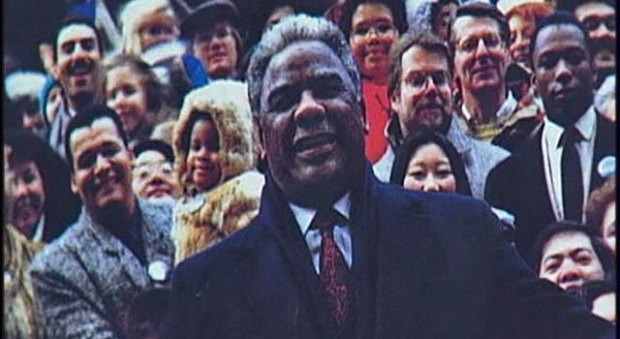

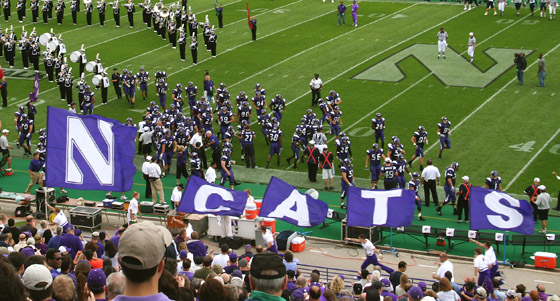
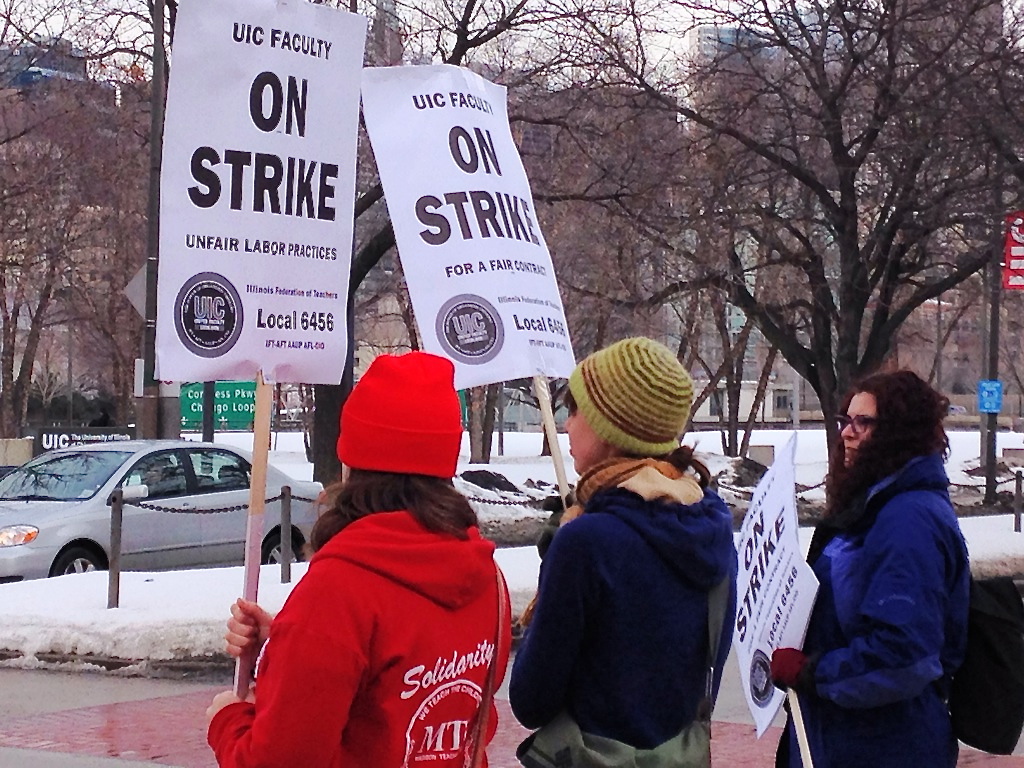
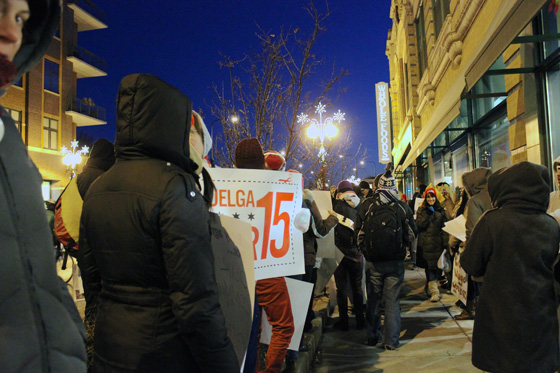

 I recently discovered that my alma mater, New Trier High School, did not make AYP (Annual Yearly Progress) mandated by the No Child Left Behind (NCLB) Act this year. (See
 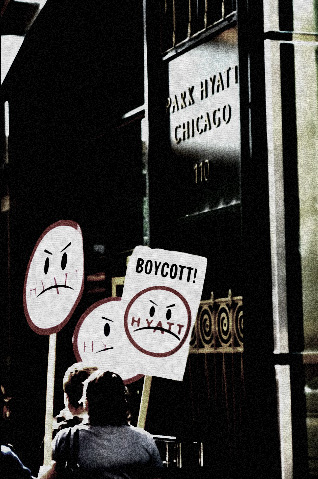 In addition to decrying the