Gapers Block published from April 22, 2003 to Jan. 1, 2016. The site will remain up in archive form. Please visit Third Coast Review, a new site by several GB alumni. ✶ Thank you for your readership and contributions. ✶
Construction equipment on the bed of the future Thornton Reservoir. Trucks on the Tri-State Tollway can be seen above the quarry.
On Saturday, I joined the Southeast Environmental Task Force (SETF) on one of its tours of Chicago's goliath infrastructure. The tour featured the future site of the Thornton Composite Reservoir, the largest such reservoir in the world, and a Deep Tunnel pumping station 350' below ground at the Calumet Water Reclamation Plant. Both are part of the Metropolitan Water Reclamation District (MWRD)'s gargantuan Tunnel and Reservoir Plan, the multi-decade, multi-billion dollar project designed to protect the Chicago region from the flooding and pollution caused by overflowing sewer and stormwater infrastructure.
In a culture where spare time is scarce and fast food is plentiful, healthy eating habits can be a bit tricky. This is especially true for young people.
Children today are constantly bombarded with flashy advertising and friendly mascots pushing chips, sprinkles, sugary beverages, and other generally non-nutritious food products. This rise of junk food has taken a considerable toll on children's health. Here in Chicago, nearly one-third of sixth graders and one-fifth of kindergarteners are clinically obese, putting them at risk for conditions like cardiovascular disease and type 2 diabetes.
Cook County Clerk David Orr, in a half-hour July 12 press conference releasing his office's required 2012 tax increment financing ("TIF") revenue report, highlighted the enormous amount of revenue siphoned from Chicago and Cook County taxpayers into TIF districts, and called for early declaration of surpluses within Chicago to fund needs like schools. Observing that billions of dollars have flowed into the now-over-500 districts, Orr released a video (embedded below) on the Clerk's website to help taxpayers grasp how the little-understood mechanisms work.
The video's tone suggests a school science filmstrip, kind of quiet in view of the alarming numbers, but this is government, not advocacy. At 2:41, over soothing guitar arpeggios, a pleasant female narrator says, "In most cases, taxpayers outside the TIFs pay more to generate the revenue requested by [their own] taxing districts." TIF critics such as the Reader's Ben Joravsky have hammered relentlessly on this, how TIFs hike your taxes, but it's easy to miss in the video unless you pause.
Orr's press conference was both longer and stronger than the official video. Noting that Chicago's collective TIF districts pull in half as many tax dollars as the City itself, Orr expressed concern that so "many taxpayer dollars are diverted into the Loop," charged that "not enough is being done in the neighborhoods," and that there has been little transparency as to how $5.5 billion in TIF dollars has been spent. He urged Mayor Emanuel and the City Council to declare a TIF surplus this year "as soon as possible" for the benefit of Chicago Public Schools, asking, "How do you explain to the kids in many of these schools that gym, music and art classes are cancelled while profitable businesses downtown ... received 25, 30, 40, 50 million?" Good question.
While Orr's remarks centered on Chicago, they echoed the same requests made by pressed suburban taxpayers for more transparency and accountability, better metrics, declarations of surpluses, and early retirement of no-longer-needed districts.
Overall, the video capably illustrates TIF workings and numbers, whose magnitude needs time to sink in, and Orr deserves credit for shining further light on what is now a gargantuan but opaque component of local governmental taxing and spending.
The argument over gun control is not, as some want to frame it, primarily partisan, let alone a battle between those opposed to violence and those OK with it. It's as much a geographic and cultural divide as anything else. Understanding the different perspectives stemming from the very different homicide rates in very different areas is key to overcoming simplistic sloganeering or unfounded assumptions, and is critical to basing policy on evidence. Consider Chicago and Iowa, for starters.
I posted an excerpt to this City Journal column last week to my Sixth Ward blog. You may have also seen it on YoChicago last week as well. The column was written by former Chicago resident and the author of The Urbanophile blog, Aaron Renn. He wrote about his column on his blog and was interviewed about it last week as well
What I highlighted were his conclusions:
Some of those challenges defy easy solutions: no government can conjure up a calling-card industry, and it isn't obvious how Chicago could turn around the Midwest. Mayor Emanuel is hobbled by some of the deals of the past--the parking-meter lease, for example, and various union contracts that don't expire until 2017 and that Daley signed to guarantee labor peace during the city's failed Olympic bid.
But there's a lot that Emanuel and Chicago can do, starting with facing the fiscal mess head-on. Emanuel has vowed to balance the budget without gimmicks. He cut spending in his 2012 budget by 5.4 percent. He wants to save money by letting private companies bid to provide city services. He's found some small savings by better coordination with Cook County. Major surgery remains to be done, however, including a tough renegotiation of union contracts, merging some functions with county government, and some significant restructuring of certain agencies, such as the fire department. By far the most important item for both the city and state is pension reform for existing workers--a politically and legally challenging project, to say the least. To date, only limited reforms have passed: the state changed its retirement age, but only for new hires.
Next is to improve the business climate by reforming governance and rules. This includes curtailing aldermanic privilege, shrinking the overly large city council, and radically pruning regulations. Emanuel has already gotten some votes of confidence from the city's business community, recently announcing business expansions with more than 8,000 jobs, though they're mostly from big corporate players.
Chicago also needs something even harder to achieve: wholesale cultural change. It needs to end its obsession with being solely a global city, look for ways to reinvigorate its role as capital of the Midwest, and provide opportunities for its neglected middle and working classes, not just the elites. This means more focus on the basics of good governance and less focus on glamour. Chicago must also forge a culture of greater civic participation and debate. You can't address your problems if everyone is terrified of stepping out of line and admitting that they exist. Here, at least, Emanuel can set the tone. In March, he publicly admitted that Chicago had suffered a "lost decade," a promisingly candid assessment, and he has tapped former D.C. transportation chief Gabe Klein to run Chicago's transportation department, rather than picking a Chicago insider. Continuing to welcome outsiders and dissident voices will help dilute the culture of clout.
YoChicago focused on the issues of demographics. Also, at another blog, Newsalert, they point to the issue of "one-party rule."
It's a big week for Midwestern conservatives. Days after WI Gov. Scott Walker's victory on Tuesday in the recall election against him will be a weekend double-whammy of the Friday-Saturday Illinois GOP convention in Tinley Park and Friday's regional installment of the Conservative Political Action Conference in Rosemont.
Action Now members rallied in front of JB Metals in the Englewood neighborhood on Thursday morning to highlight a parasitic practice of profiting off of stolen goods. Activists, many residing in the area, claim the scrap metal company knowingly accepts stolen property like fences or aluminum siding from scrappers thus depreciating home values and further harming the neighborhood.
As many cities face both costly aging infrastructure and looming budget deficits, public administrators are turning to fee increases to finance system fixes. Most recently, Chicago Mayor Rahm Emanuel's proposed 2012 budget outlines an up-to-25% increase in the annual fee for water and sewer services. The Congress for the New Urbanism supports Chicago's water modernization efforts, but the Mayor's proposed fee lacks a direct connection to urbanism and green infrastructure.
A rate increase that only patches sewer pipes will flush taxpayers' money down the drain. If this water rate increase only helps the City rebuild - instead of renew - water infrastructure, the same stormwater problems will plague the City's streets. Innovative and context-sensitive rainwater systems are not only sustainable and environmentally friendly, but also cost-effective. Green water infrastructure, the type(s) as proposed in CNU's Rainwater-in-Context initiative, helps reduce stormwater runoff and its stress on the sewer system. Permeable pavement, alternative street design, and other context-sensitive rainwater systems protect urban watersheds like Chicago's - undoubtedly one of the city's greatest assets.
The current state of disrepair of Chicago's water infrastructure should be viewed not as a liability that can only be remedied through higher rates for fixes, but rather as an opportunity to create longer-lasting, more sustainable systems that securely plant Chicago at the forefront of green design. As the Mayor is wont to say, "You never want a serious crisis to go to waste." Dense urban areas like Chicago have inherent environmental strengths (especially when compared to conventional sprawl patterns), and incorporating urban-minded water infrastructure can only enhance this standing. In committing to both green infrastructure and new urbanism, Mayor Emanuel has the opportunity to realize sustainable practices that reinforce the urban environment and protect the City's and taxpayers' assets for the long term.
Chicago helped pioneer interdisciplinary water and street planning, such as its Green Alley program. Dedicating water rate increases to broadly implementing urbanist green infrastructure keeps Chicago a leader in sustainable water policy. Mayor Emanuel's budget proposal to address inefficient water pricing is only part of a more comprehensive solution to better managing Chicago's watershed. Green - and urbanist - water infrastructure will shower rewards on both local government's coffers and taxpayers' pockets.
John Norquist is the CEO & President of the Congress for the New Urbanism, served as Mayor of Milwaukee from 1988-2004, and is the author of the book The Wealth of Cities
Caitlin Ghoshal is the Program Manager for the Congress for the New Urbanism, and served as a Mayoral Fellow in the Office of Mayor Rahm Emanuel during the Mayor's first 100 days of office.
South Side Chicago and the southern suburbs could be the battle ground for a Democratic heavyweight battle come next March. Former Congressional Representative Debbie Halvorson filed paperwork to explore a potential matchup in the second congressional district with Jesse Jackson Jr.
On August 25, Saint Francis Hospital in Evanston was fined $23,800 by the Occupational Safety and Health Administration (OSHA) for employees being exposed to patient blood.
According to Robert Malgieri, spokesman for HEART/AFSCME, the employees at St. Francis Hospital contacted OSHA due to their own concern for employee safety.
The 13-page complaint issued by OSHA states that St. Francis has failed to inform housekeeping staff of tasks that would result in exposure to bloodborne pathogens, have materials for bloodborne pathogen training in an appropriate language for the employees, explain what would be the plan for St. Francis Hospital if an employee was exposed to bloodborne pathogens, failed to explain what tasks would result in possible exposure to bloodborne pathogens, did not tell staff of methods that could prevent exposure, and that employees were not given a session to ask questions during the bloodborne pathogens training session.
Bloodborne pathogens include the Hepatitis B virus, Hepatitis C virus, and HIV as well as viral hemorrhagic fevers such as Ebola and Lassa fever.
The recent assaults on the EPA moved me to dust off and finish some notes I hadn't had time to polish into a full-blown blog post. Because the cuts now threaten Illinois clean water infrastructure projects, however, in addition to the climate change programs that have gotten deserved attention, I'm compelled to give this a little more air.
MetroPulse acts as an open-source data platform that allows press outlets, government officials, and concerned citizens to access over 20,000 data sets on 200+ different indicators that track quantifiable issues throughout Chicagoland. Using a broad array of indicators, from unemployment to foreclosure density to infant mortality rates to political participation, MetroPulse provides a picture of quality of life as measured in data.
The site serves many purposes, no small part being an ongoing checklist for the implementation of many of the recommendations of CMAP's GO TO 2040 Plan. By making such an aggregation of information readily available to any and every interested party, the Community Trust and CMAP are truly providing a means for mass engagement in development and community issues. While a site as exhaustive as MetroPulse will require constant upkeep and inputs of new data, its ability to level the playing field in terms of access to the details that shape the region - with both elected official and constituent feeding from the same source - carries the potential to change the tenor of discussion between political bodies and their public into something more frank than normal.
Give your neighborhood a test run on the site now, and start thinking about all the questions in store for those aldermanic candidates popping up all over the place.
This editorial was submitted by Valerie F. Leonard
The Chicago Public Schools has been under Mayoral control for the past 16 years. Under the Mayor's leadership we have had School Reform, Renaissance 2010 which called for school closings and reopening them as charter schools, and attempts to qualify for the national Race for the Top (which seems to have been modeled after the local Renaissance 2010 initiative). The changing of the guard in City Hall could have serious implications for the direction of education in Chicago.
The Chicago Tribune ran an interesting article regarding the fact that the State's standardized tests have been made increasingly simpler over the last 5 years. ("Students Can Pass ISAT With More Wrong Answers"). It should be noted that the article does not mention the fact that Chicago Public Schools lobbied the State to simplify the test 5 years ago.
At the same time, the Chicago Tribune's Editorial Board is urging the next Mayor to continue the course that has been laid by the current Mayor, and suggested that the new Mayor keep the current CPS CEO on board to continue the reforms that have been made. ("Reform on the Ropes?").
On the rooftop of the Harris Theater last Wednesday, over 800 people overcame the torrential rains to witness the adoption of the Chicago Metropolitan Agency for Planning's GO TO 2040 plan. CMAP, as it's colloquially called, is the regional planning organization of Chicagoland, and GO TO 2040 is their official, three-years-in-the-making guidebook that intends to serve as a road map for Chicagoland's growth and development over the course of the next 30 years. Paring its ambitious mission down to four main themes -- Livable Communities, Human Capital, Efficient Governance, and Regional Mobility -- the GO TO 2040 plan offers holistic prescriptions for the region as a whole, recognizing structural fixes are needed across all platforms.
Within its analysis, illustrations, and recommendations, CMAP, while never overtly saying so, lays claim to the argument that Chicago is effectively the main remaining relevant economic factor in the State of Illinois. (Obviously, the city is the largest and most influential in the Midwest as well.) And hence, given Springfield's antagonistic inability to recognize this, Chicago's relation to its state is simply a restraint on growth. It's Chicago's connection to Beijing, Sao Paulo, Shanghai, London, Dubai, almost anywhere but Springfield, that serves as the springboard to success for the region. Essentially, CMAP's plan is an argument that says in order maximize the global connectivity of Chicagoland to other global centers, the region's ability to successfully do so is directly correlated to the strength between its regional connections. With over 1,226 government units in the Chicagoland region due to myriad metropolitan agencies and functions, there is much room to streamline services and improve efficiency. And efficiency, used in the economic sense to mean the production of a good at the lowest possible cost that still provides benefit, plays directly into CMAP's call for sustainability.
Sustainability and tangibility are the two pillars on which GO TO 2040 rests. The plan promotes sustainability in its Livable Communities initiatives through the development of local food production, retrofitting programs to make older buildings better users of energy, and crafting local zoning laws to encourage mixed-use development of land. The Regional Mobility portion of the plan aims to improve mobility by increasing intermodal effectiveness, micromanage the budgeting process to bring transit agencies into fiscal well-being, and the implementing of five major capital projects, including extending the CTA Red Line south to 130th St, building the West Loop Transportation Center, and creating suburban highway connectors that flank the city and beyond. The Efficient Governance focus of GO TO 2040 is perhaps the crux of the entire plan. Any aspect of any plan must start with making access to government process and information more open and available, as CMAP outlines, and as detailed here in a earlier post, refocusing our taxing bodies into common sense vehicles.
CBS 2: Daley Mentored Others as He Shaped Chicago: But he's still "absolutely the best mayor in the country," Berry said. "Nationally there's no question he's been probably one of the most successful and important big-city mayors in the last couple decades."
Progress Illinois: Shift Expected at CAPS: The ground continues to shift at the Chicago Police Department. On Thursday, outgoing Mayor Richard Daley said he wanted civilians rather than uniformed police officers to run the Chicago Alternative Policing Strategy (CAPS) program. Ron Holt, the CAPS director, told the Tribune that too many of the 200 to 300 officers assigned to CAPS were doing administrative and civilian tasks. Many are expected to be reassigned to patrol work.
In These Times Working Blog: Hotel Quickie Strikes Build Union, Workers' Determination for Contract Battles: Workers in Chicago, like most of these cities, are responding with overwhelming strike authorization votes, protest rallies, sit-ins and civil disobedience, campaigns to persuade organizations and individuals to boycott certain hotels, and-last week-a planned one-day strike against hotel union UNITE HERE's national target, Hyatt, in four cities.
People of Color Organize!: Solidarity With Whittier School Occupation: The Whittier Parents' Committee has been organizing for seven years to push Pilsen alderman Daniel Solis to allocate some of the estimated $1 billion in Mayor Daley's TIF coffers to their school for a school expansion - he finally agreed to give $1.4million of TIF funds for school renovation. Cynically, Chicago Public Schools (CPS) has earmarked a part of this money for the destruction of the school's field house, which has been used for years as a center for community organizing and services. This would directly undermine the ability of the Whittier community to organize and struggle for educational rights. Parents are demanding to be part of the decision-making process.
Austin Talks: March against violence challenges community to fight back: Graham urged residents to take a stand against gun, gang and domestic violence. Rev. Jennie Jones of Pleasant Ridge Missionary Baptist Church led the group in prayer and pleaded for strength in the fight against violence plaguing Austin.
Chicago Union News: Adjunct faculty at Chicago college cries foul while trying to organize: With only a few weeks until fall classes begin, some part-time instructors at East-West University in Chicago's South Loop are still waiting to see if they will be hired back to teach after what has been a "messy" summer-long conflict involving efforts to unionize.
The Chicago Metropolitan Agency for Planning recently came out with an exhaustive blueprint for moving the region forward to the year 2040. The 416-pg manual for Chicagoland's tomorrow entitled GO TO 2040: Comprehensive Regional Plan nobly proffers an outline for greater Chicago to prosper in the years to come, and presents a view of 2040 as developed in the best of all possible worlds. Riding the waves of last year's 100th anniversary of Daniel Burnham's Plan of Chicago, CMAP
has unveiled a multi-pronged approach to dealing with the issues the region must address to build the most beneficial environment -- in all respects -- by that time. Focusing broadly on Livable Communities, Regional Mobility, Human Capital and Efficient Governance, the report breaks down each of those headings and gives them their fair due with hefty analysis.
From now till August 6, members of the public are encouraged to download the plan and comment on the ideas CMAP has offered. After the public review, CMAP will make changes as needed before presenting the plan as final to the overseeing CMAP Board. Then, acting as the designated Metropolitan Planning Organization for Chicagoland, CMAP will in turn use the Go To 2040 platform to engage the State of Illinois and the US Government for funds, approvals, and the green light on implementing projects according to the plan.
While the entirety of the report proves too exhaustive to outline in detail here, there is one sub-section of the Efficient Governance chapter that deserves a closer peek. Reforming state and local tax policies is an absolute must if Chicago intends to grow, and seeing how Springfield seems to operate in a state of permanent stasis, it will take the grit, gumption and initiative of local civic leaders to push the debate forward on this issue. CMAP encourages an almost wholesale restructuring of our current taxing system, including broadening the tax base by creating a tax on the service sector (currently exempt although it makes up nearly 70 percent of expenditures), instituting a graduated state income tax based on income levels, and in general, standardizing the tax policy across municipalities so as to avoid the large and varied discrepancies that render some communities unable to provide basic services.
I can't believe how much is ink is being spilled over the race for Cook County Assessor. While the Assessor can be an important advocate and has some policy-making flexibility, it is essentially an administrative office. Actually, maybe I can believe the ink being spilled since nowadays it's not very much ink. Maybe we need to update that cliche. I can't believe how many 1s and 0s are being coded? Too nerdy. I don't know, I'll work on that and get back to you.
Here's a modest prediction regarding that election anyway: Forrest Claypool, the independent politics darling who took on John Stroger in 2006, will make the ballot despite the onerous 25,000 signature requirement. Claypool has gathered a sufficient quantity, and, oddly enough, Scott Lee Cohen may help ensure his signatures survive.
How does bad-premise-screwball-comedy Scott Lee Cohen play into this? His oddball pursuit of an independent run for the governor's office may bring enough additional media attention to the process in the beginning to allow the Claypool people to hype any signature-challenge chicanery (or perceived chicanery) early on. The Berrios campaign is actually at a kind of disadvantage--even following the letter of the law, by challenging signatures, they may look petty or, worse, fearful of a campaign against Claypool, which will only add to his esteem among independent voters (it probably won't help that Joe Berrios is the chair of the county party). While we should probably expect Berrios' campaign to be aggressive, the public attention on the process could give Claypool a significant boost that may not be worth the electoral repercussions should he survive the challenge.
The Northwest Herald has reported that troubled Metra chief Phil Pagano killed himself this morning -- by walking in front of a Metra train. The apparent suicide follows a number of actions taken by the commuter rail transit agency against its director, who made more than a quarter-million dollars salary, following reports that he padded that amount without authorization, and the launch of a criminal investigation by the Cook County State's Attorney.
Maria is lying on the bed. She's been trying to get up, lifting her head, maybe rolling over onto an elbow, but she's gotten nowhere. Another half attempt to sit upright. She reaches in her pocket and fumbles with a cell phone. She wants to call her best friend Tammy, but her fingers forget where they're going and never make it past the US Cellular logo above the keypad. "Tammy, you wouldn't believe what I'm about to do," she'd tell her. But she can't get as far as calling her.
Seed Magazine has a fascinating piece about efforts to apply scientific "resiliency theory" usually reserved for ecological systems, to urban centers. Resiliency theory is a way of conceiving dynamic systems to gauge how they react to changes in inputs and how embedded feedback systems behave over time. By looking at cities through a resiliency lens, theorists hope they can better understand how cities change, grow, and safeguard themselves, and perhaps even better plan systems to protect the general welfare and improve quality of life.
The Urban Network has research sites in 12 cities: Bangalore, New Dehli, Cape Town, Johannesburg, Chicago, New York City, Phoenix, Canberra, Helsinki, Istanbul, and Stockholm. These cities span the globe and differ vastly in terms of culture, history, and economic development. The ultimate goal, according to Thomas Elmqvist, lead researcher of the Network, is to do a comparative analysis of these cities. How are they similar or different with respect to handling development? How do they compare it comes to withstanding shocks and surprises?
"As humans, we should try to understand how to manage systems in order to avoid passing thresholds," says Elmqvist. But this is especially difficult in urban contexts, which have already been so transformed by humans that they've breached most of the thresholds ecologists are familiar with. When great expanses of concrete and steel now exist where trees and streams once did, new tipping points must be defined for places that are, as Elmqvist puts it, "already tipped."
Case studies are now underway in each of the Network's 12 participating cities. But in deciding what kind of data to gather, researchers have had to ask themselves: What would a city look like through the lens of resilience?
So having recovered from spending the last couple weeks shaking and crying in a dark corner somewhere in Pilsen after the Hoffman defeat, and bringing all of you down with me in my last post, I'm back to depress the masses yet again with a Chicago tale.
I was reading this article today, written back in January, about state House speaker Michael Madigan. It was filed in the Tribune's "Watchdog" category, which I was browsing in need of some civic inspiration--something I've been severely lacking as of late. It's about Madigan trying--and, of course, succeeding--in using his influence to drum up business for his tax law firm. See, after a developer sought and received zoning changes for his newly acquired downtown property, Madigan swung by his office to see what other properties might need his firm's services.
"When Mike Madigan calls and asks for a meeting, you meet with him," the developer says. "I mean, I was born and raised in this town."
Editor's note: This article was written by Sofia Resnick. Multimedia slideshow by Chris Neary.
Starting this week, getting around on city buses and trains will be challenging to those who value efficient and reliable public transportation. If they're to believe the Chicago Transit Authority's promise for 18 percent less service on buses and 9 percent less service on trains, riders can expect to wait longer for even more crowded buses and trains. Who knows how many riders will abandon public transit for the warmth and comfort of their cars, the speed of their bicycles or the self-reliance of their own feet.
Not every commuter in Chicago has the luxury of choice when it comes to transportation.
People with disabilities who depend on an alternative door-to-door service — what's known as paratransit — can't alternate their plans when service plummets or fares climb, as they did at the end of 2009. Pace, the transportation agency most people associate with suburban buses, runs Chicago paratransit. As with the CTA, a troubled economy has driven Pace's budget so far into the red, riders have become accustomed to almost yearly declines in efficient, affordable service.
One paratransit rider, Dr. Ayo Maat, has a plan to bring affordable, reliable and eco-friendly transportation to Chicago's disabled community. Maat is proposing an alternative to the current paratransit system that would bring independence to riders with disabilities, by having them run their own service.
I'm not entirely sure how I should feel after Tuesday's elections. Over a year of work on behalf of Rudy Lozano's state legislative campaign culminated in the single most bizarre Election Day I've ever experienced. Being there, at the Strohacker Park Field House at 4am on that snowy Tuesday morning was just the latest in a long list of "being there" days. Being there meant endless meetings plotting strategy, developing platforms, and setting up committees and what not to get the petition drive going. Being there meant the thrill of hearing words I wrote delivered in front of over 300 volunteers and supporters at Little Village High School on a warm August evening. Being there that day also meant having to go to the bathroom for 2 hours while collecting signatures and singing every Billy Idol song I knew waiting for the light at 25th and Pulaski to turn green before I wet myself. Being there meant days when we had big groups of volunteers knocking on doors for signatures and nights when it was just me, my 6 month old in a Baby Bjorn and Manny walking around Archer Heights. It was about late nights updating databases, running over to the Chicago Board elections for data CDs and ultimately, serving as a precinct captain on Election Day.
The most immediately important race for Chicagoans is probably the Cook County Board President's race, with the addition of insurgent candidate Jesus "Chuy" Garcia's win in the Southwest Side 7th District. John Fritchey, another reformer--based on his activities in Springfield--won election to replace Forrest Claypool, who retired this year.
If Cook County is truly cleaned up, a huge spigot of patronage dollars--of both the old-school and pinstripe kind--can suddenly go dry for significant portions of the Chicago machine. Contracts with the County and particularly it's hospital system are an important source of income and campaign donations for Regulars and their associates. Commissioner Moreno himself was embroiled in a scandal whereby he allegedly shook down a health care software company to hire a political ally in order to qualify as a minority-owned business.
Assuming the Board's reformers have the gumption to take that system head on, the machine system in Cook County, and particularly the city, could show the kinds of weaknesses that open up electoral fronts.
In other news, wow, Terry O'Brien. Dude spent a lot of money to do as poorly as he did. Also, Quinn versus Brady may poll close, but Quinn will have to do a lot wrong to lose the enormous Cook County advantage that Democrats enjoy. Bill Brady, among the most conservative of the GOP candidates, will have trouble bringing back those suburban Republicans-turned-Democrats. In the Senate races, lots of speculation that Hoffman is perfectly positioned to run against Mayor Daley in '11. That election happens in mid-winter 2011--a year from now. If Hoffman plans to run against the Mayor, he better start in the Spring. The Mayor raised more than $50 million dollars for the Olympic bid. What do you think he could squeeze out of people for a competitive race against a prosecutor? Hoffman of course lost to Alexi Giannoulias. Speculators as to Alexi's "baggage" forget exactly what Hoffman's three-week meteoric rise should have taught them: nine months is a long, long, long time in politics. Who knows what's going to happen by November? Nine months ago the only tea party we talked about here happened at the Drake Hotel, in white gloves.
I wrote previously on this blog about the state of media in Chicago, specifically that branch of journalism that goes by so many names which I shall call public accountability journalism (see last section). With traditional media in the state of disrepair it finds itself, the civic-minded are in a fit over what will become of their beloved citizen watchdog.
My previous comments pointed the way to some excitingnewventures trying to fill that void in Chicago, a motley group of start-ups with interesting but uncertain business models. But there is another sublimity to the forsaken print newspaper that has to a debatable degree been lost in the bifurcated world of online media and it's seeming preference for niche publication. This idea, which is far from new or my own, I'll call the General Reader Principle.
Woke up on the couch I call bed the other day, rolled over and popped open my Mac. Email; check. Facebook; check. Grab some coffee, head back to couch. Twitter feed; new updates from @ChicagoCurrent, @WBEZ, @chicagonewscoop, not to mention the dinosaurs.
Checking my twitter feed in the morning is sliding comfortably into that sacred place once occupied by pouring over the broadsheets, grey paper no longer splayed out across the table, coffee in hand, trying awkwardly to fold the page back upon itself.
"They never thought of the children first," Lillie Gonzalez exclaimed to several hundred people's applause at Malcolm X college. The small, but feisty, Latino community activist was speaking at the Democratic Alternatives to Renaissance 2010 conference organized by the Grassroots Education Movement (GEM) and the Caucus of Rank and File Educators (CORE) on January 9, 2010. Gonzalez was "one of the lucky ones," who was able to stop the closure of Peabody Elementary School in 2009 in Chicago's Near West Side. The planned closure of the more than a century old school was a part of Renaissance 2010, Chicago's program to privatize its public schools.
"Renaissance 2010 and 15 years of mayoral control are 15 years of failure." Explained Kenwood Community Organization organizer Jitu Brown. Describing the conference, Brown stated, "we want to begin to project what we think should happen in our schools... Our vision, not a corporate vision."
President Obama's appointment of Arnie Duncan to the Secretary of Education made the conference particularly important. "The first thing that Arnie Duncan did as US Secretary of Education is fly to Detroit and promise Detroit Public Schools major federal funds if they were to adopt the Chicago model," Pauline Lipman, a professor at the University of Illinois Chicago, explained.
Lipman pointed out that, "Renaissance 2010 is a partnership between Mayor Daley and the most powerful financial and corporate leaders in the city. What is their goal?" she asked before answering "to train a low wage workforce and to support real estate development. That's their education agenda. Their strategy is to hand public school to private operators, undermine the teachers union, phase out local school councils, the only democratic community voice we have, and replace neighborhood schools with selective enrollment schools and gentrifying neighborhoods."
"They have a long term plan. If they don't kick you off this year, they will pick you off next year." Lipman explained.
The trafficking of human beings from foreign lands into the United States has caught plenty of media attention. The narrative of young women from Eastern European and South Asian countries being promised work in America, only to be forced into labor- or sexual-exploitation is familiar.
But homegrown trafficking is just as serious. Because of the illicit nature of the industry, numbers are hard to come by. The legal and academic literature on the matter is littered with phrases like "to an unknown extent" and "ambiguity in scope." But in Chicago, many women are forced into prostitution by family members and boyfriends, pimped out for money by force, or worse.
Today is Human Trafficking Awareness day, and the Chicago group Traffick Free is spreading awareness tonight by screening the film Cargo: Innocence Lost, followed by a Q&A with local experts on the matter. The event takes place at Park Community Church, 1001 N. Crosby St., at 7pm. See Traffick Free's website, linked above, for more information.
On top of that, and perhaps not too surprisingly, two Illinois congressmen came out last week endorsing Stroger's opposition. Rep. Danny Davis endorsed Brown, ahead in the polls at the moment, because he wants "to be with the one who's going to win." Rep. Gutierrez endorsed Preckwinkle, he reportedly said, because of her progressive values.
But let's back up a moment. The interesting thing here, I believe, is Rep. Davis's reason for endorsing Brown.
I had the pleasure yesterday, in between e-mail and a client meeting, to take in the 7th Annual lunchtime media briefing by Chicago Metropolis 2020. CM2020 is a non-profit organization originally established by the Commercial Club of Chicago "to promote long-term planning, better regional cooperation, and smart investments in the Chicago region and its people." The briefing, attended by a number of notables on the Chicago journalism scene, promised presentations on criminal justice reform; campaign finance limits; housing policy, early childhood education, and the Burnham Plan Centennial.
Adele Simmons, VP of the Burnham Plan Centennial, combined a general welcome with an overview of the mission of the Centennial, which is to carry on the legacy of legendary planner Daniel Burnham by focusing on innovative regional solutions for the Chicago metro area, saying, "The choices we make today will shape the future." While that statement might seem tautological at first, the emphasis was on bringing to the forefront of our decisionmaking the long-range, rather than short-term drivers.
The following is a repost from Mike Fourcher's blog, Vouchification.
The increasingly desperate straits of Chicago's news outlets is already having an impact on what - and how much - news gets covered. More cuts are coming. In the next year we should expect a significant decrease in community and political news coverage in the Chicago area. Small start-up are trying to fill the gaps, but they lack resources and readership to make up the difference.
Last week I reviewed the financial states of Creative Loafing, Inc. and the Sun Times Media Group. Although CLI is suffering, friends from the Chicago Reader assure me their paper remains profitable - despite CLI's debt. But STMG regulatory and bankruptcy filings seem to show that the Chicago Sun Times is the major money loser among STMG properties. It seems possible - even likely - that the Sun Times may not exist in 2010.
Earlier this year the Chicago Tribune's parent company, the Tribune Company, went into bankruptcy, burdened by $12 billion in debt created by Sam Zell's leveraged buyout of the company. Although recent news suggests Zell will be muscled out and the company will become the property of creditors - especially Deutche Bank - it seems likely that the new owners will be looking for ways to increase cash, reduce expenses, prepare the company for sale, or dismember it into parts for individual sales.
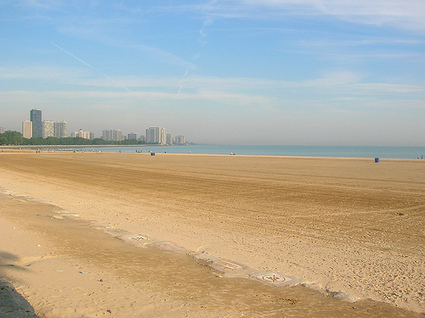
Ahh, mid-summer. It's a good time to think about finally scheduling that relaxing day at the beach along Lake Michigan. But take a closer look at the water you're about to take a swim in -- the Natural Resources Defense Council has some unpleasant news about what's lurking underneath.
According to the Council's annual survey of water quality, "pollution caused the number of beach closings and advisories to hit their fourth-highest level in the 19-year history of the report." The report notes that old and "poorly designed" sewage and stormwater systems are two main factors causing beachwater pollution. How did Illinois fare?
An Illinois state law could prevent a Skokie man from calling himself an engineer despite an engineering background of 50 years, 123 patents, and work on cameras that accompanied astronauts to the moon.
On July 8th, Judge Mary K. Rochford of Cook County Circuit Court heard oral arguments brought by attorneys for Burton Siegal in an emergency hearing that could make or break legal precedent on free speech rights reaching far beyond the engineering field.
At stake: Government regulation of the use of words.
Most people would shudder at the very idea of laws governing speech, but in reality, it happens all the time...and we're fine with it. Consider the fines levied against CBS when Janet Jackson experienced her infamous wardrobe malfunction during the 2005 Superbowl, or those pesky bleeps you hear every time Cartman on South Park utters words you know anyway.
The accepted basis for this approved form of censorship is for the protection of people, whether pure of heart (children), or weak of heart (the elderly). But politicians also claim they should regulate words for the general welfare. We wouldn't want just anyone calling himself a doctor, teacher or engineer, right?
Tune in to Ray Hanania's morning talk show--WJJG 1530 AM, Radio Chicagoland--to hear me and Progress Illinois' Josh Kalven talk about local and state politics of the preceding week tomorrow at 8 a.m. We'll be on until 8:30 or 8:45, as part of a weekly feature. Josh has a pretty soothing voice and Ray is a comic, so there will be plenty to counter act my very limited wit and nasally, accent-y voice (also I have a nasty cold, so there's that).
Any issues you'd like us to talk about? Email me (email is below on the side bar) or comment here.
Five local transit and planning advocates held a media briefing via conference call on June 25 to elevate the attention level of House Transportation Committee chairman James Oberstar (D.-MN)'s $500 billion surface transportation stimulus/funding bill, as well as to call for improvements in the bill. The consensus of the panel was that the bill provides much needed funding but still lacks some key elements, most prominently performance measures and a heavier mass transit emphasis, to effect meaningful change in national transportation policy.
Oberstar and Rep. John Mica (R.-FL) released the full draft text of the 775-page Surface Transportation Authorization Act of 2009 ("STAA") on Monday, June 22. A shorter 17-page summary was made available the week before. Fuller account below.
TV typically only carries a few seconds of action from an event. One or two pictures in print media are all that we can usually expect. This is not a rap on those media, just acknowledgment of their limits, especially in an economy this stressed.
Since I was downtown at the Responsible Budget rally last week, I thought I'd post this short (3-min.) clip, which gives more of the real size and flavor. It was the biggest rally I've ever seen for a tax increase. No doubt there are still places to cut the budget, but that doesn't negate the reality of needing to do something responsible to prevent the hurt that will occur if the draconian cuts threatened take place.
The video includes the remarks by Bill McNary of Citizen Action as well as those of working mother Gloria Gonzalez. You may have better luck viewing without interruption if you go directly to YouTube.
I'm
sure many of us have experience some type of frustration now that
Chicago has employed the use of red-light cameras to catch people in
the act!
This was the story of a woman who was nowhere near the location
a camera caught her at. She got a ticket in the mail and she decided to
contest this. She had to cough up some money to even protest this red
light ticket and had to appear at the Daley Center three times before a
license plate was produced.
That license plate was key to getting her case dismissed. Why?
After all the dust had cleared and the expenses were paid by this
tenacious senior citizen, including time, parking fees, tolls as well
as anguish and distress, the case was dismissed.
It was dismissed
simply because, after investigation by this lady, it was discovered
that two vehicles registered in the state of Illinois can have the same
identical plate number. The only difference is that one is a vanity
plate.
A case of mistaken identity! Especially since this woman drives a
Buick and the car that was caught on camera was a Chrysler van.
Some major transportation and planning projects that affect your daily commute may be in jeopardy if the Chicago Metropolitan Agency for Planning cannot secure more state dollars.
The planning organization -- which studies land use and transportation planning for the seven counties of northeastern Illinois -- is asking on its Web site that concerned residents write to state legislators, expressing their concern that Governor Quinn's proposed Fiscal Year 2010 budget does not include the Comprehensive Regional Planning Fund (CRPF).
In past years, CMAP received about $3.5 million, or 70 percent, of the $5 million statewide CRPF fund annually, according to Tom Garritano, CMAP's communications director. Garritano says this money is crucial to current and future CMAP projects.
"The money is really important, even though it doesn't make up the majority of our annual budget," he says. "It is needed to match the federal transportation dollars that come to the region, and it pays for a lot of the non-transportation planning that CMAP does."
So how is it that this relatively small portion of money affects CMAP so significantly?
It's become almost cliché that mass transit was "saved" last year through a sales-tax funded revenue scheme, amended by Gov. Blagojevich to include, among other things, free rides for seniors. Something, anything, needed to be done to keep the trains and buses running, and my state Rep. Julie Hamos (D-Evanston) rightly got credit for brokering a deal between Springfield factions who didn't often play well with others. However, I suspect that most of those lauding the fix don't actually ride mass transit very often.
Given typical political schedules, I doubt many opinion leaders have spent as much time as you and I have standing on windy, freezing, sometimes-scary platforms, held hostage in tunnels or "slow zones," or stranded in the Twilight Zone of a bus stop for 40 minutes on a route that's supposed to provide service every 15. I wonder how many legislators have picked up a copy of Metra's February newsletter, On the Bi-Level, which spells out how their lack of capital funding for the last 5 years now imperils the very rails on which we ride.
State senator Martin Sandoval, acknowledging what has become clear, that last year's so-called save of mass transit was only a band-aid that avoided yet one more "doomsday" scenario, and after first criticizing the recent "mini-capital" bill as allotting insufficient monies for transit, has called for a three-part solution to address transit funding on a permanent, not stopgap, basis:
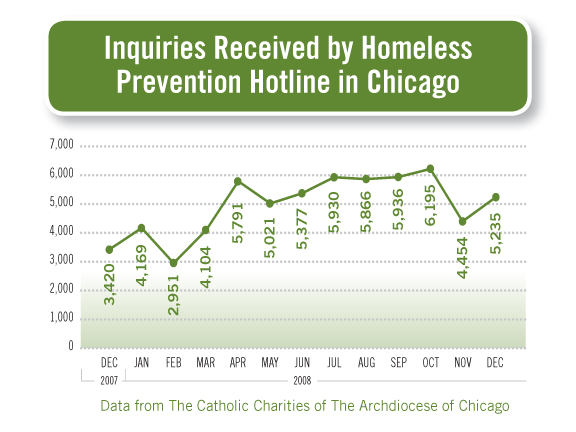
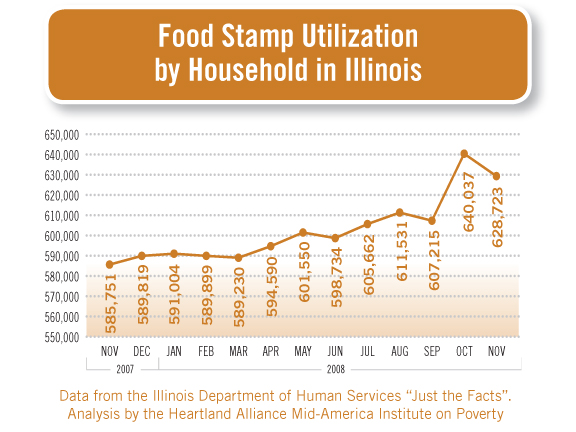
The Chicago Community Trust has released some disturbing numbers today, indicating homelessness continues to rise in the city. And across the board, all of the indicators of economic collapse are on the rise over 2007 -- homes dependent on food stamps, the explosion in foreclosures, unemployment, everything.
gulp.
The work of the Trust in distributing these "vital signs" of our city's economic health are critical to understanding what "hard times" means in real terms. In 2008, nearly 40,000 more households -- somewhere over 100,000 people -- came to be dependent on food assistance to make sure they had enough to eat. The type of social and political instability that kind of economic insecurity causes is hard to comprehend unless you've lived in the middle of it. To have tens or hundreds of thousands of people plunged into economic insecurity creates the atmosphere of desperation that, often, only radical change can address.
Jump the jump for the January reports from the Chicago Community Trust.
While the Roland Burris docudrama was playing out, Metropolitan Water Reclamation District Commissioner Patricia Young quietly announced her resignation. Young will be stepping aside to take a full-time public affairs job with the MWRD that pays nearly twice as much. The kicker: under the Metropolitan Water Reclamation District Act, the vacancy is filled by...appointment of the governor "until the next regular election."
No accusations have been made that Blagojevich tried to sell this seat, a $50K job that most treat as part-time, but no doubt there are many who would oppose his filling the vacancy. Will he? Should he, now that he's been formally impeached? Unlike the U.S. Senate, where a political argument could be made that Barack Obama may well need that Illinois vote, no compelling urgency to fill the vacancy jumps out. But unlike the U.S. Senate scenario, there doesn't seem to be any requirement that Jesse White put his thumbprint on an appointment -- so it would seem to be at his complete discretion.
The District's storied history as a place rife with murky dealings that the public rarely even hears of would seem to set this up as perhaps one last big opportunity for some pay-to-play type chicanery. Hard to imagine that any of the more nefarious influences on county politics want Pat Quinn having the choice.
The MWRD is an agency desperately in need of some new blood. Out of the sunshine, it doles out enormous sums on contracts and bond issues incomprehensible to the average voter, all the while pouring tax dollars into a Deep Tunnel project destined to go on seemingly forever but with no apparent progress in stemming city and suburban flooding, or releases of sewage into Lake Michigan.
Regardless of who makes the pick, some supporters of Mariyana Spyropoulos are urging she get the nod. This last March, she just missed nomination for the MWRD, coming in fourth in a field that gives the Democratic advantage to three. Spyropoulos had the endorsement of both the Trib and the Sun-Times, as well as environmental groups such as the Sierra Club.
I doubt we'll see any clamor for a special election for this spot, so we could do worse than slotting in someone who already demonstrated some voter support as well as the approval of third-party reviewers.
It's now been 11 days since the carbon monoxide leak which sent over 80 Prussing Elementary School students and staff to the hospital. While officials from Chicago Public Schools have partially answered some questions, and CPS CEO Forrest Claypool has informed that he will be visiting the school to field more questions on Nov. 16, many parents remain irate at the CPS response to date. More...
It's not surprising that some of Mayor Emanuel's sympathizers and supporters are confusing people's substantive disputes with the mayor as the effect of poor marketing on his part. It's exactly this insular worldview that has gotten the mayor in hot... More...