Gapers Block published from April 22, 2003 to Jan. 1, 2016. The site will remain up in archive form. Please visit Third Coast Review, a new site by several GB alumni. ✶ Thank you for your readership and contributions. ✶
Matt Farmer, local activist, musician, attorney, columnist and LSC member, spoke at the CTU rally last week with an interesting conceit: subjecting Board of Education member (and big time Barack Obama fundraiser) Penny Pritzker to a withering mock cross examination. Farmer, like many CPS parents, is incensed at the double standard deployed by the city's elite leadership when it comes to what their kids deserve and what working class children deserve. Watch:
The Illinois General Assembly is considering legislation, known as SB3261, to require hospitals that receive property tax exemptions to provide more than stabilization care (already required by the federal Emergency Medical Treatment and Active Labor Act, or EMTALA) to people who earn 125% or less of the federal poverty level in rural areas, and 200% or less in urban areas. The amount of free and subsidized care provided by hospitals has been a hot button issue in Illinois, and across the country, at least since 2007, when the U.S. Senate began a series of hearings on charity care, and in Illinois since a high-profile case involving Provena health care put hospitals' tax exemptions in limbo. The legislation is an interesting approach to solving the problem of health care provisioning for low-income residents, given the immense shortfalls in Medicaid funding states have been facing since the freefall in tax revenue brought on by the Great Recession.
Last Wednesday, the Chicago Teachers Union held a rally in preparation for contract negotiations beginning later this summer. Karen GJ Lewis, who was elected president of the CTU in 2010 after a hard-fought, close election against the incumbent, mayor-friendly leadership, sums up the frustrations teachers feel as they've been made scapegoats by school-privatization special interests like Stand for Children.
Last year, Stand for Children and affiliated interest groups pushed through SB7, designed to restrict collective bargaining rights and weaken teachers' negotiating position. Part of that strategic attack on public school teachers was a requirement that 75 percent of union members vote to authorize a strike should contract talks fail.
Nearly 6,000 members of the approximately 25,000 member union showed up to the rally on Wednesday, and as the video below shows, they were fired up. That 30 percent of union members could be motivated to turn out, march, and rally to show their unity should have been a chilling image for the Mayor's contract bargaining team. If talks fail, the CTU may very well have the leadership in schools across the city to secure a strike authorization vote; and if 75 percent of teachers vote for a strike, that will be a resilient strike.
Mayor Rahm Emanuel and Police Superintendent Garry McCarthy detailed a gang-reduction strategy at a press conference Tuesday.
"Very clearly, we have a gang problem in the city of Chicago," said McCarthy. He then went on to detail a strategy that involves the mapping of gang intelligence, which will be available to police officers in their patrol cars.
"It includes the monitoring of social media," McCarthy said, stating that gangs often communicate using Twitter and Facebook.
Using police intelligence on gangs, officers can look into a gang-related violent incident, predict where retaliation might occur and respond appropriately.
Mayor Emanuel referred to the success of the recent crackdown on liquor stores that attract gang violence, which he refers to as a "cancer on the community."
Four liquor stores have already been shut down, and there are 30 more that could have their license revoked.
"All of us have to be on the frontline of this issue," said Emanuel.
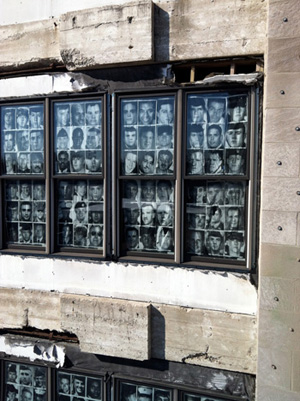
There are just faces. No sign. No numbers. No flag.
In the windows above the Chicago Printmakers' Collaborative a powerful memorial to the United States servicemen killed in the War in Iraq is fading. Six hundred forty-eight faces fill three stories of windows. Some are now torn, faded, water-stained, or simply falling down.
"We have to keep repairing it," says the Collaborative's owner, Deborah Lader. "We go up and tape pieces back up."
Each piece is the face of a soldier who lost their life serving in Iraq. The Façade Project, created in August of 2004 by artist Carrie Iverson, abuts the tracks of the Brown Line's Western stop in Lincoln Square at 4642 Western Ave. There, the faces of the fallen peer out at the thousands of riders who pass through the stop every day.
By the time the project was completed in August of 2004 it was clear the war would not be the tidy six-month engagement that former Defense Secretary Donald Rumsfeld infamously predicted. The deaths of soldiers were no longer getting front-page hero treatment. As the death toll climbed, the faces slipped deeper and deeper into the paper and out of newscasts.
So here's an interesting problem for students of how cities operate.
Public health and public transportation are two of the marquee issues for planners, and they're intertwined. Land use planners have recently turned towards policies that encourage walkability, bikeability, and "transit-oriented development." Mayor Emanuel's administration is currently undertaking an impressive, ambitious plan to introduce more than 100 miles of protected bike lanes, of the type found on Kinzie Avenue between Jefferson and Wells. Decreasing reliance on cars is a public health issue because it makes it easier for people to be active, and decreases vehicle emissions that pedestrians encounter as they move around the city. Similarly, the Affordable Care Act had provisions for public/private community health facilities with a focus on patient outcomes rather than fee-for-service models that merely encourage remedial care.
Two of the main sources of funding for public transportation and public health (particularly as the latter is undergirded by state Medicaid) are gasoline and cigarette taxes, respectively. You can see the immediate problem; the better transportation and health systems are designed, the more they must compromise the source of their funding. With transportation, this creates the most immediate problem: with increased volatility of gasoline taxes and a sharp increase in ridership, ill-equipped public transportation systems need more and more money to handle the increase (the fares are never enough to capitalize increased infrastructural capacity).
A brief by the American Public Transportation Association touches on this problem; as public transportation ridership increases, capacity needs increase even while revenues drop. Because fares will never be sufficient for real expansion of capacity, there's a systemic knot that can't be untied without a federal-state-local approach to overhauling the funding system.
Obviously, there's a similar problem with the vice-and-obesity taxes on things like cigarettes, alcohol, and fast and junk food. Where these revenues are meant to fund necessities--community health care in particular--the fact that the tax exists as a "disincentive" to unhealthy decision making implies the outcomes we want--healthier city living--are not really priorities. The addiction persists.
According to the study, the goals were to find ways to improve capacity for a predicted increase in Metra and Amtrak riders, improve transfers and make the terminal more inviting.
As someone who uses Union Station on occasion, I think that all of these are much needed improvements.
Despite coverage to the contrary, the last few days of "No NATO" activities were overwhelmingly peaceful. The near constant demonstrations snaked their way through downtown while flanked by onlookers and hundreds of police officers, while complementary efforts to rehabilitate derelict houses, discuss contemporary politics and celebrate inhabited far flung neighborhoods.
The following slide show samples from those events while featuring some of the most public demonstrations.
Ugh. There's no good way to go about this, particularly so soon after the protests have settled and the fact and myth detritus is yet to be sifted through. Forensics at this stage are dicey.
I've never been keen on protests as purely symbolic gestures, though I generally don't criticize them, as speech acts have an (admittedly de minimis) inherent value in a republic. Protests qua protests typically serve as an internal act of organizing--honing organizational processes, identifying activists and leaders, developing messages, and serving the omnipresent need for "consciousness raising." But protests as pure speech acts are ephemera--or, maybe better, phenomena--that should express organizational acumen and announce a program to the public, rather than being the program itself. In other words, an organization's strength won't come from protests; protests should be an expression of strength built as a result of direct action contending with the status quo.
The protests that unfolded over the weekend, particularly over the last twenty-four hours, reflect the lack of a means-ends connection. Their listing from an identifiable objective, perceived lack of focus, and disparate employment of means are a function of not having an objective--even a grand one, like Gandhi's all-encompassing goal of an independent nation void of all forms of social violence--and thus being unable to calibrate their activities to that vision.
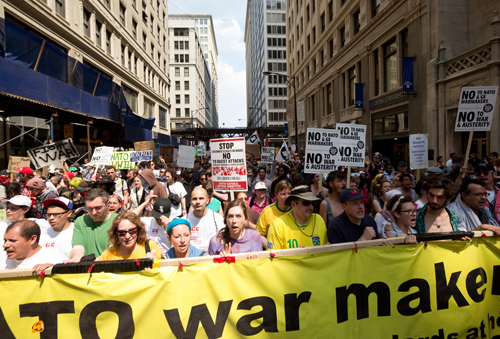
Thousands marched from Grant Park to the intersection Michigan Avenue and Cermak Road, about two miles, led by the Iraq Veterans Against the War (IVAW). At the end of the march, as close to the NATO conference at McCormick Place as the demonstrators were allowed to go, veterans of the wars in Iraq and Afghanistan threw their military service medals onto the ground as a symbolical gesture of their disapproval.
Around 50 protestors gathered at President Obama's campaign headquarters downtown to protest the use of unmanned, weaponized drones in the War on Terror. Organized by the women's anti-war group Code Pink, the protest moved from the campaign headquarters to the Canadian, British and German consulates.
The march was joined by around 20 bicycle-riding police officers, who used their bikes to block off the front pavilion of the Obama campaign headquarters.
"Drone strikes that target both militants and civilians are illegal," said Bill Quigley, a lawyer who is involved in the cause against drone strikes. "It's been illegal to assassinate people in other countries since President Ford and President Reagan made it illegal."
Protestors wore the names of drone strike victims from Pakistan, Somalia and Yemen and carried two large cardboard drones. Included in the names worn by protestors was Anwar Al-Awlaki, an American citizen and leading member of Al Qaeda who was killed by a drone strike in September, 2011.
In front of the German consulate, the group was joined by Tobias Plueger, former German delegate to the European Parliament, and Inge Hoeger, a member of the German Parliament.
"When they do wars they kill people, and when they do wars they also kill democracy," said Pflueger, referring to NATO.
"Because NATO is a war organization, Germany should be out of NATO," said Hoeger in German, translated by Plfueger. "And NATO should be disbanded."
When civic leaders like Mayor Emanuel, his billionaire backers on the World Business Council, or the Commercial Club, talk about making Chicago a "global city," they don't quite mean making it a shining beacon to the world's reformers struggling to make the world a better, more egalitarian place; they mean they want to make it attractive to the already wealthy and powerful. They want to showcase it as a potential playground for those who can enjoy its luxuries; in a piece for Huffington Post, Tammy Webber quotes Richard Longworth from the Chicago Council on Global Affairs:
"We ought to be known for something more than the old stockyards, smog or Al Capone, but we aren't," said Richard Longworth, a senior fellow at the Chicago Council on Global Affairs. "People are surprised when they visit, and that's why" Mayor Rahm Emanuel wanted the summit.
"We have to stop being a surprise," Longworth added.
When you do that, you create a stark relief between those who enjoy the recreation and those who can't pay the price of admission.
The litany of protests planned for the NATO Summit reflect this. If Chicago is to be a locus for convening the powerful, the powerless are going to want to confront them. Activists and reformers from all over the world are targeting the NATO Summit for what it represents: war as a priority, even while a devastating recession has thrown tens of millions of families into the dread of economic insecurity.
Today, Code Pink is marching on President Obama's reelection headquarters to protest "endless war" in Afghanistan and the killing of innocent families with remote-controlled drone attacks. On Saturday, the Mental Health Movement is planning to protest in Mayor Emanuel's neighborhood against the closure of six mental health clinics at the same time the Mayor and his business supporters are raising tens of millions of dollars to provide refreshments and entertainment for some of the most powerful people on Earth.
In turn, the city has a choice; are we going to treat activists and protesters as criminals-in-waiting and militarize our public safety (and expand our already troubling surveillance state) to the same degree that we become more and more global a city? Or accept that with global money come global problems and preserve Chicago's historical place as a center of intellectual and organizational freedom?
The introduction of equipment like the Long Range Acoustic Device, or LRAD, is not a good sign. Excellent at dispersing people because of the intense pain and sometimes long-term damage it causes, LRADs win the approbation of police forces because they appear harmless, even while causing real damage--in the words of some experts, a form of "acoustic assault."
Just as the city has been thrown into turmoil for its residents--street closures leading to business closures, traffic snarls making it difficult for people to move around, and intense security cordons that are discouraging residents from moving through areas of the city they'd otherwise enjoy on a weekend.
As we become more of that type of "global city," with more permanent institutions meant for the global elite, will a sanitized corridor controlled and maintained by militarized police empowered with new surveillance tools itself become institutionalized? In other words, is this the first of occasional nuisances, or the trial run for the long-term "globalization" of a portion of our city meant to create a comfortable space for the global elite at the expense of local desires, wishes, and needs?
It needn't be. Insofar as hosting events does indeed bring needed money into the city, that's a good thing; and protests and activists are integral to reminding the city's leadership why we need that money: to promote economic security for all of us and remember our priorities.
A global city is one that provides an example to the world, not a warning.
The Grassroots Collaborative, a coalition of community groups, labor unions, and faith communities, has launched an initiative to invite the foreign press in town to cover the NATO Summit to take some time out for a bus tour of Chicago's neighborhoods, to give them a true taste of Chicago.
As part of the initiative, they've launched a video series featuring community leaders from Chicago's disparate neighborhoods talking about the community needs that have gone addressed for generations.
Here's Pastor Victor Rodriguez, from the Little Village neighborhood, talking about the lack of basic facilities faced by the neighborhood's kids, and how just a fraction of the $14 million being spent on parties and entertainment for NATO functionaries could change the lives of hundreds or thousands of Chicago children.
The NATO summit is being boosted by the city's leadership with the same trickle-down rationale Mayor Daley used to justify so much spending (and TIF-ing) in the central business district: by making Chicago a "world-class" destination, money pours in and that benefits everybody. Pastor Vic rightly wonders just why after years of these priorities, so little, if anything, has redounded to the benefit of Chicago's neighborhoods.
Fifteen weeks after suffering a stroke that partially paralyzed the left side of his body, Illinois Senator Mark Kirk shared video on his YouTube account today of himself learning to walk again at the Rehabilitation Institute of Chicago. He's enrolled in an intensive walking study for stroke patients. With ongoing training, the senator says he hopes "to climb the 45 steps that my staff counted from the parking lot to the Senate front door to fight for the people of Illinois."
I met with a man who works with the Mexican community to raise money to build hospitals and schools. His job sounds charitable, but it can be tense and dangerous when he works with Mexican towns that are occupied by drug cartels. He would not talk to me about the violence he's encountered.
He was apologetic. He explained that the drug cartels had already approached him and given him two choices: If he does not speak about the drug cartels, they promised they would leave him alone to do his work. If he does speak about them, they promised they would come and "get him." He has stayed silent since.
He has stayed silent, even though he doesn't live in a Mexican city controlled by drug cartels. He actually lives in Chicago. My conversation with him took place in a restaurant in Pilsen.
Yesterday protestors took to the streets for May Day protests supporting workers rights and other causes in what many saw as a dress rehearsal for the upcoming NATO summit. Mechanics contributor Mike Ewert chronicled the posts, pictures, and tweets from the day's events on Storify.
If you missed Mayor Emanuel's "live show" last night, here's the video. The mayor addresses school reform, food trucks, mental health funding cuts, small business licensing, transportation and infrastructure upkeep, crime levels, minority hiring and more. The first few minutes are just a title screen; skip to about 6:40 for the talk.
It's now been 11 days since the carbon monoxide leak which sent over 80 Prussing Elementary School students and staff to the hospital. While officials from Chicago Public Schools have partially answered some questions, and CPS CEO Forrest Claypool has informed that he will be visiting the school to field more questions on Nov. 16, many parents remain irate at the CPS response to date. More...
It's not surprising that some of Mayor Emanuel's sympathizers and supporters are confusing people's substantive disputes with the mayor as the effect of poor marketing on his part. It's exactly this insular worldview that has gotten the mayor in hot... More...




 In the windows above the
  So here's an interesting problem for students of how cities operate.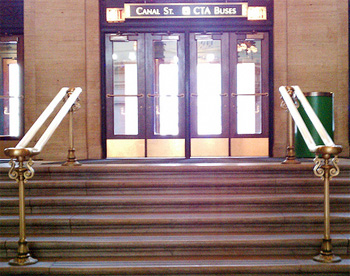
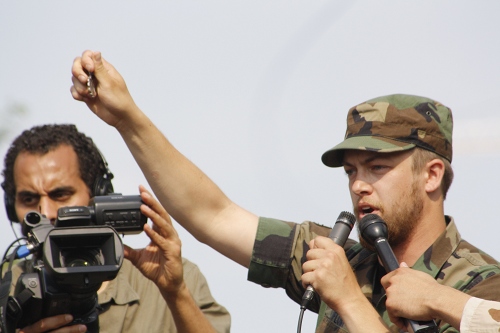 Thousands marched from Grant Park to the intersection Michigan Avenue and Cermak Road, about two miles, led by the
 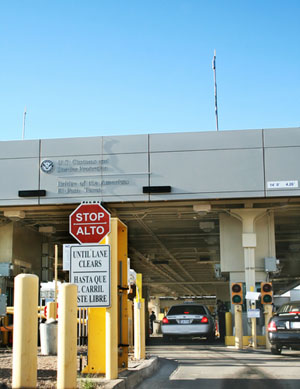 I met with a man who works with the Mexican community to raise money to build hospitals and schools. His job sounds charitable, but it can be tense and dangerous when he works with Mexican towns that are occupied by drug cartels. He would not talk to me about the violence he's encountered.